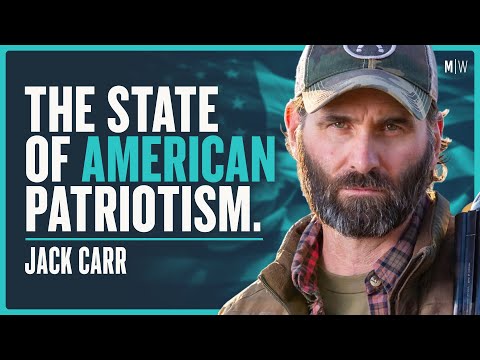
What Has Happened To The Love For America? - Jack Carr
Jack Carr (guest), Chris Williamson (host)
In this episode of Modern Wisdom, featuring Jack Carr and Chris Williamson, What Has Happened To The Love For America? - Jack Carr explores jack Carr On War, Writing, Patriotism, And Modern Cultural Cynicism Former Navy SEAL and bestselling author Jack Carr discusses how his combat experiences in Iraq and Afghanistan shape his fiction, using real emotions and memories to fuel his storytelling while keeping plots fictional. He explains the realities of sniper work, the psychological experience of prolonged combat, and the sense of relief that comes from being tested under fire and not being found wanting. Carr and host Chris Williamson also explore the adaptation of his novel The Terminal List for TV, creative integrity versus criticism, and the entrepreneurial realities of being a modern author. They close by examining declining American patriotism, the manipulative dynamics of social media, and the importance of historical awareness, optimism, and lifelong learning.
Jack Carr On War, Writing, Patriotism, And Modern Cultural Cynicism
Former Navy SEAL and bestselling author Jack Carr discusses how his combat experiences in Iraq and Afghanistan shape his fiction, using real emotions and memories to fuel his storytelling while keeping plots fictional. He explains the realities of sniper work, the psychological experience of prolonged combat, and the sense of relief that comes from being tested under fire and not being found wanting. Carr and host Chris Williamson also explore the adaptation of his novel The Terminal List for TV, creative integrity versus criticism, and the entrepreneurial realities of being a modern author. They close by examining declining American patriotism, the manipulative dynamics of social media, and the importance of historical awareness, optimism, and lifelong learning.
Key Takeaways
Use real emotions, not literal events, to fuel powerful storytelling.
Carr doesn’t recreate exact missions; instead he takes the feelings from real ambushes and firefights and drops them into fictional scenes, which makes his narratives both authentic and safe from security issues.
Get the full analysis with uListen AI
True tests reveal whether your self-belief is justified.
He describes an unexpected sense of relief in combat—after years of training and imagining war, being under fire confirmed that he could perform and lead effectively when it mattered most.
Get the full analysis with uListen AI
War is a thinking contest where adaptation speed decides outcomes.
From urban battles in Najaf to sniper overwatch, Carr emphasizes that both sides constantly adjust tactics; whoever adapts faster to changing conditions usually prevails.
Get the full analysis with uListen AI
Creative integrity means serving the story, not the critics.
On both the page and screen, Carr and the Terminal List team refused to soften key scenes (like the tomahawk disembowelment) just to appease potential backlash, prioritizing the core audience and the story’s spirit instead.
Get the full analysis with uListen AI
Modern authors must treat writing as a full-spectrum business.
Carr details how he added agents, a manager, a publicist, podcast production, and an assistant so he can protect his focus for high-leverage work—writing—while still running social media and outreach authentically.
Get the full analysis with uListen AI
Delegation and systems are essential to sustaining high performance.
He’s consciously learning to relinquish control, outsource logistics, and build a team so he can reclaim time, eventually re-prioritize sleep, health, and training, and avoid burnout as his projects multiply.
Get the full analysis with uListen AI
Patriotism erodes when historical memory fades and manipulation rises.
Carr links declining love of country to distance from the WWII generation and our failure to study history, compounded by social media incentives that reward outrage and cynicism instead of reflection and responsibility.
Get the full analysis with uListen AI
Notable Quotes
“You think you can do the job, but you don't really know until bullets are whizzing by and you’re prioritizing things in real time.”
— Jack Carr
“It was a relief to have been tested and, for lack of a better phrase, to not be found wanting.”
— Jack Carr
“We’re not making this for critics. We’re making it for the person who went to Iraq and Afghanistan, so when they sit on that couch and crack a beer, they know we put in the effort.”
— Jack Carr
“People are trusting me with time they’re never getting back. Every part of me has to go into every single word.”
— Jack Carr
“Take a breath for the person who sacrificed everything in the Revolutionary War, in the Civil War, in World War I, in World War II, so you could have these freedoms—and study the issue a little bit before you react.”
— Jack Carr
Questions Answered in This Episode
How does repeatedly revisiting combat memories for fiction affect Carr’s long-term mental health, and where does he draw boundaries for himself?
Former Navy SEAL and bestselling author Jack Carr discusses how his combat experiences in Iraq and Afghanistan shape his fiction, using real emotions and memories to fuel his storytelling while keeping plots fictional. ...
Get the full analysis with uListen AI
In a culture that increasingly valorizes cynicism, how can individuals practically cultivate the kind of grounded optimism Carr and Williamson advocate?
Get the full analysis with uListen AI
What ethical lines does Carr use when depicting vigilantism and graphic violence, and where does he think thriller writers can go too far?
Get the full analysis with uListen AI
How might younger Americans reconnect with a meaningful sense of patriotism without sliding into blind nationalism or performative flag-waving?
Get the full analysis with uListen AI
Given his experience with government pre-publication review, what does Carr believe are the real versus perceived limits on what authors can safely reveal about national security?
Get the full analysis with uListen AI
Transcript Preview
... Twitter tells you something, an influencer tells you something, a politician tells you something, a news organization tells you something. What do they want to get out of that? They want a response, so you're being manipulated right there. So at least just to recognize that before immediately getting angry and retweeting something. Well, hey, take a breath. You owe it to that person who sacrificed everything in the Revolutionary War, in the Civil War, in World War I, in World War II. You can have these freedoms. Well, take a breath for them and study the issue a little bit. (jet whooshing)
You are somebody that is ex-military service, now an author. You have the opportunity to write out scenarios that may be inspired by stuff that you went through and stuff that's complete fantasy as well. How therapeutic do you find the process of being able to dispose of bad guys with as much, uh, inventiveness as you want and no restrictions at all?
Right. Well, I joke that it keeps me out of prison, and that's only half-joking, I think, 'cause it is extremely therapeutic. And our senior-level military leaders and elected politicians give me a lot to work with. The world in general gives me a lot to work with these days. But, uh, at the outset, I didn't really realize that it was going to be something that was therapeutic or something that was intensely personal. I thought I'd get the sniper weapon stuff right, and if I didn't know who to talk to, or if I didn't know something about some sort of a- a tank or a plane or something, I at least knew who I could call to ask these questions. Um, but as soon as I started writing, and not even in the coming up with a title, coming up with a theme, coming up with a one-page executive summary, getting the outline done. It wasn't until I wrote the first words that I realized, "Oh, this is going to be extremely personal." And not so much in the fact that I am recreating exact scenarios that happened in Iraq or Afghanistan, but more so that if I have my character get ambushed in Los Angeles, California, as part of a completely fictional narrative, I go back and remember what it was like to be ambushed in Baghdad 2006, and I take those feelings and emotions and apply them to a completely fictional storyline. Uh, so that was personal. And then a lot of the other things that come in that are not so dramatic as that, that just help the story move forward, y- to... down to the- the, uh, the type of car that my protagonist drives and his wife drives. Um, like that sort of a thing. Just those little personal... The kind of music that his wife listens to and listened to, um, uh, in the first book. So, all those little things really ended up making it very personal, as did the, uh, the more dramatic, uh, action sequences where I go back and remember what it was like to be a sniper in Ramadi and then just take that and plop it into the fictional narrative.
Install uListen to search the full transcript and get AI-powered insights
Get Full TranscriptGet more from every podcast
AI summaries, searchable transcripts, and fact-checking. Free forever.
Add to Chrome