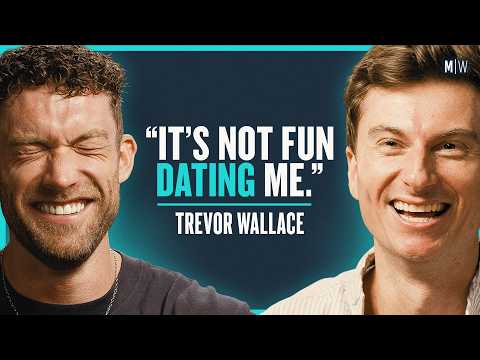
Autism is the New Stolen Valor - Trevor Wallace (4K)
Trevor Wallace (guest), Chris Williamson (host)
In this episode of Modern Wisdom, featuring Trevor Wallace and Chris Williamson, Autism is the New Stolen Valor - Trevor Wallace (4K) explores trevor Wallace on obsession, creativity, and social-media-driven self-worth loops Chris Williamson interviews comedian/creator Trevor Wallace about modern culture (autism memes in dating, “stolen valor” identity claims) and then quickly pivots into the deeper mechanics of creative success.
Trevor Wallace on obsession, creativity, and social-media-driven self-worth loops
Chris Williamson interviews comedian/creator Trevor Wallace about modern culture (autism memes in dating, “stolen valor” identity claims) and then quickly pivots into the deeper mechanics of creative success.
Wallace explains that his happiness is tightly linked to productive work, but that same obsession can undermine relationships, rest, and enjoyment in the moment.
They unpack how social media metrics and constant comparison create “nexting” behavior, hedonic adaptation to goals, and a tendency to equate recent performance with personal value.
The discussion ends with practical ideas: act on inspiration immediately, create space and buffers between making and posting, prioritize rest/exercise to invite creativity, and reduce noise by checking results less frequently or delegating posting.
Key Takeaways
Passion is an attractive trait because it signals aliveness and direction.
Wallace frames “wanting a touch of the ’tism” less as a fetish and more as admiration for intensity and deep interest—someone who genuinely loves something (work or hobby) creates a shared energetic life rather than a guilt-tinged mismatch.
Get the full analysis with uListen AI
Identity labels can become “stolen valor” when used as a social shield.
He worries that casual self-diagnosis (autism/ADHD) becomes a cop-out for poor social habits or chronic online behavior, diluting empathy for people with serious daily impairment.
Get the full analysis with uListen AI
People forgive almost anything if you’re still elite at the core craft.
Using Charlie Sheen (and analogies like Kanye), they argue public scandals are survivable when the output remains excellent; when performance drops, moral/social criticism hardens and sticks.
Get the full analysis with uListen AI
Obsession is “free fuel,” but it depreciates—use it while it’s abundant.
Chris’ framework: motivation = want to; discipline = make yourself; obsession = can’t not. ...
Get the full analysis with uListen AI
You can’t white-knuckle creativity; you can only set conditions for it.
Wallace’s “pre-creativity plan” is rest, sleep, exercise, and changing environments (mall, coffee shop, farmer’s market) to notice observations—because stressed admin-mode blocks idea intake.
Get the full analysis with uListen AI
Social media turns creative work into a casino: variable rewards and anxious checking.
A viral hit sets a new internal minimum, producing paralysis (“nothing will beat this”) or compulsive refresh loops. ...
Get the full analysis with uListen AI
Create distance to reduce algorithm-induced mood swings: buffer + delegation + fewer checks.
They recommend building an inventory of finished posts, having someone else upload, and reviewing performance on slower cadences (weekly/monthly) to prioritize signal over noise and avoid “desperate energy” creation.
Get the full analysis with uListen AI
Notable Quotes
“I feel bad for people who are genuinely autistic right now because I think there's a lot of stolen valor out there.”
— Trevor Wallace
“Inspiration is perishable. Act on it immediately.”
— Chris Williamson
“Model the rise, not the result.”
— Chris Williamson
“You can't create creativity, but you can set yourself up for creativity.”
— Trevor Wallace
“Golden years only exist in the past.”
— Chris Williamson
Questions Answered in This Episode
When you say autism is being “memed” in a new way, what specific harms do you think it causes (dating, workplace, clinical understanding), and what’s just harmless slang?
Chris Williamson interviews comedian/creator Trevor Wallace about modern culture (autism memes in dating, “stolen valor” identity claims) and then quickly pivots into the deeper mechanics of creative success.
Get the full analysis with uListen AI
You distinguish “passion” from “fetishizing neurodivergence.” Where’s the line in a dating profile between a respectful preference and objectification?
Wallace explains that his happiness is tightly linked to productive work, but that same obsession can undermine relationships, rest, and enjoyment in the moment.
Get the full analysis with uListen AI
Your happiness is strongly linked to productivity—what practices help you avoid turning downtime or relationships into “content extraction”?
They unpack how social media metrics and constant comparison create “nexting” behavior, hedonic adaptation to goals, and a tendency to equate recent performance with personal value.
Get the full analysis with uListen AI
You said your excitement for a video becomes dependent on how it performs. What would a healthier metric system look like for you (process goals, batch review, peer review, live-testing)?
The discussion ends with practical ideas: act on inspiration immediately, create space and buffers between making and posting, prioritize rest/exercise to invite creativity, and reduce noise by checking results less frequently or delegating posting.
Get the full analysis with uListen AI
You described admin work as draining the funny. What are the first 2–3 tasks you’d delegate tomorrow to protect creative energy, and what would you still insist on owning?
Get the full analysis with uListen AI
Transcript Preview
That's really- how do I, how do I look? Cool, silence. All right, it's, [laughing] it's, uh... Does anybody- [laughing] you have 19 people on set, and everyone's like, "I don't wanna tell him he looks like shit."
No, it's fine. It's just moving.
Yeah, see, there we go.
Look at this. [laughing] Yes, dude.
Is that better?
See, now this is the problem. Now, now that you've asked for feedback, all that you've got-
Yeah, I know, yeah
... All you've got is like neuroaticism and judgment.
You're like, "Okay, yeah, and can you write some better jokes?" I'm like, [laughing] "Dude, I'm doing my outfit."
Trevor Wallace, welcome to the show.
Hey, thanks for having me, Chris.
Vogue published an article saying, "Having a boyfriend is embarrassing now." Meanwhile-
I don't have one.
I figured. Meanwhile-
Okay
... Men are on dating apps saying that they're looking for a slightly autistic woman. Swaths of men saying they want a girl with a touch of the 'tism.
Okay, I just want the touch. I don't even care about the 'tism, you know what I mean? Like, if... Whatever they bring to the table, I'm... Well, I, you know what it is? Autistic women, like, from my experience, they're just passionate. They're just, like, I just... That's all I've ever wanted, dating somebody, somebody who's passionate about something.
Mm.
Whether it's a career or, or, or, you know, uh, trains. Like, whatever you're g- passionate on, I'm passionate for you.
Well, you were saying that about, uh, hot girls that are just good at anything-
Mm-hmm
... chess or DJ-ing-
Mm, mm-hmm, mm-hmm
... or crochet stitching or something.
Mm-hmm.
That that is a, a niche-
Yeah
... that I think you're right as well. I think we like anybody that really loves-
I just want you to love something.
Yeah.
I don't care what your career is, just love it.
Can that be you? Can the something be you? What if the, what if you are their hobby?
A part of it, sure. A part of it, sure. But, like, I've been in relationships where somebody didn't have that, that, that void they wanted to fill of, like, love, and you, you almost feel guilty if you're, if you're too passionate. I would come home from, like, a show or filming something, and I had so much fun on the set or filming, and I love it, and then they're like, "Oh, that's nice," and you're like, "Here we go again. I mean, can we get her a Zyn or something? Like, perk up," [laughing] "like, what are we... "
[laughing]
So you almost feel guilty, so, like, I just wanna come home and share a communal experience where you're like, "How was your day?" "Oh, I loved that I got to do blah, blah, blah, blah, blah. I love that I get to do this."
Mm.
So I've, I found that, uh, just incredible, where you can just both share and not feel this, like, weird one-sided guilt.
Install uListen to search the full transcript and get AI-powered insights
Get Full TranscriptGet more from every podcast
AI summaries, searchable transcripts, and fact-checking. Free forever.
Add to Chrome