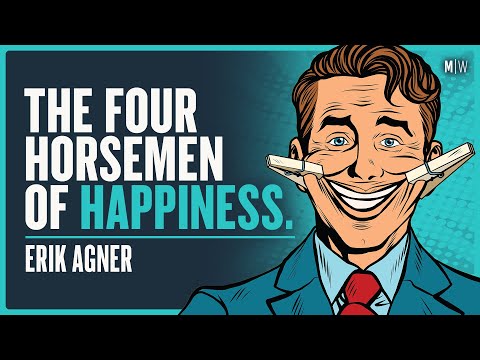
An Economist’s Guide To Avoiding A Life of Misery - Erik Angner
Chris Williamson (host), Erik Angner (guest), Narrator
In this episode of Modern Wisdom, featuring Chris Williamson and Erik Angner, An Economist’s Guide To Avoiding A Life of Misery - Erik Angner explores economist-Philosopher Explains Happiness, Money, Kids, And Meaningful Trade-offs Erik Angner, an economist and philosopher, argues that economics is really about human well-being and the trade-offs behind every significant life choice, not just markets and finance. He distinguishes happiness (feeling good) from well-being (a life going well) and shows how goals like having children or pursuing excellence can reduce momentary happiness while increasing meaning and overall life quality. The discussion covers how money, inequality, unemployment, health, religiosity, and aspirations shape happiness, along with our tendency to overweight short-term comfort and social comparison. Angner also offers a practical stance on expectations: be selectively ambitious in a few domains, accept mediocrity in most others, and focus on consistent practice over outcome-obsession.
Economist-Philosopher Explains Happiness, Money, Kids, And Meaningful Trade-offs
Erik Angner, an economist and philosopher, argues that economics is really about human well-being and the trade-offs behind every significant life choice, not just markets and finance. He distinguishes happiness (feeling good) from well-being (a life going well) and shows how goals like having children or pursuing excellence can reduce momentary happiness while increasing meaning and overall life quality. The discussion covers how money, inequality, unemployment, health, religiosity, and aspirations shape happiness, along with our tendency to overweight short-term comfort and social comparison. Angner also offers a practical stance on expectations: be selectively ambitious in a few domains, accept mediocrity in most others, and focus on consistent practice over outcome-obsession.
Key Takeaways
Economics is a general toolkit for understanding life choices, not just markets.
Angner frames economics as the study of decisions under scarcity—any choice with consequences for well-being, from crime and climate to family and career—using trade-offs, costs, and benefits to clarify our options rather than dictate values.
Get the full analysis with uListen AI
Differentiate happiness (feelings) from well-being (a life going well).
Many valuable pursuits—children, difficult goals, demanding careers—often reduce day-to-day happiness yet increase life meaning, pride, and overall flourishing; confusing happiness with well-being leads people to avoid worthwhile sacrifices.
Get the full analysis with uListen AI
Money can buy happiness, but with diminishing returns and hidden costs.
More income reliably boosts happiness, especially for the poor, but each additional dollar helps less at higher levels and may require trading off leisure, relationships, and health; the rational strategy is not “maximize income” but balance it against what you give up.
Get the full analysis with uListen AI
High aspirations raise achievement but can lower happiness.
Research suggests satisfaction depends on both what you achieve and what you expected; ambitious “John Henry” types often accomplish more, yet feel less happy because they chronically fall short of their own high standards.
Get the full analysis with uListen AI
Be selectively excellent and accept mediocrity elsewhere.
Angner’s personal strategy is to aim for top performance in a very narrow professional niche while being content with being average in most other domains (sports, hobbies, domestic tasks), reducing unnecessary frustration without abandoning meaningful ambition.
Get the full analysis with uListen AI
Short-termism and weak support structures make parenting look worse than it is.
Modern culture overvalues immediate comfort, downplays long-term meaning, and often isolates young parents from family and social support; combined with high financial and time costs, this deters people from having children even when they deeply value them.
Get the full analysis with uListen AI
Context strongly shapes how health and inequality affect happiness.
People can adapt surprisingly well to some conditions (e. ...
Get the full analysis with uListen AI
Notable Quotes
“Economics is about anything and everything connected to human well-being.”
— Erik Angner
“Some things are good for us even if they don’t make us happier.”
— Erik Angner
“Anytime somebody says, ‘This is the only solution,’ they’re not recognizing the trade-offs involved.”
— Erik Angner
“One of the things that I’ve done quite successfully is to be satisfied with being mediocre in almost everything.”
— Erik Angner
“If you live in the US or the UK right now, you’re one of the richest people who’ve ever walked the face of the earth, and yet some people do nothing but complain.”
— Erik Angner
Questions Answered in This Episode
How can individuals practically balance short-term happiness against long-term meaning when making big life choices like career paths or having children?
Erik Angner, an economist and philosopher, argues that economics is really about human well-being and the trade-offs behind every significant life choice, not just markets and finance. ...
Get the full analysis with uListen AI
What concrete methods can people use to set ambitious goals without letting expectations chronically undermine their happiness?
Get the full analysis with uListen AI
Which public policies (e.g., parental leave, healthcare, unemployment insurance) most effectively improve population-wide happiness per dollar spent?
Get the full analysis with uListen AI
How can someone intentionally reduce their susceptibility to status competition and materialism without becoming complacent or unmotivated?
Get the full analysis with uListen AI
In what situations should we prioritize well-being and meaning over happiness, and how can we recognize those moments in our own lives?
Get the full analysis with uListen AI
Transcript Preview
Why is economics not any sexier than it is?
(laughs) I think economics has the, um, disadvantage of being associated with lots of, like, very uncool people. You know, numbers, data, models, i- in the formal sense. You know, these are not things that attract our attention. But it's a shame because economics is actually pretty cool. Now, I may not be the best person to pitch that (laughs) idea, but it is, and, um, I wish more people saw that.
What is it that people misunderstand about what economics contains, then?
So one thing that people might not get is just how broad it is, right? So so many people think of economics in terms of, like, stock markets, housing markets, inflation rates and things, and that is part of economics. That is one of the things that... or some of the things that economists study but economics is so much broader than that. It's about anything and everything connected to human well-being. Any choice that you make that has any implications for the way you live your life and the way things turn out. So that means you can do economics and study crime, uh, child-rearing, uh, climate change, uh, uh, family formation. Whatever you like, there's likely to be an economic angle to it. And in fact, if you think about, like, the big problems, like, whichever problem you're thinking about, I bet there's an economic angle to that as well, right? There's gonna be some economic implications or some economic perspect- perspective and, in many cases, some economic tool that you can use to address it.
What do you mean when you say an economic angle? Like, what are you referring to? What is the toolkit or the worldview or the paradigm through which economics looks at these sorts of things?
What I'm thinking about primarily is a way of looking at human decisions, and basically everything is a result of human decisions, right? Everything's social. And even if it isn't, the solution to whatever problem you're thinking about is gonna involve human behavior. And when economists think about that, what they think about is the various values that are at stake. Oftentimes, we have to make choices, right, because there's a limited amount of whatever we care about, and what that means that we have to strike a balance between the different things. We have to give up a little bit of this in order to get a little bit of that. Now, some people out there want everything always at once, right? That's childish. Once you see that the world isn't designed like that, you got to think about the ways in which things come at a cost. And that's the core of what economics has to offer: a way of looking at decisions that brings to the fore the values that are at stake, the costs involved, but also the benefits that you can get from making the best available decision.
Install uListen to search the full transcript and get AI-powered insights
Get Full TranscriptGet more from every podcast
AI summaries, searchable transcripts, and fact-checking. Free forever.
Add to Chrome