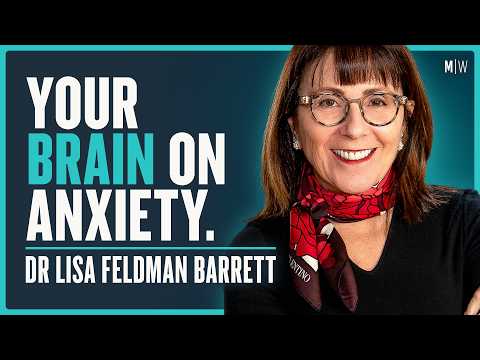
The Secret Life Of Emotions - Dr Lisa Feldman Barrett
Chris Williamson (host), Lisa Feldman Barrett (guest), Narrator
In this episode of Modern Wisdom, featuring Chris Williamson and Lisa Feldman Barrett, The Secret Life Of Emotions - Dr Lisa Feldman Barrett explores emotions Reimagined: How Your Brain Constructs Feeling, Meaning, And Self Dr. Lisa Feldman Barrett explains that emotions are not fixed, universal states but constructed experiences: each instance of ‘anger’ or ‘joy’ varies with context, body state, and past learning. The brain is constantly solving an “inverse problem,” using past experiences and concepts to guess the causes of raw bodily and sensory signals and to prepare actions, with experience being a blend of prediction and present input. This process makes reality “relational” rather than purely objective, and gives people more agency than they assume over how they feel—though that agency is effortful, slow, and constrained by biology and circumstance. She connects this to anxiety, chronic stress, health, relationships, and offers practical ways to build emotional flexibility and resilience by changing present experiences, habits, and contexts.
Emotions Reimagined: How Your Brain Constructs Feeling, Meaning, And Self
Dr. Lisa Feldman Barrett explains that emotions are not fixed, universal states but constructed experiences: each instance of ‘anger’ or ‘joy’ varies with context, body state, and past learning. The brain is constantly solving an “inverse problem,” using past experiences and concepts to guess the causes of raw bodily and sensory signals and to prepare actions, with experience being a blend of prediction and present input. This process makes reality “relational” rather than purely objective, and gives people more agency than they assume over how they feel—though that agency is effortful, slow, and constrained by biology and circumstance. She connects this to anxiety, chronic stress, health, relationships, and offers practical ways to build emotional flexibility and resilience by changing present experiences, habits, and contexts.
Key Takeaways
Emotions are constructed, not hardwired states.
Labels like ‘anger’ or ‘joy’ refer to populations of varied instances shaped by context, body, and past experience. ...
Get the full analysis with uListen AI
Concepts and experiences—not just words—enrich emotional life.
A bigger emotion vocabulary usually reflects more underlying concepts and diverse experiences, giving your brain more flexible ways to make sense of sensations. ...
Get the full analysis with uListen AI
Your brain predicts first and perceives second.
The brain is in a dark skull receiving effects (sensations) without direct access to causes, so it uses past instances to guess what’s happening and prepare action; experience is a mix of remembered past and sensory present. ...
Get the full analysis with uListen AI
Reality is ‘relational’, not purely objective or ‘all in your head’.
Features like ‘redness’ or ‘anger’ in a scowl are not inherent in objects or faces but arise from the relation between external signals and the observer’s biology and concepts. ...
Get the full analysis with uListen AI
Anxiety often reflects uncertainty plus arousal, which can be re-channeled.
High arousal in uncertain situations doesn’t have to be experienced as anxiety; it can be experienced as determination, curiosity, or “butterflies in formation. ...
Get the full analysis with uListen AI
Chronic stress quietly dysregulates metabolism and damages health.
Repeated predictions of big metabolic demands (social stress, uncertainty, toxic contexts) can make systems like cortisol signaling go “numb,” leaving you exhausted, fuzzy-headed, and vulnerable to metabolic illnesses, depression, and anxiety. ...
Get the full analysis with uListen AI
You gain real agency by changing present contexts and habits, not by willpower alone.
You can’t snap out of feelings or erase old memories, but you can deliberately cultivate new experiences, routines, and attentional habits that your brain will later use as predictions. ...
Get the full analysis with uListen AI
Notable Quotes
“Anger isn’t one thing, joy isn’t one thing.”
— Dr. Lisa Feldman Barrett
“Sensation doesn’t lead to action. Preparation for action leads to sensation.”
— Dr. Lisa Feldman Barrett
“Reality is relational… we are elevating certain human experiences and calling them ‘objective.’”
— Dr. Lisa Feldman Barrett
“Hope is a practice.”
— Dr. Lisa Feldman Barrett
“Sometimes we’re responsible for things not because we’re to blame for them, but because we’re the only ones who can change them.”
— Dr. Lisa Feldman Barrett
Questions Answered in This Episode
If meaning is constructed and relational, how should we rethink moral responsibility for actions taken ‘in the heat of emotion’?
Dr. ...
Get the full analysis with uListen AI
What are practical daily exercises to expand our emotional concepts and diversify the experiences our brain can draw on?
Get the full analysis with uListen AI
How can clinicians or educators integrate this predictive-brain model to better treat anxiety and teach emotional skills?
Get the full analysis with uListen AI
In a world engineered for chronic uncertainty and metabolic strain, what societal or policy changes would most reduce large-scale anxiety and stress?
Get the full analysis with uListen AI
Where is the ethical line between using drugs or interventions to block memory consolidation after trauma and allowing painful experiences to shape future learning?
Get the full analysis with uListen AI
Transcript Preview
How unique is the way that we all experience emotions? Is your experience of anxiety or anger or joy the same as mine, or different?
Well, I think the proper question to start with is, your experience of joy on one occasion exactly the same as your experience of joy on another occasion? And I think what we know is the answer is no, it isn't. That joy or anger or any other word for emotion really refers to a population of instances that are variable. Not infinitely variable, but variable and tied to the situation that you're in. So sometimes anger is pleasant and sometimes it's unpleasant. Sometimes it's, you know, you're full of energy during anger, and other times you're not. Sometimes your blood pressure goes up, sometimes it goes down, sometimes it stays the same, depending on what actions you're taking. And your actions differ in anger, right? People scowl in anger about 35% of the time, which is more than chance. But that means 65% of the time people express anger in this culture, in Western cultures, actually I should say in urban cultures, because it's in the East and the West, um, that this is, um, meta-analytic evidence, um, 65% of the time you're doing something else with your face in anger. You know, you might smile in anger, you might cry in anger, you might sit silently and plot the demise of your enemy in anger. And half the time when you scowl, you're not angry. You're feeling something else. So the point being that, you know, all this variation is not random, but it's not, um, but it's not... You know, anger isn't one thing, joy isn't one thing. So when you ask the question, "Is your experience of joy the same as mine?" I think what you mean is, to say, is, um, your vocabulary of joy the same as mine? Is your distribution of joy, is your population of instances the same as mine? And, um, probably not. But there, there has to be enough overlap that we can communicate about it or else we wouldn't be communicating. Right?
That suggests that the breadth of language that you have to be able to describe the things that you're feeling unlocks, in some way, or enables you to have a deeper or richer emotional experience.
Yeah, I think the, the, you know, the focus on words, on language is there, but it's, language isn't really the point. The point is your ability to, um, h- your concepts or your knowledge. So that tends to be linked to words. But words aren't really necessary. I think this is a constant confusion that people have, that if you just label your experience differently, you know, you'll have a richer experience. And that's not true at all. Um, but it does tend to be the case that words are invitations to learn concepts, they're invitations for knowledge. That's how they work. And the more vocab, the larger your vocabulary is, the more concepts you probably have, and that's what's going to lead to a richer emotional life.
Install uListen to search the full transcript and get AI-powered insights
Get Full TranscriptGet more from every podcast
AI summaries, searchable transcripts, and fact-checking. Free forever.
Add to Chrome