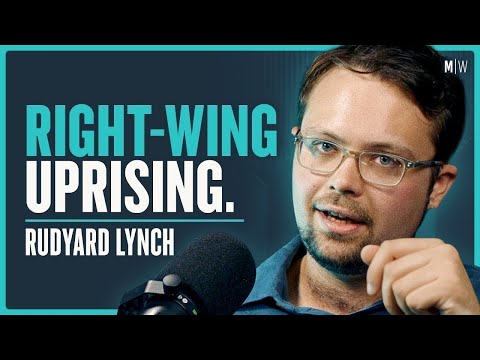
Why Nothing Seems To Makes Sense Anymore - Rudyard Lynch
Chris Williamson (host), Rudyard Lynch (guest), Narrator
In this episode of Modern Wisdom, featuring Chris Williamson and Rudyard Lynch, Why Nothing Seems To Makes Sense Anymore - Rudyard Lynch explores historian Predicts Imminent Civilizational Crisis And Far-Right Backlash Rudyard Lynch argues that our era is historically abnormal and uniquely absurd, driven by a 20th–21st century break from ancient and traditional wisdom about human nature, sex differences, religion, and limits to progress.
Historian Predicts Imminent Civilizational Crisis And Far-Right Backlash
Rudyard Lynch argues that our era is historically abnormal and uniquely absurd, driven by a 20th–21st century break from ancient and traditional wisdom about human nature, sex differences, religion, and limits to progress.
Drawing on historical cycles, game theory, and economic trends, he predicts a “crisis of the 21st century” within decades—likely including severe conflict, potential American civil war, and a far‑right backlash led by radicalized young men.
He sees modern elites as decadent, incompetent, and ideologically captured by a leftist, managerial worldview that both over-socializes individuals and humiliates core groups (especially young white men), eroding social cohesion and incentives to cooperate.
Despite this bleak macro outlook, Lynch argues individuals can still build meaningful lives through religion, honor, authenticity, and consciously choosing what is worth living and dying for, rather than defining themselves purely by hatred of an opposing tribe.
Key Takeaways
Study history or you’re ‘making stuff up’ about the present.
Lynch insists that ignoring millennia of recorded patterns—wars, collapses, revolutions—creates a dangerous illusion of uniqueness; our belief that “this time is different” is itself a classic symptom of decadent civilizations before crisis.
Get the full analysis with uListen AI
Rising inequality, stagnant wages, and elite job competition reliably precede upheavals.
Citing Peter Turchin and David Hackett Fischer, he argues these three variables, which are currently flashing red, historically predict major systemic crises marked by war, famine, and regime change roughly every 200–250 years.
Get the full analysis with uListen AI
When reproduction and life prospects collapse, people become willing to risk revolution.
As housing, family formation, and dignified work become unattainable—especially for young men—losers in the current system rationally ‘roll the dice’ on radical change, even at personal risk, because the status quo offers no future.
Get the full analysis with uListen AI
Mass movements are driven by small, radical minorities, not majorities.
Game theory and history suggest about 20% of people are altruistic, 20% opportunistic, and 60% follow social consensus—meaning revolutions and civil wars are typically initiated and directed by tiny organized factions who then conscript ‘normies’.
Get the full analysis with uListen AI
Over-socialization and bureaucratic life erode authenticity and mental health.
Industrial civilization replaces intimate, integrated communities with fragmented bureaucracies, forcing people to wear ‘masks’ everywhere; Lynch, borrowing from Ted Kaczynski and Norbert Elias, links this to widespread ennui, neurosis, and disconnection.
Get the full analysis with uListen AI
Contemporary leftist ideology creates fragile coalitions and deep male resentment.
He argues wokeness offers straight white men no path to moral inclusion while over‑indulging favored groups, and that DEI plus economic stagnation make young white men both excluded from elite pathways and increasingly angry—fuel for a far‑right backlash.
Get the full analysis with uListen AI
Personal meaning must rest on positive values, not just hatred of the out‑group.
Lynch criticizes both left and right for defining themselves primarily by enemies; he urges individuals to orient around honor, truth, spiritual grounding, and a clear sense of what is worth dying for, rather than pure cynicism or revenge.
Get the full analysis with uListen AI
Notable Quotes
“If you're not using history to study the world, you're making stuff up.”
— Rudyard Lynch
“Modernity is motivated by this concept that if we get it right, we can break the entire game and win forever—and the rest of history would view that as completely insane.”
— Rudyard Lynch
“Most young men won’t want to fight. Small cadres of radicals will—and they’re the ones who end up in charge.”
— Rudyard Lynch
“The modern world is divided between those who numb themselves to its meaninglessness and those who realize it and go crazy.”
— Rudyard Lynch (paraphrasing an Orthodox theologian)
“Assume the left is completely evil, just for this one sentence argument. What's next?”
— Rudyard Lynch
Questions Answered in This Episode
How seriously should we treat historical cycle models like Turchin’s when forecasting modern crises in a nuclear, globally interconnected world?
Rudyard Lynch argues that our era is historically abnormal and uniquely absurd, driven by a 20th–21st century break from ancient and traditional wisdom about human nature, sex differences, religion, and limits to progress.
Get the full analysis with uListen AI
Is Lynch underestimating the ‘sedation’ power of porn, screens, and comfort in preventing large-scale violent uprisings among young men?
Drawing on historical cycles, game theory, and economic trends, he predicts a “crisis of the 21st century” within decades—likely including severe conflict, potential American civil war, and a far‑right backlash led by radicalized young men.
Get the full analysis with uListen AI
What would a non-cynical, genuinely inspiring right-wing or centrist vision look like that isn’t built on hatred of the left?
He sees modern elites as decadent, incompetent, and ideologically captured by a leftist, managerial worldview that both over-socializes individuals and humiliates core groups (especially young white men), eroding social cohesion and incentives to cooperate.
Get the full analysis with uListen AI
To what extent is our current mental health epidemic a direct consequence of industrial civilization and over-socialization, rather than purely individual or economic factors?
Despite this bleak macro outlook, Lynch argues individuals can still build meaningful lives through religion, honor, authenticity, and consciously choosing what is worth living and dying for, rather than defining themselves purely by hatred of an opposing tribe.
Get the full analysis with uListen AI
If modern ‘managerial’ civilization is rootless and doomed, what practical steps can individuals or communities take now to build more resilient, meaningful alternatives?
Get the full analysis with uListen AI
Transcript Preview
As a guy who has spent a lot of time studying history, how unusual do you think that the time we're living in right now is?
We are the most absurd era in history by a very significant margin. Uh, and I can get into why I think that's true. I think there's only one under... there's one easy underlying variable that explains all of it, but I invented an acronym called SAW. And SAW is Studies in Ancient Wisdom, and what that means to convey is that there's an underlying shared truth that all the world religions share, all the world's folk ways going back thousands of years, and then this is corroborated by modern evidence, and I think s- this podcast is a great example. You might be like the, one of the biggest SAW content creators, where what you do is you compare ancient teachings with what modern science says, and so there is a strong tether between the two. And the 20th century is just a bizarre century, and that's true for about a dozen different reasons. Uh, the 20th century established different intellectual precedents as it related to mating, as it related to the n- idea of community, the nation, religion, how economic, uh, conditions worked. And so you could kind of call it the blue pill era of history from roughly the world wars until COVID or now, and it's really the century of social engineering. So our era of history is incredibly bizarre, and the irony is that we judge everyone else according to our standard, but our standard is incredibly strange. And so I like to say that a fish in a pond cannot know its place in the world because it only knows the water, and that we are that fish. And the reason we don't study history is because if we started looking for what it taught us, we'd realize we're doing something very, very wrong.
How so?
Oh, a variety of ways. Um, the largest example, and something I frequently like to say, is the idea that's killed the most people in history is the idea that humans are inherently perfectible, where the, the crisis that started, or the world wars in the 20th century's totalitarianism killed over 150 million people, and that's larger than anything else that's in any way comparable in history. And that was based upon the assumption that you can break and mold human nature to be whatever you want, and the blank slate, or the idea that all people are born the same, all people are born with the same capabilities sounds nice on paper, but in reality, its immediate next jump is totalitarianism, to socially engineer people to reach whatever aim you would like. And that's just one example where there's so many of these. The idea of infinite financial progress no matter what. This is an idea the left holds up a lot, which is, um, the left sees money as something to divide, not something to create. The reality is money is created every single year by people producing it, and if you look at most of history, most of civilization, stagnation is the norm. It's you have an empire rise. The empire exploits the peasants. They grow weak. Another... they fall. Barbarians restart the process. Only for pretty small slivers of history, including ours, for creating up certain incentive structures do you see very rapid progress, but we take that completely for granted.
Install uListen to search the full transcript and get AI-powered insights
Get Full TranscriptGet more from every podcast
AI summaries, searchable transcripts, and fact-checking. Free forever.
Add to Chrome