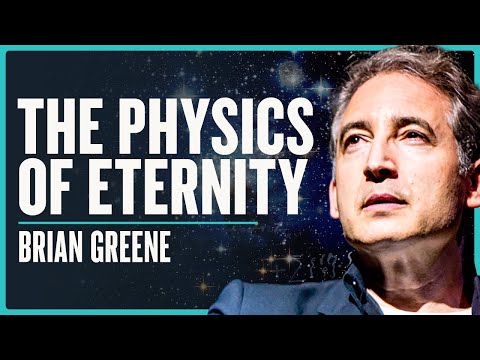
Brian Greene - The Mind-bending Physics Of Eternity | Modern Wisdom Podcast 308
Brian Greene (guest), Chris Williamson (host)
In this episode of Modern Wisdom, featuring Brian Greene and Chris Williamson, Brian Greene - The Mind-bending Physics Of Eternity | Modern Wisdom Podcast 308 explores brian Greene Explores Time, Entropy, Meaning, and Humanity’s Cosmic Fate Brian Greene discusses the long-term fate of the universe, outlining scenarios like the heat death, black hole evaporation, and bizarre far‑future phenomena such as Boltzmann brains. He explains how concepts like entropy, quantum mechanics, and cosmic inflation reshape our intuitions about time, space, and the apparent fine‑tuning of physical laws. The conversation then connects physics to evolution, consciousness, and thought itself, showing how all minds and meanings are temporary physical processes bound by thermodynamics. Greene ultimately argues that although the universe is fundamentally purposeless, the extreme unlikelihood of our existence makes our capacity to create meaning, beauty, and understanding profoundly significant.
Brian Greene Explores Time, Entropy, Meaning, and Humanity’s Cosmic Fate
Brian Greene discusses the long-term fate of the universe, outlining scenarios like the heat death, black hole evaporation, and bizarre far‑future phenomena such as Boltzmann brains. He explains how concepts like entropy, quantum mechanics, and cosmic inflation reshape our intuitions about time, space, and the apparent fine‑tuning of physical laws. The conversation then connects physics to evolution, consciousness, and thought itself, showing how all minds and meanings are temporary physical processes bound by thermodynamics. Greene ultimately argues that although the universe is fundamentally purposeless, the extreme unlikelihood of our existence makes our capacity to create meaning, beauty, and understanding profoundly significant.
Key Takeaways
The most likely cosmic ending is an eternally expanding, freezing universe.
Current data and models favor a universe that expands forever, cooling toward a uniform, near‑zero temperature state (the ‘heat death’ or ‘big freeze’) where stars burn out, black holes evaporate, and only stable elementary particles and rare quantum fluctuations remain.
Get the full analysis with uListen AI
Time is measurable and relative, but its fundamental nature remains unknown.
Einstein showed that time flows at different rates depending on motion and gravity—verified by atomic clock experiments—yet physicists still cannot say what time ‘is’ and some suspect it may emerge from deeper, more fundamental constituents rather than being basic.
Get the full analysis with uListen AI
Entropy drives disorder, but evolution locally builds complexity in an ‘entropic two‑step.’
The second law of thermodynamics pushes systems toward disorder overall, yet within that trend, evolutionary processes (beginning with self‑replicating molecules) can carve out pockets of increasing order and refinement, so long as greater disorder (heat, waste) is exported to the environment.
Get the full analysis with uListen AI
Thought and computation are physically costly and cannot continue forever.
Any thinking system must generate heat as it preserves internal order; in the far future, as the universe becomes too cold and sparse to absorb this heat, additional thoughts would overheat and destroy the thinker, implying that thinking itself has a finite cosmic lifetime.
Get the full analysis with uListen AI
Boltzmann brains and simulations expose troubling limits of our cosmological models.
In an eternal universe, random quantum fluctuations could more often produce isolated ‘Boltzmann brains’ with false memories than entire histories like ours, leading to a self‑defeating skepticism; similarly, simulation arguments challenge whether our apparent physical constraints reflect base reality or a programmed environment.
Get the full analysis with uListen AI
Our existence is extraordinarily improbable, yet that amplifies its value.
Given the fine‑tuning of physical constants, innumerable contingent quantum events, and the astronomical improbability of specific DNA sequences, the fact that conscious beings exist and can understand the universe is staggeringly unlikely—turning our brief lives into something to approach with awe and gratitude rather than nihilism.
Get the full analysis with uListen AI
Meaning and purpose are not built into the universe; we invent them.
On Greene’s view, the cosmos is fundamentally particles following laws without intrinsic value or purpose, but humans—improbable configurations of those particles—can create narratives, values, art, science, and goals, making meaning a genuine, emergent human project even in a purposeless universe.
Get the full analysis with uListen AI
Notable Quotes
“When you realize how unlikely it is that collections of particles would come together to yield a living system called a human being, and how spectacular it is that this collection of particles called a human being can invent, manufacture notions of value and meaning and purpose, how spectacular is that?”
— Brian Greene
“We can measure this quality of the world called time to incredible accuracy... But if you ask me, 'What is it that you are measuring?' I don’t know.”
— Brian Greene
“Any thinking system, in order to have thought, must generate heat because it’s a physical process… in the far future a thinking system that generates heat… if it thinks one more thought, it will burn up.”
— Brian Greene
“There is no fundamental notion of meaning in reality, in the world… and yet we can invent, manufacture notions of value and meaning and purpose.”
— Brian Greene
“I do physics because I want to understand reality. I mean, I really want to understand reality.”
— Brian Greene
Questions Answered in This Episode
If time might be emergent rather than fundamental, what kind of deeper structure or ‘atoms of time’ could underlie it, and how could we ever test that experimentally?
Brian Greene discusses the long-term fate of the universe, outlining scenarios like the heat death, black hole evaporation, and bizarre far‑future phenomena such as Boltzmann brains. ...
Get the full analysis with uListen AI
How should we balance the emotionally unsettling implications of ideas like heat death and Boltzmann brains with the practical, day‑to‑day value of those same physical theories?
Get the full analysis with uListen AI
If meaning and purpose are entirely human‑constructed, what criteria—if any—should we use to decide which narratives and value systems are worth committing our finite lives to?
Get the full analysis with uListen AI
Does the fine‑tuning of physical constants push you more strongly toward a multiverse explanation, a still‑unknown physical principle, or some form of design—and what evidence could realistically distinguish between these?
Get the full analysis with uListen AI
Given that thought and complex life are thermodynamically doomed, how much should long‑term cosmic prospects influence our ethical decisions and priorities here and now?
Get the full analysis with uListen AI
Transcript Preview
When you realize how unlikely it is that collections of particles would come together to yield a living system called a human being, and how spectacular it is that this collection of particles called a human being can invent, manufacture notions of value and meaning and purpose, how spectacular is that? (wind blows)
Brian Greene, welcome to the show.
Thank you.
Thank you for being here. I am a massive fan of your work. I'm very, very glad that you're joining me today.
Oh, thank you. That's great to hear.
We hear a lot about the big bang and the beginning of the universe 13 and a bit billion years ago, but I wanna start at the end. Have you got any predictions for the end of the universe? If the big bang is when time began, then when will time stop?
Well, we don't know. But there certainly are ideas that people have developed, so it's not as though we're just shooting in the dark. The most straightforward interpretation of the data and the mathematics suggests that the universe may continue to expand forever. Forever's a kind of funny concept. It's an idea where time wouldn't literally end, but en route to that eternity, everything that we know about will end. Every star will end, every galaxy, every planet. Matter itself will, according to some of our cutting-edge theories, disintegrate into a spray of more refined particles, electrons, neutrinos, that will just continue to waft through that ever-expanding cosmos. So we don't know that that's how things will end up, but if you were to ask me to place bets, based on what we know today and what we've observed today, that would probably where the bulk of my money would go.
Is that what's referred to as the big freeze?
It is, because the universe will just continue to get ever colder as it gets ever larger. And weirdly enough, it's also referred to as the heat death. It seems to be a kind of tension between the big freeze and the heat death. But they're actually the same thing, because the idea is that you'll reach a kind of equilibrium, where every place in the universe will come to the same temperature, and it's that equal distribution of heat that is what we refer to at the heat death. But, but the temperature, the common temperature will be so low that you can also think of it as a kind of big freeze.
What is a way that people can wrap their heads around how far away from us that is now?
Uh, that's a tough one. I, I have a metaphor that I like to use when taking people on a journey toward the far future. I use the Empire State Building in Manhattan, where I envision that every floor is 10 times the duration of the previous floor in this sort of poetic representation. So the ground floor is one year, the next floor, 10, the next floor, 100. So it's an exponential scale, where 10 to the floor number is representing the year that you're on at a given floor. And that approach takes you to 10 to the 100 years into the future. Today, we're 10 to the 10 years from the big bang, so we're on the 10th floor. So everything that we know about from the big bang till today only gets to the 10th floor, and exponentially far into the future as you climb. Now, by the time you reach 10 to the 100 years into the future, we'd be en route, if the ideas that we currently have are correct, we'd be en route toward that heat death. We'd be en route toward that big freeze. But again, if it keeps on going forever, then even the 100th floor of the Empire State Building, 10 to the 100 years in the future, at some point, that will be a mere blink of an eye en route to the (laughs) timescales that we'll ultimately encounter. So it's hard to have a metaphor. It's hard to have an image, but I think the Empire State Building and that exponential growth at least takes you part way toward the incredibly long timescales that we're talking about here.
Install uListen to search the full transcript and get AI-powered insights
Get Full TranscriptGet more from every podcast
AI summaries, searchable transcripts, and fact-checking. Free forever.
Add to Chrome