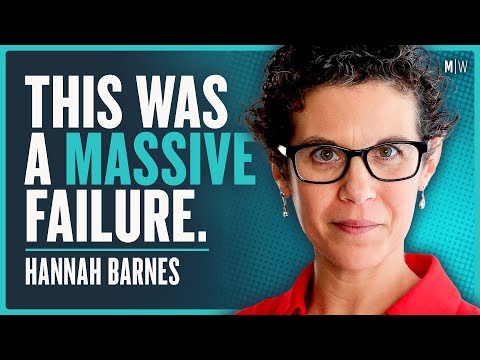
The Collapse Of The UK’s Gender Identity Clinic - Hannah Barnes
Hannah Barnes (guest), Chris Williamson (host)
In this episode of Modern Wisdom, featuring Hannah Barnes and Chris Williamson, The Collapse Of The UK’s Gender Identity Clinic - Hannah Barnes explores inside GIDS: Ideology, Evidence Gaps, And Safeguarding Failures Exposed Journalist Hannah Barnes explains the rise and collapse of the UK’s Gender Identity Development Service (GIDS), detailing how a cautious talking‑therapy clinic became a high‑throughput assessment-and-referral service for puberty blockers. She traces GIDS’s history, the rapid demographic and volume shift in referrals, and the weak evidence underpinning medical interventions for distressed young people. Barnes highlights systemic failures: poor data collection, minimal oversight, ideological and activist pressure, and the sidelining of safeguarding and differential diagnosis for highly complex patients. The conversation also explores international policy shifts, ethical questions about consent, and emerging plans to replace GIDS with more holistic, research‑driven regional services.
Inside GIDS: Ideology, Evidence Gaps, And Safeguarding Failures Exposed
Journalist Hannah Barnes explains the rise and collapse of the UK’s Gender Identity Development Service (GIDS), detailing how a cautious talking‑therapy clinic became a high‑throughput assessment-and-referral service for puberty blockers. She traces GIDS’s history, the rapid demographic and volume shift in referrals, and the weak evidence underpinning medical interventions for distressed young people. Barnes highlights systemic failures: poor data collection, minimal oversight, ideological and activist pressure, and the sidelining of safeguarding and differential diagnosis for highly complex patients. The conversation also explores international policy shifts, ethical questions about consent, and emerging plans to replace GIDS with more holistic, research‑driven regional services.
Key Takeaways
A cautious talking-therapy clinic morphed into a medical referral pipeline without solid evidence.
GIDS began in the late 1980s as a small, exploratory service focused on psychotherapy and uncertainty-tolerant support, but by the 2010s it was primarily assessing for and referring to puberty blockers and hormones, despite a thin and largely extrapolated evidence base.
Get the full analysis with uListen AI
Early puberty blockers were rolled out widely before the research results were in.
In 2011 GIDS started a study of blockers from age 12; by 2014, before outcome data were available, they made early intervention standard practice and dropped lower age limits, allowing prescriptions for children as young as 9–10 based simply on pubertal stage.
Get the full analysis with uListen AI
Blockers did not demonstrably improve mental health and often led straight to cross-sex hormones.
GIDS’s own study showed no measurable psychological benefit from blockers and found that virtually all eligible participants progressed to cross-sex hormones, undermining the claim that blockers provide neutral ‘time and space to think’ and raising concern they may effectively lock in a transition pathway.
Get the full analysis with uListen AI
Most patients were complex, with high rates of other mental health issues, autism, and same‑sex attraction.
Clinicians reported that many young people had severe comorbidities (OCD, depression, trauma, eating disorders), significant autistic traits, and high levels of same‑sex or bisexual attraction, yet exploration of sexuality, neurodivergence, and trauma as possible drivers of distress was often discouraged as ‘transphobic’.
Get the full analysis with uListen AI
Institutional and ideological pressures weakened normal clinical safeguards and oversight.
Staff describe activist groups like Mermaids exerting strong informal influence, a leadership framing GIDS as a ‘justice project,’ and an NHS culture that treated ‘gender’ as too specialist to question, all contributing to poor data tracking, inadequate scrutiny, and failure to respond when internal concerns were repeatedly raised.
Get the full analysis with uListen AI
Accountability is diffuse, spanning clinic leaders, the Tavistock Trust, NHS England, regulators, media, and politicians.
Barnes emphasizes that no single ‘villain’ explains GIDS’s problems; instead, leadership denial, oversight gaps, political timidity, and professional reluctance to admit error allowed questionable practices to persist despite clear warning signs.
Get the full analysis with uListen AI
The UK is pivoting toward regional, holistic, research‑linked services with talk therapy first.
GIDS is being phased out in favor of multiple regional centers emphasizing psychosocial care, robust data collection, specialist input on autism and trauma, and enrollment in research protocols for those accessing medical interventions—though thousands of young people remain on long waiting lists in the meantime.
Get the full analysis with uListen AI
Notable Quotes
“This is a health story. It’s not an ideological story.”
— Hannah Barnes
“We have extended the use of physical interventions to those for whom there isn’t a robust evidence base.”
— Hannah Barnes (quoting GIDS leaders’ 2015 evidence to Parliament)
“For some clinicians, that was their holy fuck moment, because it exploded this idea that the blocker was providing time and space to think.”
— Hannah Barnes
“From its outset, GIDS was not just a therapeutic project. It was a justice project.”
— Hannah Barnes (summarizing Bernadette Wren’s view)
“It’s systemic failure on quite a large scale.”
— Hannah Barnes
Questions Answered in This Episode
How can future gender services practically balance respect for identity with rigorous differential diagnosis for complex mental health presentations?
Journalist Hannah Barnes explains the rise and collapse of the UK’s Gender Identity Development Service (GIDS), detailing how a cautious talking‑therapy clinic became a high‑throughput assessment-and-referral service for puberty blockers. ...
Get the full analysis with uListen AI
What specific data should new clinics be mandated to collect to reliably assess both benefits and harms of puberty blockers and cross-sex hormones over the long term?
Get the full analysis with uListen AI
How should health systems manage relationships with activist or patient groups so that legitimate advocacy does not undermine clinical independence and safeguarding?
Get the full analysis with uListen AI
What ethical framework should guide consent for irreversible or hard-to-reverse interventions when adolescents cannot legally consent to much less consequential decisions?
Get the full analysis with uListen AI
Given the high rates of same-sex attraction among referrals, how can services ensure they are not inadvertently medicalizing or redirecting underlying homophobia and internalized shame?
Get the full analysis with uListen AI
Transcript Preview
Who's to blame? Lots of people are to blame. The leadership of GIDS is to blame, and they should take responsibility for the decisions they did and didn't make. The leadership of the Tavistock Trust are to blame for not taking seriously enough the concerns that were brought to them by a sizeable number of staff working in that service, who were not transphobic, who were relaying clinical concerns, safeguarding concerns, safety concerns, and potentially child protection concerns about the young people they were caring for. (wind blows)
How did you feel before releasing this book, and during the research, what did you think the sort of response was going to be like upon revealing your investigation, and what's it actually been like since it's come out?
I think the weeks and months prior to publication were the worst. I was very, very nervous, and it had been years of work, and it's a bit like, it was a bit like a third baby really. I've got two kids, and, you know, you take your baby out into the world and you want people to, to love it. Um, obviously not the way that you do, and, uh, I love my children more than my work, but I was really nervous about how it would be received and, and the response that I would, would get as well. And I have to say, I've been so pleasantly surprised, in that the, the response has been overwhelmingly positive. I mean, there have been favorable reviews on the left, on the right of British politics. I've spoken with Public Service Radio in Australia, the first time the ABC have really looked at this topic, acknowledging that, you know, p- people do have concerns about the evidence base in particular. I've spoken to NPR over there in the States. Um, and I think when you get favourable reviews, um, for your British viewers, you know, from The Guardian newspaper, from The Observer, from The New Statesman, but also from The Telegraph, The Mail on Sunday, The Sunday Times, The Times, you know, it really speaks to the, what I was trying to do with this book, which is, this is a health story. It's not an ideological story. I'm not a culture warrior in any way. It's about whether the best care was always provided to each and every one of the young people being seen at, at that gender clinic.
It seems like, for the very well-meaning people who are trying to raise well-meaning concerns around the ability to consent, the effectiveness of different treatments, the, um, confusion both, on both sides of the, uh, consultant desk, around how this stuff works, that because it is so ideologically heated, it's incredibly difficult. And also, it, this decision, I would actually say that some of the people on the right have made this a more difficult conversation to have, because of how inflammatory and how reactionary some of their conversations have been, because it's very easy to lambast anyone who decides to criticize this. It's, "Oh, you must be one of those reactionary far right people. You, you just want, you know, all trans people to die." And you go, "Well..." I can see why, uh, treading carefully, as it seems like you have done, uh, has hopefully managed to, uh, even out the, uh, the balance between left and right.
Install uListen to search the full transcript and get AI-powered insights
Get Full TranscriptGet more from every podcast
AI summaries, searchable transcripts, and fact-checking. Free forever.
Add to Chrome