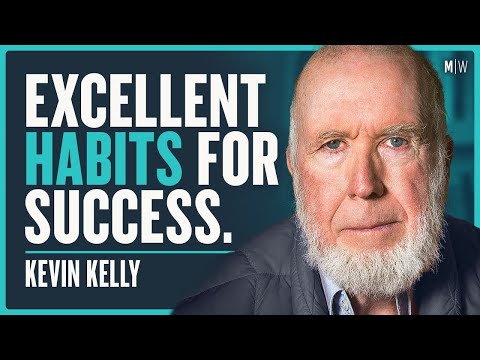
22 Habits To Follow For A Happy Life - Kevin Kelly
Chris Williamson (host), Kevin Kelly (guest)
In this episode of Modern Wisdom, featuring Chris Williamson and Kevin Kelly, 22 Habits To Follow For A Happy Life - Kevin Kelly explores kevin Kelly’s Radical Optimism And Habits For A Happier Life Kevin Kelly joins Chris Williamson to unpack the core ideas from his book of aphorisms, arguing for ‘radical optimism’ and a life designed around unique strengths rather than conventional success. He explains why optimism is both evidence-based and a learnable skill, and why “don’t be the best, be the only” should guide career and life choices. The conversation explores wealth versus time, prototyping your life instead of over-planning, and cultivating habits that raise your average day rather than chasing rare highs. They also discuss understanding yourself through irritations, the illusion of grand conspiratorial ‘thems’, and why kindness and present-focused living are ultimately the most “selfish” winning strategies.
Kevin Kelly’s Radical Optimism And Habits For A Happier Life
Kevin Kelly joins Chris Williamson to unpack the core ideas from his book of aphorisms, arguing for ‘radical optimism’ and a life designed around unique strengths rather than conventional success. He explains why optimism is both evidence-based and a learnable skill, and why “don’t be the best, be the only” should guide career and life choices. The conversation explores wealth versus time, prototyping your life instead of over-planning, and cultivating habits that raise your average day rather than chasing rare highs. They also discuss understanding yourself through irritations, the illusion of grand conspiratorial ‘thems’, and why kindness and present-focused living are ultimately the most “selfish” winning strategies.
Key Takeaways
Practice optimism as a skill by lengthening your time horizon.
Looking 10–30 years ahead makes progress and compounding improvement more visible and turns short-term setbacks into temporary noise rather than destiny, which both improves your mood and your willingness to build ambitious things.
Get the full analysis with uListen AI
Aim to be the only, not the best.
Instead of competing on a narrow, external definition of success, combine your unusual interests and strengths into a niche where what you do is essentially unique, and define success in personally meaningful terms that usually don’t center on money.
Get the full analysis with uListen AI
Trade money for control of your time whenever you reasonably can.
Kelly argues that true wealth is autonomy over your schedule, not extreme net worth or fame, both of which carry hidden ‘taxes’ and constraints that can imprison you and harm your family more than they help.
Get the full analysis with uListen AI
Design your life and habits around bad days and average Tuesdays.
What you do when things go wrong matters more than what you do on peak days; raising the quality of your average day and your ‘lows’ creates a more stable, satisfying life than merely chasing occasional highs.
Get the full analysis with uListen AI
Protect and cultivate the weirdness you had as a child.
The quirks and obsessions that made you odd as a kid often point directly at your adult genius; if you don’t let school, status, and money incentives beat that out of you, they can become the basis of a one‑of‑a‑kind career.
Get the full analysis with uListen AI
Prototype decisions and projects instead of committing to grand plans.
Treat careers, businesses, and big life choices like prototypes—run small, low-commitment experiments (internships, tiny product tests, rough drafts) to stress-test assumptions and learn fast, rather than over-investing in an untested path.
Get the full analysis with uListen AI
Prioritize kindness over being right, and don’t assume a sinister ‘them’.
Most harmful-seeming coordination is actually individuals following incentives and avoiding risk, not masterminded conspiracy; in everyday conflicts, choosing to be kind instead of proving you’re right tends to strengthen relationships and, paradoxically, serves your own long-term interests.
Get the full analysis with uListen AI
Notable Quotes
“Don’t be the best, be the only.”
— Kevin Kelly
“The rich have a lot of money; the wealthy have control of their time.”
— Kevin Kelly
“What you do on your bad days matters more than what you do on your good days.”
— Kevin Kelly
“The thing that made you weird as a kid will make you successful as an adult—if you don’t lose it.”
— Kevin Kelly
“Trust me, there is no them.”
— Kevin Kelly
Questions Answered in This Episode
How can someone who feels deeply pessimistic start practically training themselves in ‘learned optimism’ without feeling fake?
Kevin Kelly joins Chris Williamson to unpack the core ideas from his book of aphorisms, arguing for ‘radical optimism’ and a life designed around unique strengths rather than conventional success. ...
Get the full analysis with uListen AI
What concrete steps could I take this month to move from trying to be ‘the best’ in my field toward becoming ‘the only’ at something?
Get the full analysis with uListen AI
How do you balance prototyping your life—constant experimenting—with the need for stability, commitment, and long-term relationships?
Get the full analysis with uListen AI
In what ways might I be unconsciously sacrificing real wealth (time autonomy, relationships, health) in pursuit of money or status?
Get the full analysis with uListen AI
Can you give more examples of choosing kindness over being right in high-stakes situations, and what the long-term outcomes looked like?
Get the full analysis with uListen AI
Transcript Preview
(wind blowing) Your new book feels like it was purpose-written for me, massive fan of aphorisms, massive fan of pithy, short life advice. For the people that haven't read it, I notice a trend throughout the entire book, which is one of optimism and hope.
Mm-hmm.
And at the moment, I notice on the internet a, uh, current, um, rhythm of serious cynicism, people believing that the world can't improve, that the people who hope that it can are the ones that are genuinely the problem. What's the case for optimism? Why should people be optimistic at all?
I think there's, um, three reasons w- w- uh, why you should be optimistic as you possibly can, understanding that it's somewhat a temperament, but actually I think it is a skill. And, um, the first reason is, is that, um, if you read any history at all, you soon... A- and, and look at the evidence and the actual science, you have to conclude that progress is real and that the conditions that generated that progress are still working, at work in the world, and that this will statistically probability continue for a while. That's one reason. The second reason is that, um, we know from the wor- work of child psychologists that people who are optimistic thrive better. That... And that... And they, th- they, they understand, they, the psychologists understand that one of the ways you teach children is co-learned optimism, to be more optimistic is to have them come to understand that setbacks are only temporary. They're not... They're inevitable, but they're only temporary. And then the third reason is, is that, um, uh, it's the optimists who actually are creating all the cool things that we need and that there is making our lives better. All the, um... Optimist is someone who envisions a world or something that they wanna have and can believe, believes that it's possible, and that, that belief in that envisioning help make it come about, because the really good things that we want are so complicated, they're not gonna happen accidentally, inadvertently. You actually have to imagine them and have to believe that they're gonna happen. And that requires optimism, and that's why basically it's the optimists who are shaping our future.
How much do you think that people can nudge their disposition?
One of the easiest ways is to change your time horizon. If you look out beyond just next year or the year after, 10 years, 20 years, 30 years, it becomes much easier to be optimistic because that, that slow growth, that slow compounding of progress can overwhelm even fairly serious setbacks and downturns and disasters even. And so, um, which are hard to kind of accept or even to, to confront with the short term, but if you take a longer term view, a long horizon, then, um, you have the ability to kind of see that they can be overcome, and that goes back then that the setbacks were just temporary.
Install uListen to search the full transcript and get AI-powered insights
Get Full TranscriptGet more from every podcast
AI summaries, searchable transcripts, and fact-checking. Free forever.
Add to Chrome