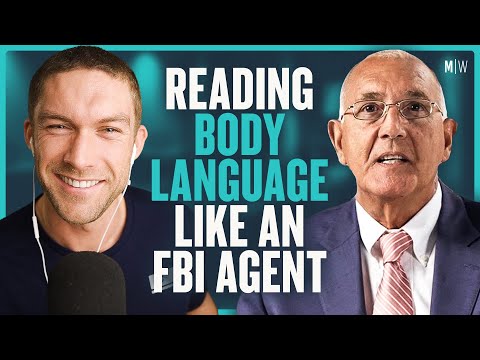
An FBI Agent's Guide To Body Language - Joe Navarro | Modern Wisdom Podcast 389
Joe Navarro (guest), Chris Williamson (host)
In this episode of Modern Wisdom, featuring Joe Navarro and Chris Williamson, An FBI Agent's Guide To Body Language - Joe Navarro | Modern Wisdom Podcast 389 explores ex-FBI Spycatcher Reveals Secrets of Mastery, Fear, and Body Language Former FBI agent and body language expert Joe Navarro discusses lessons from 25 years in the Bureau, spanning SWAT, counterterrorism, and spycatching, and how these experiences shaped his understanding of human behavior.
Ex-FBI Spycatcher Reveals Secrets of Mastery, Fear, and Body Language
Former FBI agent and body language expert Joe Navarro discusses lessons from 25 years in the Bureau, spanning SWAT, counterterrorism, and spycatching, and how these experiences shaped his understanding of human behavior.
He explains self-mastery as emotional control plus long-term, self-designed apprenticeship, emphasizing the price of practice, sacrifice, and focus behind exceptional performance.
Navarro dives into practical nonverbal communication: reading facial cues and feet, using distance and gaze to calm conflicts, and structuring environments (like seating) to foster openness and confession.
Throughout, he contrasts exceptional and unexceptional people, arguing that curiosity, empathy, and reducing others’ fear are hallmarks of great leaders and communicators.
Key Takeaways
Self-mastery starts with emotional control and radical self-honesty.
Navarro describes self-mastery as taking responsibility for your emotions, recognizing when you’re not mentally fit (as when he pulled himself from a SWAT operation), and being willing to act on that awareness even when it’s humbling.
Get the full analysis with uListen AI
Design your own apprenticeship and be willing to pay the price.
Exceptional people create ‘permissionless’ apprenticeships—like Jane Goodall or Benjamin Franklin—by building scaffolding around their interests, studying relentlessly, seeking mentors, and accepting the grind (dozens of edits, endless rehearsals) most people won’t tolerate.
Get the full analysis with uListen AI
Great leaders reduce fear; poor leaders inflame it.
Navarro argues that a core, often untaught leadership duty is to identify what followers fear and systematically lessen its impact, because fear can paralyze performance or mutate into hatred when stoked rather than soothed.
Get the full analysis with uListen AI
Body language is rich context, not a lie detector.
Facial tension, eye movements, lip compression, jaw shifts, and especially foot orientation reveal comfort, doubt, or disengagement—but no single gesture proves deception; instead, they’re clues to emotional and cognitive states.
Get the full analysis with uListen AI
Environment and positioning dramatically affect openness and conflict.
Sitting at an angle rather than face-to-face, reducing intense eye contact, and even using a focal point like a fireplace can relax people; it’s easier to resist someone in front of you than someone seated beside you, which Navarro leveraged in spy interrogations.
Get the full analysis with uListen AI
Observation is a trainable skill that requires deliberate practice.
Navarro sharpens his observation by watching foreign films for nonverbals and playing quick visual ‘scan’ games (counting car colors), noting that time behind a desk dulled his situational awareness until he consciously retrained it.
Get the full analysis with uListen AI
Exceptional people are curious, empathetic, and action-oriented.
In contrast, the ‘unexceptional’ are rigid, incurious, entitled, and apathetic; Navarro emphasizes that exceptional individuals actively provide psychological comfort, want others to win, and continually explore people and the world around them.
Get the full analysis with uListen AI
Notable Quotes
“One of the greatest attributes of a great leader is the ability to observe the needs and the wants, but also the fears and concerns of the people they lead.”
— Joe Navarro
“Exceptional individuals don’t have to follow a particular regimen. They can create their own regimen, and that is true self-mastery.”
— Joe Navarro
“Everything comes at a price. The question is your dedication to that.”
— Joe Navarro
“Too much eye contact affects interviewing. Allowing the person to drift off, to be comfortable, to be reflective is often better than what you see on television.”
— Joe Navarro
“We didn’t know what world records were, so we just ran fast everywhere.”
— Unnamed Kenyan/Ethiopian cab driver, as recounted by Joe Navarro
Questions Answered in This Episode
How can someone practically assess whether they truly want a goal or just like the fantasy of it, before committing years of effort?
Former FBI agent and body language expert Joe Navarro discusses lessons from 25 years in the Bureau, spanning SWAT, counterterrorism, and spycatching, and how these experiences shaped his understanding of human behavior.
Get the full analysis with uListen AI
What daily or weekly exercises would Navarro recommend for systematically improving observation and nonverbal reading skills?
He explains self-mastery as emotional control plus long-term, self-designed apprenticeship, emphasizing the price of practice, sacrifice, and focus behind exceptional performance.
Get the full analysis with uListen AI
How should leaders balance reducing followers’ fear with still delivering hard truths and maintaining high standards?
Navarro dives into practical nonverbal communication: reading facial cues and feet, using distance and gaze to calm conflicts, and structuring environments (like seating) to foster openness and confession.
Get the full analysis with uListen AI
In what ways might cultural differences in body language lead to serious misunderstandings in international business or diplomacy?
Throughout, he contrasts exceptional and unexceptional people, arguing that curiosity, empathy, and reducing others’ fear are hallmarks of great leaders and communicators.
Get the full analysis with uListen AI
How can an introverted person use Navarro’s strategies to become better at small talk and building rapport without feeling inauthentic or drained?
Get the full analysis with uListen AI
Transcript Preview
Too much eye contact affects interviewing. Allowing the person to drift off, to be comfortable, to be reflective is often better than what you see on television. It's actually easier to resist someone when they're in front of you. You know, it's easier to fend somebody off than somebody who's next to you. Somebody who's next to you, it's pretty tough to argue with them. It's like we're both on the same side. (air whooshing)
Joe Navarro, welcome to the show.
Good to be here, Chris.
For the people who aren't familiar with you and your background, where have you gone that's led you to this point?
Not very far, you know, (laughs) 25 years in the FBI where, uh, I, I got to play as a SWAT team commander, spycatcher and, uh, bureau pilot. Uh, I was the FBI's body language expert, and then I retired and wrote 14 books. And, um, so not much. (laughs)
Yeah, uh, a, uh, colorful career path-
(laughs)
... I think you could say. What's the-
Y-
What are those different, um, elements within the Bureau there, for the people that haven't got a clue what you're talking about?
Y- yeah. Well, you know, i- within the FBI, uh, we have a lot of subprograms. So, uh, I en- when I entered into the Bureau, I was already a, a licensed pilot and we were always in need of pilots because we use, uh, uh, aircraft as platforms for surveillance. So I, I got to do that. And then, (laughs) they, they wanted volunteers, which means I was pushed into, uh, going into the SWAT program because, uh, you know, sometimes you're up against some, um, (smacks lips) uh, some pretty dastardly groups. And, uh, spent 14 years as a ... on a SWAT team, uh, in, uh, Puerto Rico and then in, in Tampa and, um, and, uh, doing counterterrorism investigations. But mostly, you know, I spent those 25 years ... So, so you can do other things within the FBI. Um, I was, uh, part of the National Security's, uh, uh, behavioral program, which, uh, looked at, uh, human behavior. And, uh, and actually that's really what led me, um, not only my spycatching, but, uh, but led me to, uh, to, to begin to write books. And, uh, and in fact, the, the, the first book, uh, that I wrote with, uh, Jack Schaefer, uh, really was I was getting ready to retire from the FBI and, and people were saying, you know, "There's all this knowledge that you have, but you're taking it with you. Uh, w- why don't you share it?" And, um, I never w- I never intended to, to, uh, uh, be a writer. Um, and in fact, I often say I'm, I'm a writer, I'm r- or an author. I'm really not a writer. (laughs) I know what a (laughs) good writer is. Uh, I'm sure you know the, the, uh, the difference. But, um, you know, all o- all in all, it's, it's, uh, it was, uh, a fantastic experience. And, um, and obviously you, you learn a lot. Um, you know, I got to work with, uh, uh, British Intelligence. I wor- I worked with, uh, German Intelligence. Uh, um, and just different folks around the world. And it, uh, it makes for an interesting, uh, career.
Install uListen to search the full transcript and get AI-powered insights
Get Full TranscriptGet more from every podcast
AI summaries, searchable transcripts, and fact-checking. Free forever.
Add to Chrome