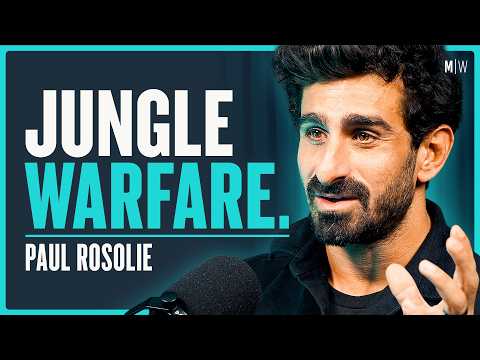
Uncontacted Tribes, Jungle Warfare & Being Eaten Alive - Paul Rosolie
Chris Williamson (host), Paul Rosolie (guest), Chris Williamson (host)
In this episode of Modern Wisdom, featuring Chris Williamson and Paul Rosolie, Uncontacted Tribes, Jungle Warfare & Being Eaten Alive - Paul Rosolie explores amazon explorer reveals conservation fight, jungle dangers, and uncontacted tribes’ reality Paul Rosolie describes the Amazon as both serene and lethal—sharing vivid stories about stingray venom, bullet ants, infections, jaguars, and encounters with uncontacted tribes—while emphasizing that humans, not animals, are the most dangerous threat in the jungle.
Amazon explorer reveals conservation fight, jungle dangers, and uncontacted tribes’ reality
Paul Rosolie describes the Amazon as both serene and lethal—sharing vivid stories about stingray venom, bullet ants, infections, jaguars, and encounters with uncontacted tribes—while emphasizing that humans, not animals, are the most dangerous threat in the jungle.
He explains how a sensationalized Discovery Channel project (“Eaten Alive”) nearly ruined his credibility, ultimately forcing a reset that sharpened his mission and led to the creation of JungleKeepers.
Rosolie argues the Amazon is near a tipping point: deforestation disrupts a massive “aerial river” of moisture recycling (around 20 trillion liters/day), risking drought, fire susceptibility, and ecosystem collapse.
He details a pragmatic conservation model—buying land, employing former loggers/miners as rangers, and targeting 300,000 protected acres to secure Peruvian national park status—while managing modern threats like narco-traffickers and ethically fraught contact events with isolated tribes.
Key Takeaways
Indigenous/local knowledge can outperform “default” Western responses in the field.
Rosolie contrasts a stingray injury treated successfully with a locally made bark poultice versus a friend’s hospital route that led to nerve damage and infection, arguing the rainforest has “a tree for that” and locals have generational protocols.
Get the full analysis with uListen
The jungle’s danger is real—but intermittent; fear is often about rare spikes, not the baseline.
He notes most days are calm and beautiful, but incidents (stingray, bullet ants, wasps) are sudden and overwhelming; the constant anxiety comes from anticipating consequences more than the event itself.
Get the full analysis with uListen
The Amazon’s stability depends on a self-reinforcing moisture system that can fail past a threshold.
Rosolie describes trees lifting ~20 trillion liters of water daily into an “invisible mist river,” and warns that crossing a deforestation tipping point breaks rainfall recycling, drying the forest and enabling catastrophic burn and dieback.
Get the full analysis with uListen
Conservation succeeds when it competes with destructive livelihoods—by offering better jobs and dignity.
JungleKeepers recruits loggers/miners by paying more, providing benefits, and replacing chainsaws with binoculars; Rosolie frames deforestation as poverty-driven behavior that can be redirected with viable alternatives.
Get the full analysis with uListen
Credibility is hard-won and easily destroyed—yet failures can become strategic assets.
The “Eaten Alive” rebrand created public outrage and professional exile, but later taught him to recognize bad-faith deals and pushed him toward building real infrastructure (rangers, land purchases, governance) instead of media stunts.
Get the full analysis with uListen
In many modern conservation conflicts, humans—not wildlife—are the primary lethal risk.
He reports needing armed security due to narco-traffickers expanding cocaine cultivation into remote areas; animals (even jaguars) are portrayed as largely predictable compared to armed criminal actors.
Get the full analysis with uListen
Protecting uncontacted tribes ethically often means protecting land, not forcing contact.
Rosolie supports the prevailing “leave them alone” approach while documenting that tribes may initiate contact for goods and also commit sudden violence; the practical solution is securing vast intact territory where they can remain isolated by choice.
Get the full analysis with uListen
Notable Quotes
“"It’s like having an electrical wire shoved into your veins."”
— Paul Rosolie
“"The jungle is actually very, very serene… the most dangerous thing is falling trees."”
— Paul Rosolie
“"We’re the first generation in history that has a planetary crisis on our hands that we can stop."”
— Paul Rosolie
“"We started asking our enemies, the loggers and the gold miners, if they’d like to join our team."”
— Paul Rosolie
“"We want bananas, and stop cutting down our trees."”
— Paul Rosolie
Questions Answered in This Episode
On the stingray story: what exactly was in the poultice (species/bark/sap), and is there any documented pharmacology behind why it “sucks out” venom?
Paul Rosolie describes the Amazon as both serene and lethal—sharing vivid stories about stingray venom, bullet ants, infections, jaguars, and encounters with uncontacted tribes—while emphasizing that humans, not animals, are the most dangerous threat in the jungle.
Get the full analysis with uListen AI
You claim Amazon “wildfires” are largely human-set because the intact forest won’t burn—what conditions (drought, edge effects, fragmentation) make it burnable, and how close is your region to that state?
He explains how a sensationalized Discovery Channel project (“Eaten Alive”) nearly ruined his credibility, ultimately forcing a reset that sharpened his mission and led to the creation of JungleKeepers.
Get the full analysis with uListen AI
Your “20 trillion liters/day” aerial-river figure is striking—what’s the best primary source or study listeners can check to validate the number and the tipping-point threshold?
Rosolie argues the Amazon is near a tipping point: deforestation disrupts a massive “aerial river” of moisture recycling (around 20 trillion liters/day), risking drought, fire susceptibility, and ecosystem collapse.
Get the full analysis with uListen AI
When you convert loggers/miners into rangers, what stops replacement labor from moving in—how do you scale this beyond bottom-up actors to the companies and supply chains?
He details a pragmatic conservation model—buying land, employing former loggers/miners as rangers, and targeting 300,000 protected acres to secure Peruvian national park status—while managing modern threats like narco-traffickers and ethically fraught contact events with isolated tribes.
Get the full analysis with uListen AI
You criticize big NGOs spending heavily on advertising—what governance practices, audits, and transparency mechanisms does JungleKeepers use to keep admin creep from rising as you scale?
Get the full analysis with uListen AI
Transcript Preview
How was getting stung by a stingray?
[inhales] That's a- it was wonderful. I loved every second of it, because people pursue ice plunges and ayahuasca journeys, and, and people, people are constantly looking for the edge. And, and I found the edge, right? I thought I was tough. I thought I'd been through pain. I didn't know anything. I was, I was making deals with God. I was, I was in so much pain, and you don't think, you know... You think, like, y- your chest cavity or your head. You didn't think that your foot could throw you into agony. I got- you know, so it, it stung me in the foot, and what happened was-
Tell me this, where were you?
So I'm in a stream in the Amazon rainforest, and I had my shoes on just 'cause I'd been hiking, and I reached this waterfall, and I said, "I'm gonna take my shoes off to enjoy the waterfall and swim around." And as I'm playing in the waterfall, I just... You instantly know it. It's like you got shot in the foot. And the stingray, I stepped on the stingray, and it stuck its barb, and it's, you know, it's the size of a steak knife. It sticks its barb in through the skin, and the thing is, it wagged its tail under the skin, so it flayed the skin off of the meat of the foot and then swam out-
So just what does a-
... in a split second.
What does a, a stingray, 'cause it's flat-
Yeah
... and it's the, just the tail? So have you stood on the tail, or has it been looking for you?
No, no, no, it's flat, flat.
Yeah.
The whole thing is flat, and then if it gets scared, it stings to make you go away.
Oh.
They're not trying to attack you.
Right, right, right.
They want to be left alone. I stepped on him. It's my fault. I couldn't see him.
And then the tail came up-
Tail went straight up, in the, the... And the arch of your foot is sensitive. And so, so steak knife to the arch of the foot, injected a ton of venom as it flayed the skin off, pulls out, and so I'm like... I'm like, "Look, this hurts," but the flesh wounds don't hurt that much. And I'm like, "That hurt. Getting stabbed hurt." And so I'm over there, I'm about to film, and I'm like, "I'm in the Amazon rainforest, and I just got hit by a stingray." My friend comes up to me, and he goes, "We don't have time for this." He's like: "You're gonna pass out soon, and when you pass out, we can't carry you to the river." And I say, "How do you know I'm gonna pass out?" He goes, "It happens to everybody." And sure enough, the next thing I know, I'm on a cart, uh, getting, getting wheeled through the jungle. I don't remember the boat ride at all, and then they got me to the, to the, to the research station, and I was in so much pain. I was, you know, I was making every deal with the universe. "If you just make this stop, I promise I'll do whatever," [chuckles] you know, just everything. And, uh, they, they... Luckily, I was with the local guys, so they were scraping the trees, gathering medicinal barks that they baked in a pan. They, they wrapped it in leaves, and they baked it into a poultice. And they put that on the wound, boiling-hot poultice, which actually, weirdly enough, felt good. Boiling hot, but the skin was already off. They put that on, and then they wrap it to your foot, and they leave that there for a few hours, and that sucks out the venom. But for about four or five hours, it was the worst, most blinding pain, like level 10. You know, the doctor goes, "You know, what, what are, what are you feeling, a two or an eight?" And I was like, "This was a 10." I can't imagine more pain than that. It's like being... Just, just the venom, it's like having e- an electrical wire shoved into your veins. But the last guy I know that got stung by a stingray, he went to a hospital, and he had permanent nerve damage, didn't walk for two months, had a systemic infection, because he went with the Western medicine way. The local guys are like, "Dude, we know how to deal with this. We have trees for that. There's a sap for that." They have it. They know. They've learned from their grandfathers and grandmothers. [exhales] My God.
Install uListen to search the full transcript and get AI-powered insights
Get Full TranscriptGet more from every podcast
AI summaries, searchable transcripts, and fact-checking. Free forever.
Add to Chrome