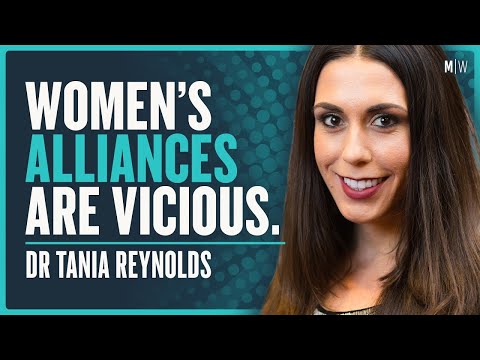
The Hidden Motives Behind Female Friendships - Dr Tania Reynolds
Dr Tania Reynolds (guest), Chris Williamson (host)
In this episode of Modern Wisdom, featuring Dr Tania Reynolds and Chris Williamson, The Hidden Motives Behind Female Friendships - Dr Tania Reynolds explores evolutionary Roots Of Female Friendship, Rivalry, Gossip, And Care Dr. Tania Reynolds explains how ancestral conditions like patrilocality and different reproductive pressures shaped distinct male and female patterns of cooperation, competition, and friendship. Women historically relied on symmetric, one‑to‑one alliances with unrelated females, making kindness and personal loyalty central—and making status gaps and competition especially corrosive to female friendships.
Evolutionary Roots Of Female Friendship, Rivalry, Gossip, And Care
Dr. Tania Reynolds explains how ancestral conditions like patrilocality and different reproductive pressures shaped distinct male and female patterns of cooperation, competition, and friendship. Women historically relied on symmetric, one‑to‑one alliances with unrelated females, making kindness and personal loyalty central—and making status gaps and competition especially corrosive to female friendships.
Men, by contrast, evolved in coalitional warfare and hunting contexts where hierarchy, specialization, and accepting status asymmetries within the group increased survival and reproductive success, making male friendships more resilient to competition. Reynolds details how these evolved tendencies manifest today in workplace dynamics, sport, gossip, cross‑sex friendships, and reactions to sexual norms and harassment policies.
She also discusses biases in how we perceive male versus female suffering and moral agency, the reputational centrality of women’s sexual behavior, and how modern phenomena—social media, MeToo, skewed sex ratios, and growing female economic independence—interact with ancient psychological mechanisms.
Throughout, she argues that understanding intrasexual competition and the reputational logic behind female alliances, gossip, and mate choices can clarify current gender tensions and help design better social and institutional responses.
Key Takeaways
Female friendships evolved to prioritize symmetry, kindness, and personal loyalty.
In patrilocal societies, women were surrounded by non-kin and had to build trust via reciprocal altruism under roughly equal power and resource conditions, making deviations in status or perceived loyalty especially damaging to female bonds.
Get the full analysis with uListen AI
Male cooperation historically benefited from hierarchy and status asymmetries.
Coalitional warfare and hunting favored clear chains of command and role specialization; men could tolerate and even celebrate higher-status male allies because group success meant survival and mating opportunities for all.
Get the full analysis with uListen AI
Competition corrodes female relationships more than male relationships.
Evidence from children, athletes, and economic games shows that women are less likely than men to return to cooperation after conflict or defection, suggesting interventions that emphasize forgiveness and recollection of past loyalty could strengthen female cooperation.
Get the full analysis with uListen AI
Gossip is a central, low-risk tool in female intrasexual competition.
Because physical aggression endangers women and their offspring, reputational attacks—especially about sexual behavior, niceness, and loyalty—allow women to undermine rivals or protect their own reputation while masking hostility as concern or self-disclosure.
Get the full analysis with uListen AI
Women’s reputations hinge heavily on perceived sexual chastity, making them vulnerable.
Since sexual restraint is a negative, hard-to-prove state, accusations of promiscuity are difficult to counter and can severely damage mate value and social standing, driving secrecy about sexual history and intense condemnation of perceived promiscuity in certain ecologies.
Get the full analysis with uListen AI
Cross-sex friendships often function as latent mating arrangements or protection.
Preferences for opposite-sex friends resemble mate preferences and people report distress when a ‘backup mate’ finds a partner; historically, male allies may also have provided physical protection for patrilocally displaced women, which helps explain modern jealousy around such friendships.
Get the full analysis with uListen AI
Society more readily sees women as victims and men as perpetrators, shaping sympathy and policy.
Moral typecasting biases people to assign women to the ‘victim’ role and men to the ‘agent/perpetrator’ role, increasing sympathy for women, blame toward men, and support for female-favoring narratives—but also making it harder to see men’s suffering or women’s agency and leadership potential.
Get the full analysis with uListen AI
Notable Quotes
“In order to be popular as a female, you have to be super nice; otherwise other girls will hate you.”
— Dr. Tania Reynolds
“Competition tends to corrode female relationships more than men's. Men can more easily return to cooperation following competition than can women.”
— Dr. Tania Reynolds
“What female allies might actually be doing is helping women better compete—but in a social, reputational, gossip way.”
— Dr. Tania Reynolds
“We more instinctively classify women as victims and men as perpetrators, and that makes it harder to see men as victims and women as agents.”
— Dr. Tania Reynolds
“Almost all competition between women is with other women, and almost all competition for men is with other men. That’s a really lovely antidote to this adversarial framing of the sexes.”
— Chris Williamson
Questions Answered in This Episode
How can institutions and workplaces encourage cooperation between women without erasing real intrasexual competition and status sensitivities?
Dr. ...
Get the full analysis with uListen AI
What practical steps can men and women take to manage opposite-sex friendships in long-term relationships, given evolved backup-mate dynamics and mind-reading failures?
Men, by contrast, evolved in coalitional warfare and hunting contexts where hierarchy, specialization, and accepting status asymmetries within the group increased survival and reproductive success, making male friendships more resilient to competition. ...
Get the full analysis with uListen AI
How might we design sexual harassment policies that protect targets without unintentionally undermining mentorship, collaboration, and goodwill between the sexes?
She also discusses biases in how we perceive male versus female suffering and moral agency, the reputational centrality of women’s sexual behavior, and how modern phenomena—social media, MeToo, skewed sex ratios, and growing female economic independence—interact with ancient psychological mechanisms.
Get the full analysis with uListen AI
In a world of social media and globalized comparison, how can women buffer themselves against the body dissatisfaction and anxiety driven by local and virtual sex ratios?
Throughout, she argues that understanding intrasexual competition and the reputational logic behind female alliances, gossip, and mate choices can clarify current gender tensions and help design better social and institutional responses.
Get the full analysis with uListen AI
If we systematically misperceive women as victims and men as perpetrators, what changes in media, education, or law would help us recognize men’s suffering and women’s agency more accurately?
Get the full analysis with uListen AI
Transcript Preview
What we might be doing when we form opposite sex friends is basically recruiting kind of, like, backup mates. The preferences that we espouse for our opposite sex friends look pretty similar to our preferences for mates, and so it suggests we might be cultivating backup mates. And there are some data that people do this explicitly. They'll report being distressed if their backup mate forms a relationship. (wind blows)
Among over 11,600 US employees, women were less satisfied with their jobs when they reported to a female boss, whereas men showed no difference in job satisfaction based on their supervisor's gender. Why do you think that is?
So, I think this goes back to the challenges faced by our female ancestors. Throughout human history, a larger percentage of social groups were patrilocal, meaning that when women were married, they left their families to go live with their husbands. And so, this would have been particularly challenging for ancestral women because they're surrounded by individuals with whom they weren't genetically related, and we know that it's harder to form cooperative relationships with non-kin compared to kin. And so, I've thought about, okay, well, how might women have navigated these relationships? How might they have recruited allies in these contexts? And Dave Geary has made the argument that one way women might have formed cooperative bonds in these contexts is through either reciprocal altruism or mutualism. So, meaning they're forming relationships based on shared goals, or exchanging benefits in a tit-for-tat manner. And so, if you look at what are the contexts that allow those types of relationships to succeed, it tends to be when relationship partners have symmetrical lever- levels of power and resources. And so, I think one way to think about this might be, what would it look like if, say, there was a huge asymmetry in resources between partners? So, say a famous celebrity tried to form a cooperative relationship with an unhoused person, or a homeless person. This would be very challenging because they ... It would be quite unlikely that they'd have mutually aligned goals, and over time, you would expect that this relationship would devolve into either, um, kind of exploitation or just kind of, you know, a unilateral extraction of resources, so leeching on another person's resources. And indeed, that's what mathematicals find, is that when partners diverge in power and resources, the cooperative bonds kind of, um, they, they're no longer mutually beneficial. It's one partner taking advantage of the other partner. And so, if these are the conditions that uphold reciprocal altruism, what I suspect is that women throughout human history upheld their reciprocal bonds with unrelated same-sex women under such conditions, such that they preferred contacts where they were of equal power and equal resources, and too strong of deviations would have led to conflict and kind of corroded the relationship. And so, I think that this can become problematic in modern contexts where there are clear demarcations in status and resources, or in contexts, say, where we have social media and we could observe the lives of people who deviate strongly from us in their social conditions. That basically, these deviations might be more corrosive to women's same-sex relationships if, throughout human history, our female ancestors were forming cooperative bonds with one another under conditions of symmetry.
Install uListen to search the full transcript and get AI-powered insights
Get Full TranscriptGet more from every podcast
AI summaries, searchable transcripts, and fact-checking. Free forever.
Add to Chrome