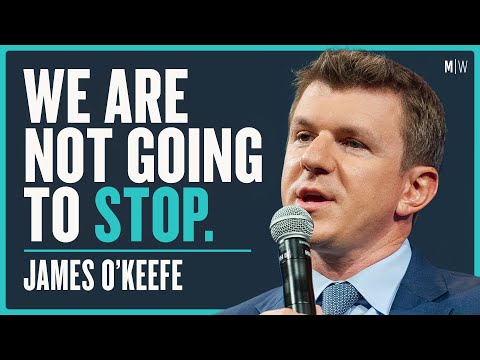
The State Of Modern Journalism - James O'Keefe
James O'Keefe (guest), Chris Williamson (host)
In this episode of Modern Wisdom, featuring James O'Keefe and Chris Williamson, The State Of Modern Journalism - James O'Keefe explores james O’Keefe Defends Undercover Journalism Amid Raids, Lawsuits, Censorship Battles James O’Keefe discusses his work with Project Veritas, focusing on undercover journalism, government pressure, and legal battles that he argues threaten press freedom. He recounts the FBI raid over Ashley Biden’s alleged diary, his ongoing litigation with federal authorities, and his defamation victory against The New York Times. A large portion of the conversation explores the ethics and legality of hidden-camera reporting, source verification, and where to draw the line on privacy versus public interest. Throughout, O’Keefe frames modern journalism as a struggle against institutional power, fear, and public self-censorship, arguing that whistleblowers are increasingly willing to risk their careers to expose concealed information.
James O’Keefe Defends Undercover Journalism Amid Raids, Lawsuits, Censorship Battles
James O’Keefe discusses his work with Project Veritas, focusing on undercover journalism, government pressure, and legal battles that he argues threaten press freedom. He recounts the FBI raid over Ashley Biden’s alleged diary, his ongoing litigation with federal authorities, and his defamation victory against The New York Times. A large portion of the conversation explores the ethics and legality of hidden-camera reporting, source verification, and where to draw the line on privacy versus public interest. Throughout, O’Keefe frames modern journalism as a struggle against institutional power, fear, and public self-censorship, arguing that whistleblowers are increasingly willing to risk their careers to expose concealed information.
Key Takeaways
Undercover journalism relies on strong legal grounding and meticulous ethics.
O’Keefe argues that hidden cameras and deceptive setups are justified when they expose powerful institutions, but insists every action be vetted by lawyers and judged as if a jury were watching, to avoid crossing legal or ethical lines.
Get the full analysis with uListen AI
Whistleblower credibility hinges on documents and corroboration, not job titles.
He stresses that low-level employees can surface high-level truths if they provide authentic documents, recordings, and corroborating evidence; what matters is whether claims are verifiably true, not how senior the source is.
Get the full analysis with uListen AI
Legal adversaries can become evidence of journalistic integrity.
O’Keefe maintains that repeated lawsuits and investigations have forced full discovery of Veritas’ methods; he claims their undefeated record in court is used to rebut accusations of deceptive editing or fabrication.
Get the full analysis with uListen AI
Fear and personal risk are major barriers to exposing wrongdoing.
Drawing parallels with communist societies and citing Solzhenitsyn, he says many insiders know “it’s all a lie” but fear losing jobs, pensions, or social media accounts, producing a collective-action problem where few bear all the cost for everyone else’s benefit.
Get the full analysis with uListen AI
Choosing what not to publish is as important as what to expose.
The decision not to publish Ashley Biden’s alleged diary illustrates his claim that Project Veritas sometimes withholds sensitive material—even when it might be politically advantageous—if it seems overly invasive or insufficiently corroborated.
Get the full analysis with uListen AI
The law can still provide real checks on media and government overreach.
He highlights Supreme Court precedents protecting journalists who publish illegally obtained documents they did not steal, and cites cases where courts have ruled mainstream outlets, not Veritas, acted with “disinformation and deception.”
Get the full analysis with uListen AI
Public distrust of mainstream media is driving a new whistleblower culture.
O’Keefe claims that as politics increasingly affects daily life, more insiders in tech, media, and government are concluding that the public’s right to know outweighs their own security, creating a “domino effect” of leaks.
Get the full analysis with uListen AI
Notable Quotes
“Journalism is printing what somebody does not want printed, not being the representative spokesperson for those in power.”
— James O’Keefe
“Good journalism harms people. Information harms people.”
— James O’Keefe
“You have two choices: you can deceive the audience or you can deceive your subject. And I would prefer to deceive my subject such that I can tell the truth to my audience.”
— James O’Keefe
“In communist countries, 98% of people did not want the communist outcome but were too afraid to push back against the 2% of the crazy.”
— James O’Keefe
“Always behave like there’s a jury in the room watching everything you do and say, even when you’re alone.”
— James O’Keefe
Questions Answered in This Episode
Where should journalists draw the ethical line between legitimate undercover work and unacceptable invasion of privacy?
James O’Keefe discusses his work with Project Veritas, focusing on undercover journalism, government pressure, and legal battles that he argues threaten press freedom. ...
Get the full analysis with uListen AI
How can the public independently verify claims made by outlets like Project Veritas or mainstream media when both accuse each other of deception?
Get the full analysis with uListen AI
Does the growing fear of censorship and deplatforming fundamentally change how whistleblowers and journalists operate today?
Get the full analysis with uListen AI
Are certain types of sensitive information—like private diaries or intimate communications—ever justifiable to publish in the public interest?
Get the full analysis with uListen AI
If most people distrust mainstream media, what would it take to rebuild trust, and is that even possible within current political and economic structures?
Get the full analysis with uListen AI
Transcript Preview
In communist countries, 98% of people did not want the communist outcome but were too afraid to push back against the 2% of the crazy. They're afraid to lose something. And I see it in my own life with people that I know, that they know it's all a lie, but they're not willing to push back against it. (wind blowing)
James O'Keefe, welcome to the show.
Great to be with you.
Rogan called you the boogeyman. Are you the boogeyman?
Um, y- yes, in some respects. Uh, a- as, uh, journalism is printing what somebody does not want printed, not being the representative spokesperson ombudsman for those in power, if you're challenging, then I guess I'm a boogeyman. Depends upon who you're talking to.
The FBI stole your phone as well. Have you got that back yet?
No, I have not. They took two phones in a raid against me in November, uh, which is highly unusual because they didn't take my iPad or my laptop, but they did have a search warrant, um, signed by a magistrate judge in the Southern District of New York, which is federal court, and the federal judge, uh, ordered the FBI to stop going through my phones. And now it's in this sort of litigation, this sort of battle in court, in federal court. Um, and a- a- a special master was assigned. People don't know what that means.
What's that mean?
Usually, it's- it's a special, independent, uh, legal official to oversee what the FBI is doing. And the federal judge cited journalistic privilege, which was a big win for Project Veritas, but I haven't been charged with a crime. Um, I mean, we could spend an hour just on this matter, but, uh, it was absolutely unconstitutional, illegal for- for them to do this to an American journalist, and we're gonna fight it. We're gonna fight it all the way.
What was the story there?
Well, a source had given or transmitted me a document. Ashley Biden is the daughter of President Joe Biden. Uh, her diary, and, uh, I looked into it. There were some things in this diary, there were some- some- some things she wrote, um, including that she had taken showers inappropriately with her father. I didn't know what that meant. Um, I did not know if it happened, and I didn't know with 100% certainty that the diary belonged to Ashley Biden. I was almost certain, but not totally certain. So I didn't- I didn't run the story. I- I reached out to Joe Biden for comment. Um, I tried looking into it, and I'd made the decision, which was very controversial internally at Project Veritas, to not run this diary, not publish the diary. And then a year later, the feds showed up at my door with a battering ram, a search warrant, put me in handcuffs, raided my apartment, and took my devices. And, uh, the Attorney General of the United States, Merrick Garland, expressly forbids this, er, these execution of these search warrants against journalists. Journalists in the United States are protected by Supreme Court law, uh, Bart- Nicky Vivaper from 2001. You can publish a document that is stolen so long as the journalist did not participate in the theft of that document. Think of it using common sense. If you stumble across a d- document, (laughs) what is your... you can't be liable for that. Um, but, uh, of course, we live in a clown world where, uh, two plus two equals five, to quote your- George Orwell, the late and great George Orwell from 1984. Different laws apply to different people. The US attorneys in New York argued that I'm not a journalist before the judge. Their logic was, and I'm not making this up, I'm paraphrasing the prosecutors, their argument was James O'Keefe does not get permission from the people he reports on, Your Honor, and that's why he's not a journalist, which is an argument so preposterous and so absurd, it defies reason, which is why I wrote this book called American Muckraker.
Install uListen to search the full transcript and get AI-powered insights
Get Full TranscriptGet more from every podcast
AI summaries, searchable transcripts, and fact-checking. Free forever.
Add to Chrome