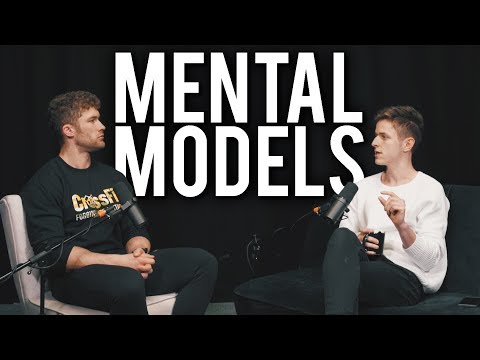
Mental Models 101 - How To Make Better Decisions | George Mack
Chris Williamson (host), George MacGill (guest), Narrator, Narrator
In this episode of Modern Wisdom, featuring Chris Williamson and George MacGill, Mental Models 101 - How To Make Better Decisions | George Mack explores mental Models Explained: Frameworks For Better Decisions And Modern Life Chris Williamson and George Mack explore mental models as practical thinking tools—"apps" for your mind—that help simplify complex decisions and modern life. Drawing heavily from Charlie Munger, Naval Ravikant, Taleb and others, they move through a wide latticework of models: inversion, contrast, first principles, signal vs noise, asymmetry, systems vs goals, high agency, and more. They apply these to happiness, careers in your 20s, social media, education, relationships, productivity, and even video game design. The conversation emphasizes avoiding stupidity over chasing brilliance, privileging reality over theory, and deliberately designing your environment and habits to compound over time.
Mental Models Explained: Frameworks For Better Decisions And Modern Life
Chris Williamson and George Mack explore mental models as practical thinking tools—"apps" for your mind—that help simplify complex decisions and modern life. Drawing heavily from Charlie Munger, Naval Ravikant, Taleb and others, they move through a wide latticework of models: inversion, contrast, first principles, signal vs noise, asymmetry, systems vs goals, high agency, and more. They apply these to happiness, careers in your 20s, social media, education, relationships, productivity, and even video game design. The conversation emphasizes avoiding stupidity over chasing brilliance, privileging reality over theory, and deliberately designing your environment and habits to compound over time.
Key Takeaways
Use inversion: define what to avoid instead of what to pursue.
Rather than asking “How do I become happy? ...
Get the full analysis with uListen AI
Manage contrast to protect happiness in a comparison-driven world.
Happiness is largely relative: on Instagram you compare your ‘8/10’ life to curated ‘10/10’ feeds and feel ‘-2’, whereas walking through a hospital or reading about extreme suffering flips the comparison, making your life feel abundant. ...
Get the full analysis with uListen AI
Think from first principles, not analogy, especially in broken systems.
Instead of accepting “this is how it’s always been done” (e. ...
Get the full analysis with uListen AI
Favor systems and habits over goals to ensure progress.
Goals create a brief win followed by an empty ‘what now? ...
Get the full analysis with uListen AI
Deliberately seek signal over noise using Lindy and time horizons.
Most people consume content produced in the last 24 hours, which is mostly noise. ...
Get the full analysis with uListen AI
Cultivate high agency: refuse the default script and act resourcefully.
High-agency people don’t accept “you can’t do that” at face value; they re-frame constraints, take ownership, and get creative (like the kid knocking on doors in Kensington who landed a BlackRock internship or the IRS agent who outperformed the FBI on Silk Road via Google). ...
Get the full analysis with uListen AI
Optimize for asymmetric bets and second/third-order consequences.
Avoid asymmetric downside (e. ...
Get the full analysis with uListen AI
Notable Quotes
“Instead of trying to seek excellence, just focus on avoiding stupidity.”
— George Mack (via Charlie Munger)
“On Instagram you’re scrolling through artificial lives designed to make yours look worse; in a hospital you’re walking past real lives who would do anything to swap with you.”
— George Mack
“If you’re on the right trajectory but complaining you’re not there yet, it’s like sitting in a car on the motorway and whining that you haven’t arrived.”
— Chris Williamson (paraphrasing James Clear)
“You think you’re drilling your beliefs into the outside world, but you’re actually drilling them into yourself.”
— George Mack (via Charlie Munger on identity)
“Maps are artificial versions of reality; terrain is reality. Where possible, seek terrain and avoid maps.”
— George Mack
Questions Answered in This Episode
Which 3–5 mental models from this conversation would most transform my decisions if I actually applied them daily, and how would I operationalize them?
Chris Williamson and George Mack explore mental models as practical thinking tools—"apps" for your mind—that help simplify complex decisions and modern life. ...
Get the full analysis with uListen AI
How can I deliberately redesign my information diet using signal vs noise and the Lindy effect instead of passively consuming whatever is most recent or visible?
Get the full analysis with uListen AI
In my 20s (or current decade), what are the ‘inversion list’ mistakes I must avoid—comfort, toxic relationships, debt, feedback-less work—and how am I currently flirting with them?
Get the full analysis with uListen AI
Where am I reasoning by analogy (copying old patterns) instead of from first principles, and what would my life or career look like if I rebuilt it from scratch?
Get the full analysis with uListen AI
If I treated my life like a video game—with clear parameters, levels, feedback, and a slightly detached viewpoint—what would I change about my goals, habits, and sense of identity?
Get the full analysis with uListen AI
Transcript Preview
George MacGill of Social Chain has joined me. So, what are we talking about today, George?
Mental models, almost like recipes for, like, regular decision-making. If you can imagine, like, your consciousness is like, uh, the OS, like, mental models are just various sort of apps that you, like, plug in for, like, various decisions or situations that you find yourself in.
Mm-hmm.
So, on Instagram, you're scrolling through artificial lives that are meant to make yours look worse. Whereas walking round a hospital, you're looking at real lives who would do anything to change, like, positions with you. Let's say, for example, my life's an eight out of 10. When I'm on Instagram, I'm looking at 10 out of 10 lives, and I'm contrasting my eight out of 10 with a 10 out of 10, and feeling the minus two. The gaming industry is worth more than the music and entertainment industry combined, which is crazy, right? So, I'm immediately thinking, "The gaming industry have a greater understanding of human psychology better than anybody on the planet."
Can we do signal versus noise?
So, signal versus noise, like, how you go about establishing what's true and what's gonna be gone tomorrow. (branding flame whooshes)
Ladies and gentlemen, welcome back. George MacGill of Social Chain has joined me. How are you?
I'm not too bad. How are you?
Very good. Thank you.
Yeah.
Georgemc on Insta'.
(laughs) Twitter. No, no, no.
Twitter. Still-
Yeah.
... not, not transferred across on Instagram yet?
No, no, no. Need to.
Yeah. I like it. So, what are we talking about today, George?
Um, so I guess we, it's more like a theme of what we've been chatting about for, like, the last six to nine months, right?
Mm-hmm.
Um, which is, like, mental models. Um, and how you sort of interpret that is, like, up to you. Like, I particularly got it from, like, Charlie Munger, um, like, Naval Ravikant, a few other thinkers about, like, almost, like, recipes for, like, regular decision-making. If you can imagine, like, your consciousness is like, uh, uh, like the OS, like, mental models are just various sort of apps that you, like, plug in for, like, various, um, decisions or situations that you find yourself in. And it's almost like this, I think Charlie Munger calls it, like, a lattice work, like, from all the big, like, disciplines, whether that's, like, physics, whether that's business, whether that's microeconomics. 'Cause what a lot of people do will just specialize and go, "Okay, I learn biology, and then that's all I do," and they just go deep on that subject. Whereas that whole, like, Tim Ferriss strategy of taking the, the 10% that covers 90% of it, like, from biology, like, whether it's, like, evolution, whether it's homeostasis, um, and then going into, like, microeconomics and looking at, like, game theory, like, race to the bottom. Taking all these strategies and then almost trying to apply them instead of having to deal with, like, the overwhelm of everyday life. That's how I sort of interpret it. But then I... Now, it's much looser and just anything where it's, like, an analogy that helps me, like, explain things-
Install uListen to search the full transcript and get AI-powered insights
Get Full TranscriptGet more from every podcast
AI summaries, searchable transcripts, and fact-checking. Free forever.
Add to Chrome