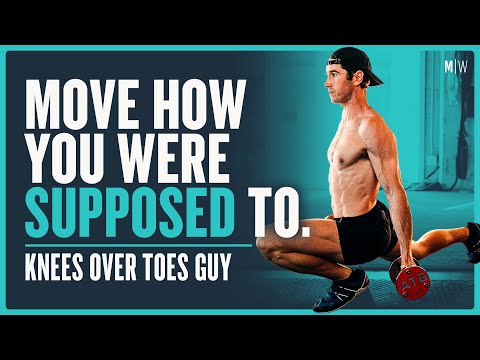
Knees Over Toes Guy - Building A Bulletproof Body
Ben Patrick (guest), Chris Williamson (host)
In this episode of Modern Wisdom, featuring Ben Patrick and Chris Williamson, Knees Over Toes Guy - Building A Bulletproof Body explores strength Through Full Range: Bulletproofing Knees, Backs, and Shoulders Safely Ben Patrick, known as the “Knees Over Toes Guy,” explains his philosophy of building a resilient, long‑lasting body by combining strength and mobility through full ranges of motion, rather than separating rehab, flexibility, and strength work.
Strength Through Full Range: Bulletproofing Knees, Backs, and Shoulders Safely
Ben Patrick, known as the “Knees Over Toes Guy,” explains his philosophy of building a resilient, long‑lasting body by combining strength and mobility through full ranges of motion, rather than separating rehab, flexibility, and strength work.
Drawing from his own history of severe knee injuries and failed conventional rehab, he challenges the long‑held cue of avoiding knees over toes, arguing that properly loaded, pain‑free training into those positions restores joint health and prevents injuries.
He outlines two universal principles: get stronger in reverse of the motion that hurts, and restore/train full, pain‑free range of motion in that area, applying this to knees, shoulders, and the spine.
The conversation also explores mindset, ego, and environment—how being “the odd one out” doing unconventional rehab in the gym can build mental toughness, gratitude, and long‑term adherence to a healthier way of training.
Key Takeaways
Train strength in reverse of the motion that hurts.
For any joint, first identify the movement that causes pain (e. ...
Get the full analysis with uListen AI
Restore and load full range of motion, but only at pain‑free levels.
Instead of avoiding deep positions (knees over toes, deep squats, full overhead or behind‑the‑neck pressing), regress the load or leverage until you can move through the complete range without pain, then progressively strengthen there to nourish joints and reduce injury risk.
Get the full analysis with uListen AI
Combine mobility and strength rather than training them in isolation.
Patrick argues that yoga‑style flexibility without load and powerlifting‑style strength without range both leave you vulnerable; exercises like ass‑to‑grass split squats or full‑ROM push‑ups and chin‑ups simultaneously improve flexibility and active strength, creating more durable joints.
Get the full analysis with uListen AI
Use simple, targeted exercises to bulletproof knees, shoulders, and back.
High‑leverage tools include backward sled drags, ATG split squats, tibialis raises, and Nordic curls for knees; external rotations, lower‑trap raises, and full‑ROM pressing/dips for shoulders; and hip‑flexor‑lengthening ATG split squats plus controlled rounded‑ and straight‑back work for the spine.
Get the full analysis with uListen AI
Rehab can and should feel like real training, not just “therapy.”
Patrick designs sessions that deliver a genuine pump, sweat, and performance benefits while also rehabbing joints, arguing that merging physical therapy with strength work makes adherence easier and transforms rehab from a chore into something people enjoy and stick with.
Get the full analysis with uListen AI
Start conservatively and let pain be your governor, not your goal.
He recommends beginning at the easiest regression, accumulating volume (multiple sets) without pain, and only progressing load or range when discomfort is absent—using sled work as a low‑risk “lube” to build tissue capacity before more demanding movements.
Get the full analysis with uListen AI
Injury can be a catalyst for mental toughness and identity growth.
Both Patrick and Williamson describe how being forced into “boring,” unglamorous rehab, and being the odd one out in the gym, broke their ego attachment to aesthetics or performance, fostered gratitude (e. ...
Get the full analysis with uListen AI
Notable Quotes
“The athlete whose knee can go farthest and strongest over the toes has the least chance of knee injury.”
— Ben Patrick (citing Charles Poliquin)
“Principle number one, get stronger in reverse of the pain… Principle number two, restore and train full range of motion, but at the level that doesn’t hurt you.”
— Ben Patrick
“Avoiding bending your knees, for example, that’s a scientific death wish for your knee because you’re signaling to your body not even to fully use the joint.”
— Ben Patrick
“Rehab can make you sexier… people didn’t realize that physical therapy and exercise don’t have to be two different things.”
— Ben Patrick
“It’s not tremendously enjoyable to not be able to, if you’re doing CrossFit or powerlifting… with the class, with your bros, just doing the thing.”
— Chris Williamson
Questions Answered in This Episode
How can someone with a long history of knee or back pain safely test their current full range of motion without triggering a flare‑up?
Ben Patrick, known as the “Knees Over Toes Guy,” explains his philosophy of building a resilient, long‑lasting body by combining strength and mobility through full ranges of motion, rather than separating rehab, flexibility, and strength work.
Get the full analysis with uListen AI
What specific regressions does Patrick recommend for people who don’t have access to sleds, specialized equipment, or a well‑equipped gym?
Drawing from his own history of severe knee injuries and failed conventional rehab, he challenges the long‑held cue of avoiding knees over toes, arguing that properly loaded, pain‑free training into those positions restores joint health and prevents injuries.
Get the full analysis with uListen AI
How should athletes balance their existing sport‑specific training (e.g., basketball, powerlifting, BJJ) with ATG work without overtraining or compromising performance?
He outlines two universal principles: get stronger in reverse of the motion that hurts, and restore/train full, pain‑free range of motion in that area, applying this to knees, shoulders, and the spine.
Get the full analysis with uListen AI
In what situations—post‑surgery, acute injury, or certain pathologies—would his principles need to be modified or temporarily avoided?
The conversation also explores mindset, ego, and environment—how being “the odd one out” doing unconventional rehab in the gym can build mental toughness, gratitude, and long‑term adherence to a healthier way of training.
Get the full analysis with uListen AI
How can people struggling with ego and identity loss after injury practically shift their mindset toward gratitude and long‑term health, as described in the conversation?
Get the full analysis with uListen AI
Transcript Preview
Principle number one, get stronger and reverse to the pain, 'cause that's usually the simplest and the least painful thing you can do. It's the full range of motion that often scares people. Principle number two, restore and train full range of motion, but at the level that doesn't hurt you. If you have only those two principles and if you then worked at it, you could probably create a cool system for just about any area of the body. (wind blows)
Dude, you are everywhere right now. You're on fire. It's a competition between you and The Liver King for who's got the most exposure on Instagram at the moment. (laughs)
Hey, I- I'm- I'm lucky, man, but not an influencer.
No, not an influencer. I agree. And I don't mean to put you in the- the same bucket as The- The Liver King, although he does do a lot of sled drags, man.
No, I appreciate it. He's- I- I appreciate it. I mean, that guy's reaching a ton of people. I don't think I have as much engagement as him, so I'm honored for the comment, but he's got me beat.
Yeah, yeah. He does do a lot of sled drags.
Very cool.
So talk to me about the first major injury that you had, because a- as far as I'm aware, you had a laundry list of, uh, injuries throughout your athletic career as a youth.
Yeah. Um, around age nine, I had something where my knee would kinda- it would pop out of place and sometimes it wouldn't go back in. And it was probably 20 years before I- like, not quite 20, but almost 20 years later before I realized a lot of people have this. So I've made videos on this now. Probably someone listening to this right now is like, "Oh my gosh, I thought I was the only person whose knee pops it out of place." So starting at nine, I knew my knees were a little bit shaky compared to other people. And by 12, that was really chronic pain. Maybe around 14 is when doctors thought I had the first real, uh, severe injury to it. So 9, 12, 14, those are dates that come to mind. So definitely not like a normal, uh, developing young adult body because my knees were having injuries and pains.
What was the sports that you were pursuing?
Just basketball, which when you go so crazy hard after one pursuit, probably just about every sport is gonna have some kind of overuse injury that if you- that you could just over- overuse, drive yourself into a problem with an area.
What are the most common injuries that basketball players get?
Knees by far.
Okay. Why?
Well, we- we not only run a lot, but you're running and then stopping, running, stopping. And yeah, you have that in football, soccer, but then we're jumping thousands of times. So you're adding- you're adding the running, stopping, cutting, and jumping. So it seems to have the greatest total volume of the stops and the jumps. So in terms of the actual amount, like if a- if a mathematician just analyzed how many pounds of force is going into someone's knees, uh, y- you know, basketball players would be putting the most stress on their knees.
Install uListen to search the full transcript and get AI-powered insights
Get Full TranscriptGet more from every podcast
AI summaries, searchable transcripts, and fact-checking. Free forever.
Add to Chrome