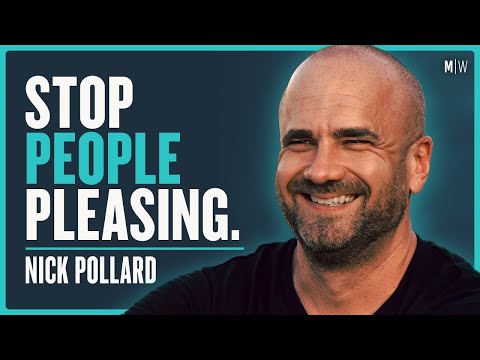
How To Put Yourself First Without Feeling Guilty - Nick Pollard
Chris Williamson (host), Nick Pollard (guest)
In this episode of Modern Wisdom, featuring Chris Williamson and Nick Pollard, How To Put Yourself First Without Feeling Guilty - Nick Pollard explores escaping People-Pleasing: Boundaries, Self-Respect, And Honest Living Chris Williamson and coach Nick Pollard explore people-pleasing as a deeply ingrained coping mechanism rooted in shame and the belief of "not being enough," often formed in childhood through enmeshment and inconsistent parenting.
Escaping People-Pleasing: Boundaries, Self-Respect, And Honest Living
Chris Williamson and coach Nick Pollard explore people-pleasing as a deeply ingrained coping mechanism rooted in shame and the belief of "not being enough," often formed in childhood through enmeshment and inconsistent parenting.
They distinguish genuine kindness from people-pleasing, framing the latter as compulsive optic management and dishonesty—saying yes when you mean no, masking resentment, and sacrificing identity, health, money, and joy.
Pollard lays out practical strategies for change: building a personal "bill of rights," practicing saying no, learning to sit with uncomfortable emotions, reframing guilt, and understanding that boundaries are about your own behavior, not controlling others.
They also discuss gender differences, male shame around pliability, the misuse of concepts like “triggers,” and how high-achieving people-pleasers can radically improve their lives once they begin advocating for themselves.
Key Takeaways
People-pleasing is usually rooted in toxic shame and an 'I am not enough' narrative.
Many people-pleasers grew up in environments with one overly enmeshed caregiver and another distant or abusive one, learning to regulate others’ emotions to avoid abandonment, then unconsciously carrying that strategy into adulthood.
Get the full analysis with uListen AI
People-pleasing is a form of dishonesty, not kindness.
Saying yes when you mean no, overcommitting, or peacekeeping to avoid disapproval are all lies to yourself and others; they erode self-respect, make your yes meaningless, and prevent genuine connection because no one ever meets the real you.
Get the full analysis with uListen AI
You must learn to trust—and use—your no for your yes to matter.
Practices like Pollard’s “seven days of saying no to everything” game help rewire your default from automatic yes to considered choice, building tolerance for discomfort and showing you that saying no doesn’t actually destroy relationships.
Get the full analysis with uListen AI
Boundaries are about your behavior and values, not controlling others.
Effective boundaries sound like, “I don’t tolerate yelling; I’ll step away and return later,” rather than “You must not yell at me”; they’re grounded in a personal bill of rights that makes your needs equal—not superior—to everyone else’s.
Get the full analysis with uListen AI
Play and self-invention are essential for discovering who you are.
Adults who chronically please others often stop playing and experimenting; Pollard argues that through play, trying personas, and exploring interests, you continually invent and refine your identity instead of endlessly searching to 'find yourself.'
Get the full analysis with uListen AI
Advocating for your needs will feel like guilt and abandonment risk—do it anyway.
People-pleasers often confuse normal discomfort with moral guilt and interpret rejection as abandonment; recognizing that feelings aren’t fatal or permanent, and acting courageously despite them, is crucial to building self-trust and self-worth.
Get the full analysis with uListen AI
Stopping people-pleasing initially makes life lonelier—but ultimately freer and richer.
As you set boundaries, some relationships with those who benefited from your compliance will fall away, creating a painful but liberating 'lonely chapter' that opens space for healthier connections and a life aligned with your own values.
Get the full analysis with uListen AI
Notable Quotes
“Most people who have this kind of tendency aren't afraid to say no; they're afraid to not say yes.”
— Nick Pollard
“If I can't trust your no, I can't trust your yes.”
— Joe Hudson (quoted by Chris Williamson)
“When somebody shows you who they are, just believe them.”
— Nick Pollard
“Your no is about as meaningless as your yes, because you never say no.”
— Nick Pollard
“The opposite of people-pleasing isn't being an asshole. They're both on the same line of 'I'm not enough.'”
— Nick Pollard
Questions Answered in This Episode
Where in my life do I say yes when I actually mean no, and what would change if I experimented with a default no for a week?
Chris Williamson and coach Nick Pollard explore people-pleasing as a deeply ingrained coping mechanism rooted in shame and the belief of "not being enough," often formed in childhood through enmeshment and inconsistent parenting.
Get the full analysis with uListen AI
If I wrote a personal bill of rights today, what would be the top five things I am allowed to want, feel, and refuse?
They distinguish genuine kindness from people-pleasing, framing the latter as compulsive optic management and dishonesty—saying yes when you mean no, masking resentment, and sacrificing identity, health, money, and joy.
Get the full analysis with uListen AI
Do I feel genuinely connected to my achievements, or does it often seem like someone else did them on my behalf?
Pollard lays out practical strategies for change: building a personal "bill of rights," practicing saying no, learning to sit with uncomfortable emotions, reframing guilt, and understanding that boundaries are about your own behavior, not controlling others.
Get the full analysis with uListen AI
How much of my generosity is driven by love versus a need for validation and fear of abandonment?
They also discuss gender differences, male shame around pliability, the misuse of concepts like “triggers,” and how high-achieving people-pleasers can radically improve their lives once they begin advocating for themselves.
Get the full analysis with uListen AI
Which relationships in my life depend on me having weak boundaries, and what might happen if I began to enforce even one clear boundary in those dynamics?
Get the full analysis with uListen AI
Transcript Preview
Why is people-pleasing such a trap for so many of us?
(sighs) I ... Uh, it's a ... There's a, a long answer and a short answer. I think the, the short answer to that is that we have created an environment through social media, really, you know, predominantly that everybody's now seeking to measure up to somebody else, rather than, you know, focused on this internal locus of control where you can y- you can really be vibrant on your own. Um, but the way that we function now as a society is, has changed that, um, and everybody's comparing themselves to people that, uh, you know, are, are insurmountable. And I find myself doing this too, so you know, I worship at the altars of, you know, Alex Hormozi and, you know, James Smith, and all these guys that I see have, you know, millions of followers and make millions of dollars, and they're exciting, and they're fun, and I'm like, "How do I get to that?" Right? Rather than recognizing in myself, like, I can just be happy with where I am. It doesn't ... It's ... Uh, I have a really great friend, um, who said this to me that really resonated with people-pleasing, which, "You don't have to hate where you are to wanna be better." And when I heard that I was like, "That makes so much sense." And I think we've kind of taught people that you have to, like, almost hate the way that you show up in the world in order to wanna better that. And I just... And I think that causes this idea of, "How do I measure up?" And then, "How do I make everyone else around me happy?" Because that's, that's really what the world is, you know, kinda built on these days.
Yeah. Draw the line for me between that sense that we, that we measure up, but, you know, people-pleasing isn't about us. It's about optic management. It's about how other people see us. It's about prioritizing their needs over ours.
Sure.
What ... Y- why is that important? What, what's that got to do with it?
So I think it's, um ... For me, when it was a, you know, when it was more of a problem, and I, I, I would say that I'm a recovering people-pleaser. It's funny, those things... It's one of those things that I don't think ever really goes away. Um, I think you just kinda battle it. But, um, mostly it's the, an overwhelming sense that you're not enough. And when you're functioning from that place, there's no way you can ever really measure up, and i- and there's ways that you can tune that to make it better, right? So if you have something like that, so if you s- you know, have that kind of inferiority complex plus a superiority complex plus, you know, uh, impulse control is a great example, you can do great things, but ... (laughs) But if you just have this idea that, "I'm not enough," and that's sort of the main track in the background, then you're always trying to measure up to something that doesn't actually exist. So, and, and so often this comes from, you know ... It's kind of a pivot point where you have, like, one parent that was super involved in your life and then one parent that wasn't. Maybe they were abusive. Very similar to the, kind of the nice guy narrative, where you, you show up trying to gain acceptance and love, because, uh, the only, and the only way you know how to do that is to either not show up, like to be completely invisible, um, or to make everyone else happy, right, or to keep everyone else calm, or to constantly be in a peace- peacekeeping, you know, frame of mind, and I think that's where people get really hung up.
Install uListen to search the full transcript and get AI-powered insights
Get Full TranscriptGet more from every podcast
AI summaries, searchable transcripts, and fact-checking. Free forever.
Add to Chrome