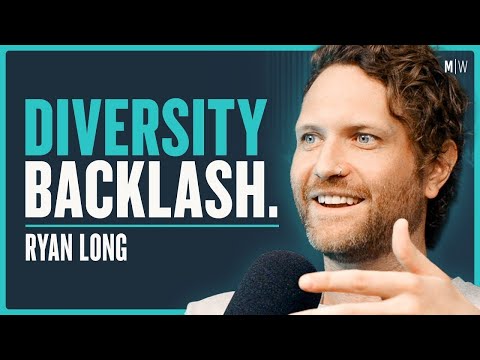
DEI Wars, Trump’s Bible & The Masculinity Vote - Ryan Long
Ryan Long (guest), Chris Williamson (host), Narrator, Narrator
In this episode of Modern Wisdom, featuring Ryan Long and Chris Williamson, DEI Wars, Trump’s Bible & The Masculinity Vote - Ryan Long explores creativity, Culture Wars, And Election Chaos With Comedian Ryan Long Chris Williamson and comedian Ryan Long dig into the psychology of creativity, type‑A overwork, and how modern content rewards volume over original ideas. They explore how culture, politics, and media have shifted from genuine risk-taking to ‘following from the front,’ with brands, pundits, and politicians frantically chasing trends they didn’t create. The conversation ranges from DEI rollback and corporate “how gay is enough?” branding, to Bud Light, Pride, Trump’s Bible, AI deepfakes, and the current U.S. election circus. Throughout, Long uses comedy frameworks—crowdwork, edge cases, the ‘fun side’ of politics—to explain how audiences, algorithms, and outrage are being systematically gamed.
Creativity, Culture Wars, And Election Chaos With Comedian Ryan Long
Chris Williamson and comedian Ryan Long dig into the psychology of creativity, type‑A overwork, and how modern content rewards volume over original ideas. They explore how culture, politics, and media have shifted from genuine risk-taking to ‘following from the front,’ with brands, pundits, and politicians frantically chasing trends they didn’t create. The conversation ranges from DEI rollback and corporate “how gay is enough?” branding, to Bud Light, Pride, Trump’s Bible, AI deepfakes, and the current U.S. election circus. Throughout, Long uses comedy frameworks—crowdwork, edge cases, the ‘fun side’ of politics—to explain how audiences, algorithms, and outrage are being systematically gamed.
Key Takeaways
Hard work doesn’t solve creative problems once effort is already maxed out.
Type‑A people often try to brute-force their way through everything, but high-level creative insight comes from new connections and inputs, not just more hours; sometimes you need rest, boredom, and different stimuli rather than more grind.
Get the full analysis with uListen AI
Many high-achievers actually need “parasympathetic Goggins” advice: rest harder.
Motivational culture is optimized for lazy or underperforming people, but insecure overachievers often need the opposite message—permission and a rational reason to slow down so their creativity and mental health don’t collapse.
Get the full analysis with uListen AI
Today’s content economy over-rewards volume, under-rewards originality.
Platforms and audiences increasingly favor people who can pump out ‘pretty good’ ideas every day over creators who craft a few exceptional ideas per year, which pushes many toward derivative, borrowed, or low-effort work just to stay visible.
Get the full analysis with uListen AI
Brands and activists are often ‘following from the front’ instead of leading.
Companies and media figures frequently jump to the head of a movement once it’s safe and socially validated—like Pride branding in already-tolerant countries—then perform leadership without having taken any real risks or driven the culture there.
Get the full analysis with uListen AI
Algorithms both predict and shape your preferences, not just reflect them.
Recommendation systems don’t merely show you what you like; they also nudge you toward content that makes you easier to predict, which can polarize politics, normalize fringe fetishes, and gradually train you into narrower, more extreme tastes.
Get the full analysis with uListen AI
Political discourse is dominated by edge cases, not everyday reality.
Many left–right battles center on rare extremes—late-term abortion horrors vs. ...
Get the full analysis with uListen AI
In social dynamics, men’s ‘friend zone’ equivalent is the ‘grandmother treatment.’
Where women desexualize men by making them ‘just friends,’ men desexualize certain women (e. ...
Get the full analysis with uListen AI
Notable Quotes
“We need a parasympathetic Goggins — a #RestHarderThanMe.”
— Chris Williamson
“Companies are having a really hard time finding the perfect amount of gay to be.”
— Ryan Long
“Most arguments in politics right now are just who has the more egregious edge case.”
— Ryan Long
“The world really is rewarding the pace people can pump stuff out at, not the quality of a few great ideas.”
— Chris Williamson
“In politics you can either be the funner side or the more righteous side — you can’t be both.”
— Ryan Long
Questions Answered in This Episode
How can an overworked type‑A person practically ‘build in’ rest without feeling lazy or guilty?
Chris Williamson and comedian Ryan Long dig into the psychology of creativity, type‑A overwork, and how modern content rewards volume over original ideas. ...
Get the full analysis with uListen AI
What would a healthier content ecosystem look like if it truly rewarded originality over volume?
Get the full analysis with uListen AI
In what ways are you seeing brands or influencers ‘follow from the front’ in your own feeds?
Get the full analysis with uListen AI
How can individuals counteract algorithmic nudging so their preferences stay genuinely their own?
Get the full analysis with uListen AI
Are we past ‘peak woke,’ or will a new form of moral righteousness simply emerge under a different banner?
Get the full analysis with uListen AI
Transcript Preview
Oh, you know what else, Chris?
Yes.
Um, I've- I probably would never do this on a podcast, but I made a couple notes of things I'm gonna say.
Oh, yeah.
Because... Well, because, uh, you know, you're probably one of the most people that... You kind of remind me of, you know, some of my, like, closest friends in Homeward. It's always, like, trying to get to the bottom of something. You know what I mean? So I felt like I have a good, couple of good theories that-
Oh, I fucking love this. You came prepared.
Yeah, also... Well, I've- we've talked about this already, but I said your stuff that you post a lot of times feels very much directed for me, like I'm the exa- like, you know, I'm the one target audience.
Being seen.
Yeah.
What was the- What was one of the ones that that's happened with?
Probably the most ever is 'cause the idea that, you know, hard work, you can't always just like hard work your way out of a problem. And I think, you know, you become so accustomed to, "This is how I, you know, excel over people." And then you're like, "Well, everyone's talented at a certain level," and then also, "These problems aren't that." And then on top of that, adding creativity into that is, like, even worse, right? Because in some- s- sometimes stand up, it's like... It, it almost feels silly when I'm just like, what might be the work is like, you need to just like sit there and think (laughs) . You know?
Yep.
(laughs)
Stare at the ceiling for a while.
Yeah, and you're like, "This is crazy, right?"
Yep. Yeah.
Yeah, so... But you have to, and then you're like, "Well, how do you... Like, how do you rationalize all those things of like, I'm trying to work hard, but at the same time, this isn't a problem that just requires more work?"
I think creativity's one of these really unique domains that sits outside of like... There's very few problems in life that working harder won't make a bit better somehow.
Yeah.
But one of them-
But you've usually... A lot of times you've maxed that out, I guess.
Yeah, you're already foot to the floor, going as hard as you can.
Yeah, that's not the issue. You're not, like, lazy, right?
Yeah. So I- I've, uh, been trying to write this for ages, and I'll see if this makes sense to you. So I've been thinking about, you know type A people and type B people?
Yeah.
So people that are sort of insecure overachievers that work too hard, and then the sort of lazy people that need to get off the couch. I've been really trying to sort of work this out. So, uh, type A problems, type B problems. I think type A people have a type B problem, and type B people have a type A problem. Insecure overachievers need to learn how to chill out and relax, and lazy people need to learn how to work harder and be disciplined. Given that you subscribe to me, I'm gonna guess you're a type A person, a kind of walking anxiety disorder harnessed for productivity, as Andrew Wilkinson says. Type A people get no sympathy, because a miserable but outwardly successful person always appears to be in a much more preferential position than a type B person being lazy but on the verge of bankruptcy. Goggins and Hormozi style advice reliably makes everyone more successful in the only way that you can get judged, outwardly, but there aren't many issues in life which can't be solved by just working harder a little bit, so everyone just smashes it with a hammer. But for a certain, perhaps minority cohort of people, they actually need to hear the opposite. We need like a, a parasympathetic Goggins, a like, #RestHarderThanMe, and that's the creativity piece.
Install uListen to search the full transcript and get AI-powered insights
Get Full TranscriptGet more from every podcast
AI summaries, searchable transcripts, and fact-checking. Free forever.
Add to Chrome