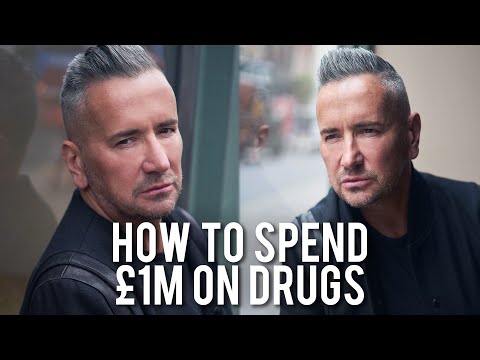
Fat Tony | How To Spend £1,000,000 On Drugs | Modern Wisdom Podcast 166
Fat Tony (guest), Chris Williamson (host)
In this episode of Modern Wisdom, featuring Fat Tony and Chris Williamson, Fat Tony | How To Spend £1,000,000 On Drugs | Modern Wisdom Podcast 166 explores from Superclub Stardom To Sobriety: Fat Tony’s Wild Redemption Journey DJ Fat Tony recounts his rise from a troubled, abused childhood and teen club kid to becoming a central figure in London’s exploding house and fashion scenes, touring the world and earning huge money as a superstar DJ.
From Superclub Stardom To Sobriety: Fat Tony’s Wild Redemption Journey
DJ Fat Tony recounts his rise from a troubled, abused childhood and teen club kid to becoming a central figure in London’s exploding house and fashion scenes, touring the world and earning huge money as a superstar DJ.
Alongside the success came decades of escalating drug and alcohol addiction—cocaine, pills, crack, crystal meth—blurring work and partying into psychosis, financial ruin, and near-death experiences.
He describes the mindset traps of ego, people-pleasing, imposter syndrome, and being ‘the party’, and how the industry’s enablers and constant travel fuel self-destruction for many artists.
After a breaking point and six months in rehab, he’s now 13+ years sober, rebuilding a career on his own terms, emphasizing boundaries, happiness, music as a ‘pure drug’, and using his story to warn and guide others in nightlife.
Key Takeaways
Success without inner stability magnifies existing wounds, it doesn’t heal them.
Tony’s childhood abuse, shame, and imposter syndrome were never resolved; when fame, money, and attention arrived at 17–18, drugs and ego became coping tools that amplified, rather than fixed, his underlying pain.
Get the full analysis with uListen
In nightlife, saying ‘no’ is a crucial professional survival skill.
He describes learning the power of declining gigs—without justification—to protect his mental health, avoid resentment and anxiety, and maintain a sense of specialness rather than becoming ‘furniture’ as a weekly resident.
Get the full analysis with uListen
Addiction often feels ‘functional’ for years before the visible collapse.
Tony partied and worked seven nights a week for over a decade believing drugs weren’t a problem; only later did use slide into full-blown abuse, nonstop binges, psychosis, and suicidal thinking, showing how denial prolongs danger.
Get the full analysis with uListen
The industry rewards self-destruction while quietly depending on it.
He points out how managers, promoters, and hangers-on enable artists’ addictions because a high, compliant star is easy to exploit and control—illustrated by stories about Avicii and his own experience being pushed onto planes and into gigs.
Get the full analysis with uListen
You are not ‘the party’—you are there to facilitate it.
For both DJs and promoters, Tony stresses that identifying as the event itself is a trap: your job is to serve the music and crowd; once you believe you are the centre, ego, excess, and burnout follow.
Get the full analysis with uListen
Recovery requires a full identity shift, not a temporary pause.
He explains that ‘taking a year off’ never would have worked; with addiction, relapse returns you straight to your previous consumption level, often fatal, so he had to build a completely new life and mindset through rehab and NA.
Get the full analysis with uListen
Music is a powerful, healthy ‘drug’ that can replace chemical highs.
Sober, Tony leans into music’s ability to transport, evoke memories, and connect him to lost people and places; emotional sets often leave him in tears, showing that intense experiences don’t require substances.
Get the full analysis with uListen
Notable Quotes
“Music is the best and biggest drug I’ve ever taken.”
— Fat Tony
“I used and abused drugs for 28 years and there was never a point where I wasn’t on drugs.”
— Fat Tony
“I’m not the party. I’m there to facilitate the party.”
— Fat Tony
“My life was shit, but it was my shit.”
— Fat Tony
“Happiness is knowing that what I’ve got right now is enough.”
— Fat Tony
Questions Answered in This Episode
How can young DJs and promoters practically set boundaries so they don’t become ‘the party’ or burn out like Tony did?
DJ Fat Tony recounts his rise from a troubled, abused childhood and teen club kid to becoming a central figure in London’s exploding house and fashion scenes, touring the world and earning huge money as a superstar DJ.
Get the full analysis with uListen AI
What warning signs distinguish heavy but ‘normal’ partying from the point where use is clearly becoming abuse?
Alongside the success came decades of escalating drug and alcohol addiction—cocaine, pills, crack, crystal meth—blurring work and partying into psychosis, financial ruin, and near-death experiences.
Get the full analysis with uListen AI
How should managers, agents, and friends intervene when an artist’s success seems increasingly tied to self-destructive habits?
He describes the mindset traps of ego, people-pleasing, imposter syndrome, and being ‘the party’, and how the industry’s enablers and constant travel fuel self-destruction for many artists.
Get the full analysis with uListen AI
In what specific ways can nightlife culture evolve to protect mental health and reduce the romanticizing of excess?
After a breaking point and six months in rehab, he’s now 13+ years sober, rebuilding a career on his own terms, emphasizing boundaries, happiness, music as a ‘pure drug’, and using his story to warn and guide others in nightlife.
Get the full analysis with uListen AI
How has Tony’s relationship with music, crowds, and performance changed emotionally since becoming sober compared to during his using years?
Get the full analysis with uListen AI
Transcript Preview
"What was Freddie Mercury like in bed?" And I was like, "I don't know. There were seven other people there."
(laughs)
Simple. I remember on my 27th birthday, I remember saying to my mum, "I don't want to live beyond 27," and my mum was like, "Why?" and I was just like, "I just thought t- 27 was like kind of the end of the road type thing." And my mum was like, "Don't be so stupid."
(laughs)
"27 is but one of the best years of your life." So, marzipan, diazepam, Rohypnol, they were kind of like the pegging parts of the cocaine. So I would take cocaine, I would take downers to suppress the cocaine. I would drink alcohol to level the cocaine, and then I would take more. And then, of course, I discovered freebasing and crack, and then I discovered crystal meth. When I finally went to see, I would sleep in the recovery position 'cause I was that scared that I was gonna choke on my own vomit every night. Music is the best and biggest drug I've ever taken. It has the ability to transport you to anywhere in the world and, and, and to be with people that you're no longer w- are no longer with us.
(wind blowing) DJ Fat Tony in the building. How are you, man?
I'm, I'm okay. I'm good. I've, uh, I've been... Yeah, I'm actually all right today. I've been ill, uh, for the last few weeks, but I'm okay. I'm good now.
You had the 'rona?
Yeah, I did. Yeah. It kind of... I kind of was like... I went through a whole week of thinking, "Oh, this is all right. I can do this." Uh, it was kind of a mild flu, bad chest, uh, but I was wise enough to ask my... Well, my doctor decided he wanted to put me on steroids for my chest 'cause I have a bad chest anyway. Uh, so thankfully, I took the steroids. Uh, I... On the... Then it went away on the Thursday, and I thought, "Yeah, it's all really good." Friday night, boom. Temperature 40, 40, in the 40s for four days and four nights. The worst fever. Uh, it went into my chest. I was breathless. It was awful. Yeah, it was really awful.
That's harsh. That's harsh, but feeling good now? Feeling-
Yeah, I'm okay. I'm just taking it easy. Do you get what I mean? I'm in no rush to go anywhere, so it's not a problem. But yeah, thank God I had it mild. Yeah.
Yeah, I guess so. Uh, so my, my first question is, why, why are you called Fat Tony when you're not fat?
Oh, that old tired old question. Uh, I... When I was a kid, I was a fat kid. I got fat about the age of 14 to 16. Uh, kind of, it was a coping mechanism for what I was going through. Uh, so I, I kind of, you know, put on loads of weight as if it's, you know, as a barrier between other people and me because I, I kind of went through s-... A lot of, uh, there was sexual abuse at an earlier age. So I kind of just got fat as a protection. So, you know, it was one of those names that people called, kind of whispered behind your back, so I just kept it.
Install uListen to search the full transcript and get AI-powered insights
Get Full TranscriptGet more from every podcast
AI summaries, searchable transcripts, and fact-checking. Free forever.
Add to Chrome