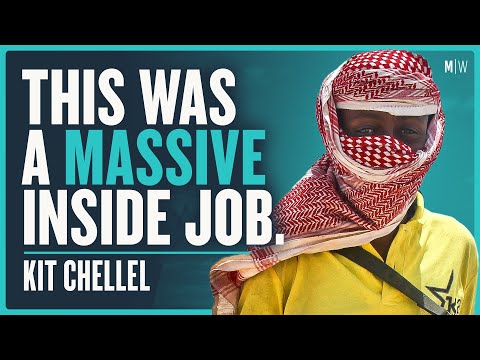
The Wild Hijacking Of A $100m Supertanker - Kit Chellel
Kit Chellel (guest), Chris Williamson (host)
In this episode of Modern Wisdom, featuring Kit Chellel and Chris Williamson, The Wild Hijacking Of A $100m Supertanker - Kit Chellel explores insurance Fraud, Piracy, And Murder: Inside A $100M Tanker Plot Journalist Kit Chellel recounts the bizarre 2011 ‘pirate attack’ on the oil tanker Brillante Virtuoso, carrying $100m of crude, which quickly appeared nothing like conventional Somali piracy. The ship was mysteriously set on fire, the crew escaped, the supposed pirates vanished, and the first marine surveyor on scene, Briton Captain David Mockett, was later assassinated by a car bomb in Yemen.
Insurance Fraud, Piracy, And Murder: Inside A $100M Tanker Plot
Journalist Kit Chellel recounts the bizarre 2011 ‘pirate attack’ on the oil tanker Brillante Virtuoso, carrying $100m of crude, which quickly appeared nothing like conventional Somali piracy. The ship was mysteriously set on fire, the crew escaped, the supposed pirates vanished, and the first marine surveyor on scene, Briton Captain David Mockett, was later assassinated by a car bomb in Yemen.
As insurers probed a nine-figure claim, two ex-Met detectives uncovered a web of insurance fraud involving the Greek shipowner “Super Mario,” a dubious local salvage boss, and Yemeni coastguard members masquerading as pirates. A London High Court judge ultimately ruled the incident was a staged attack to destroy an aging, loss-making ship and trigger insurance payouts.
Despite this, no one has been criminally charged for the murder or the fraud, the shipowner walked away debt-free, and insurers effectively fought each other over who would cover the loss. The story exposes how opaque, under-policed global shipping and a complacent insurance market create fertile ground for high-stakes crime with little accountability.
Key Takeaways
International waters remain effectively under-policed, enabling serious maritime crime.
Beyond about 10 miles offshore, practical law enforcement breaks down; overlapping jurisdictions, flags of convenience, and resource constraints make it difficult to investigate assaults, murders, and fraud at sea.
Get the full analysis with uListen AI
The Brillante Virtuoso incident was crafted to mimic Somali piracy but didn’t fit the pattern.
The ‘pirates’ arrived claiming to be security, left quickly, set a fire instead of taking hostages or demanding ransom, and caused damage inconsistent with RPG or AK-47 use—early red flags that it was not a standard hijacking.
Get the full analysis with uListen AI
Shipping insurance structures create strong incentives for fraudulent ship losses.
An old, loss-making tanker insured for far more than its resale value can be worth more destroyed than alive, especially when owners can also claim loss of future earnings and interest, driving claims well above the ship’s real market value.
Get the full analysis with uListen AI
Lloyd’s of London often finds it easier to pay questionable claims than to fight.
Because fraud is seen as “priced in,” the market typically settles rather than endure costly litigation and reputational risk—only the unusually large size of this claim forced a deeper investigation.
Get the full analysis with uListen AI
Independent experts and investigators face real danger when they threaten powerful interests.
Captain Mockett was killed by a targeted car bomb after flagging irregularities, and the ex-Met investigators later had to push against institutional reluctance just to treat the case as serious criminality instead of a routine insurance dispute.
Get the full analysis with uListen AI
Legal outcomes can expose the truth without delivering justice.
A UK High Court judge found that Yemeni coastguards, arranged by the Greek owner and local salvors, deliberately burned the ship in an insurance fraud—but no one has been prosecuted for the murder or the fraud, and the owner shed tens of millions in debt.
Get the full analysis with uListen AI
Complex global ownership structures obscure accountability in shipping.
Ships registered under flags of convenience, owned by shell companies in offshore jurisdictions, and insured via layered policies make it difficult even for insurers to identify true beneficial owners, let alone hold them criminally responsible.
Get the full analysis with uListen AI
Notable Quotes
“Out at sea, if a crewman gets thrown over the side and his fellow sailors are threatened into silence, who’s going to prosecute that crime?”
— Kit Chellel
“One unfortunate accident off the coast of Yemen is bad luck, two is probably something else.”
— Kit Chellel
“Fraud and criminality has kind of been built in to the cost structure of the Lloyd’s of London insurance market.”
— Kit Chellel
“He started with an aging, rusting, useless, money‑losing oil tanker. He burned his own ship, his debt went to zero, and he was freed of the ship.”
— Kit Chellel
“This isn’t just an insurance contract, this isn’t just a dollar dispute. A guy was murdered here, a really good man was murdered, and we need to do something about it.”
— Kit Chellel (describing the investigators’ stance)
Questions Answered in This Episode
How common are deliberate ship scuttlings and staged ‘pirate attacks’ in modern shipping, and how much loss do they create for the insurance market each year?
Journalist Kit Chellel recounts the bizarre 2011 ‘pirate attack’ on the oil tanker Brillante Virtuoso, carrying $100m of crude, which quickly appeared nothing like conventional Somali piracy. ...
Get the full analysis with uListen AI
What structural reforms—legal, regulatory, or technological—could realistically reduce lawlessness and impunity on the high seas?
As insurers probed a nine-figure claim, two ex-Met detectives uncovered a web of insurance fraud involving the Greek shipowner “Super Mario,” a dubious local salvage boss, and Yemeni coastguard members masquerading as pirates. ...
Get the full analysis with uListen AI
Why are powerful markets like Lloyd’s willing to normalize and price in fraud rather than confront it, and what would force a change in that culture?
Despite this, no one has been criminally charged for the murder or the fraud, the shipowner walked away debt-free, and insurers effectively fought each other over who would cover the loss. ...
Get the full analysis with uListen AI
How could international cooperation be improved so that murders like Captain Mockett’s can be investigated and prosecuted even when they occur in unstable states?
Get the full analysis with uListen AI
What responsibilities do consumers, investors, and governments have, given that 90% of global goods move through an industry where such opaque and dangerous practices can occur?
Get the full analysis with uListen AI
Transcript Preview
From the point of view of the sailors who were locked in the TV room in the middle of the night, it's a terrifying situation. They have no idea what's happening. They hear the engines start up, which is not a good sign because they all know what happens if this ship makes it to Somalia. And then they hear gunshots. And even worse than that, they hear, uh, uh, an explosion coming from deep within the ship and smoke starts pouring in through the grilles. They recognize that this is about the worst situation they could be in. They're sitting on top of a million barrels of, uh, explosive liquid and the ship's clearly on fire. (fire blazing)
I can't believe that modern day piracy is still a thing.
Mm. Yeah, I, you know, I didn't really know much about it before I started down the road of doing this book. Um, I just assumed that shipping was like everything else, you know. The economy modernizes, the world gets bigger and more corporatized, and, you know, generally safer. But, you know, that just didn't, uh, it hasn't happened yet with shipping. It's still, in some ways, uh, the same as it was back in the days when, you know, pirates were roaming the Caribbean. It's still kind of lawless around the edges. Um, it's still dominated by, like, very secretive wealthy people, and it still does its business completely outside of the general public and law enforcement. And we just don't know what goes on out there, but it turns out there's a lot of crime happening, uh, which is kind of the subject of the book.
Isn't it that 90% of the things that you see, 90%, pretty much everything has arrived by ship?
Yeah, that's right, Chris. It's, um, the famous expression is 90% of everything. And, you know, that go, that runs from your iPhone, your smartphone, your computer, through to a Barbie doll you bought for your daughter, um, through to, you know, some fresh fruits that's come in. It's all come by boat. It still works that way. And, you know, we're still, we're actually more reliant on ships than we have ever been in human history. It's, um, it's so important.
It's interesting, like, I, I, I don't understand how such a fundamental industry... Remembering what happened with the Ever Given, when that blocked-
Yeah.
... the Suez Canal and all hell broke loose for a couple of weeks, I don't understand how it's still such a cowboy industry. Is there something about, uh, uh, uh, is there something very particular about this industry that's causing it to have loopholes that people can take advantage of?
Yeah, there's a, there's a few things happening at once, really. I mean, the main one is, is the same story that it's always been, which is that governments and police forces and federal agencies, they only reach about 10 miles out off the shore of whatever country you're in. And out, you know, once you go past that point, there is no law. Uh, quite literally that's the case. You, you know, and so-
Install uListen to search the full transcript and get AI-powered insights
Get Full TranscriptGet more from every podcast
AI summaries, searchable transcripts, and fact-checking. Free forever.
Add to Chrome