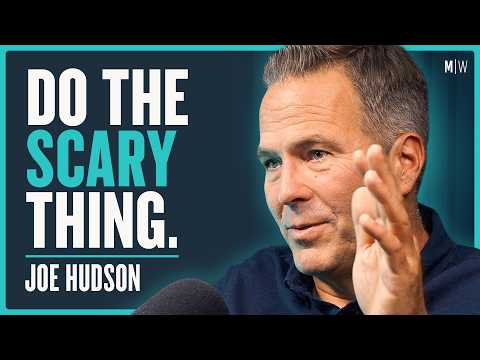
How To Let Go Of All That Heaviness - Joe Hudson
Chris Williamson (host), Joe Hudson (guest)
In this episode of Modern Wisdom, featuring Chris Williamson and Joe Hudson, How To Let Go Of All That Heaviness - Joe Hudson explores joe Hudson Explains How To Drop Self-Attack And Open Your Heart Joe Hudson and Chris Williamson explore why modern life feels so heavy, arguing that chronic stress comes less from phones and politics and more from repressed emotions, lack of connection, and harsh inner criticism.
Joe Hudson Explains How To Drop Self-Attack And Open Your Heart
Joe Hudson and Chris Williamson explore why modern life feels so heavy, arguing that chronic stress comes less from phones and politics and more from repressed emotions, lack of connection, and harsh inner criticism.
Hudson proposes shifting from self‑improvement to self‑understanding, learning emotional clarity instead of emotional control, and prioritizing genuine connection over productivity and people‑pleasing.
They unpack patterns like over‑self‑reliance, passive aggression, defensiveness, and resentment, tracing them back to childhood conditioning and unprocessed feelings.
Throughout, Hudson offers a practice of “heart opening” via vulnerability, empathy, impartiality, and wonder, suggesting that real confidence and peace come from liking and understanding yourself, not from achievement or perfection.
Key Takeaways
Your stress is more about your inner world than your circumstances.
Phones, politics, and workload add friction, but Hudson argues the core stressors are repressed emotions, disconnection, and an attacking internal voice. ...
Get the full analysis with uListen AI
Replace self-improvement with self-understanding.
“I must be better” is often just internalized abuse; it creates shame and resistance. ...
Get the full analysis with uListen AI
Emotional control backfires; aim for emotional clarity instead.
Trying to suppress or “manage” emotions tightens your system and creates stress. ...
Get the full analysis with uListen AI
Over-self-reliance usually masks a deep fear of abandonment.
The “I’m alone in this, I can’t depend on anyone” stance often comes from early experiences of feeling unsupported. ...
Get the full analysis with uListen AI
Defensiveness and shame are clues, not enemies.
If you get defensive, it’s usually because what was said rhymes with your own inner criticism. ...
Get the full analysis with uListen AI
Resentment grows wherever truths go unsaid.
Not stating your needs and boundaries to avoid conflict just guarantees long-term bitterness. ...
Get the full analysis with uListen AI
True confidence and peace aren’t performance-based.
Tying your worth to perfection or output keeps you perpetually anxious and exhausted. ...
Get the full analysis with uListen AI
Notable Quotes
“We have an epidemic of stress and lack of enjoyment, and it’s corrosive both individually and societally.”
— Joe Hudson
“I flip from self‑improvement to self‑understanding. Somehow with ourselves it’s always, ‘You gotta be better’ instead of ‘How do I understand myself?’”
— Joe Hudson
“Every time you allow your heart to break, it increases your capacity to love.”
— Joe Hudson
“If you’re not being yourself, you create a world that isn’t for you—and then you rail against the fact that it doesn’t fit.”
— Joe Hudson
“People don’t actually want you to be perfect. What they want is to feel connected to you.”
— Joe Hudson
Questions Answered in This Episode
Where in my life am I using self-attack or shame as ‘motivation,’ and what might change if I replaced that with curiosity and self-understanding?
Joe Hudson and Chris Williamson explore why modern life feels so heavy, arguing that chronic stress comes less from phones and politics and more from repressed emotions, lack of connection, and harsh inner criticism.
Get the full analysis with uListen AI
What important, scary truth am I currently not saying—to my partner, friends, family, or team—and what am I afraid would happen if I did?
Hudson proposes shifting from self‑improvement to self‑understanding, learning emotional clarity instead of emotional control, and prioritizing genuine connection over productivity and people‑pleasing.
Get the full analysis with uListen AI
In what ways am I over‑self‑reliant, and what core fear (abandonment, rejection, loss of control) is that strategy protecting me from feeling?
They unpack patterns like over‑self‑reliance, passive aggression, defensiveness, and resentment, tracing them back to childhood conditioning and unprocessed feelings.
Get the full analysis with uListen AI
Which emotions do I habitually try to manage or suppress, and how might my life look different if I practiced full emotional clarity instead?
Throughout, Hudson offers a practice of “heart opening” via vulnerability, empathy, impartiality, and wonder, suggesting that real confidence and peace come from liking and understanding yourself, not from achievement or perfection.
Get the full analysis with uListen AI
How could I begin to live more from Hudson’s VIEW framework (vulnerability, impartiality, empathy, wonder) in one key relationship this week?
Get the full analysis with uListen AI
Transcript Preview
I love everything that you do. I can't believe, I genuinely can't believe it took me as long as it did to find your work. It's Charlie Hooper from Charisma on Command that said you'd been a gateway drug for him-
(laughs)
... to a bunch of other stuff. And, um, I get the sense you're kind of an underground hero in sort of the self-work world, who's now becoming, uh, increasingly less underground, um-
Yeah, because of you. (laughs)
(laughs) Yeah, and OpenAI. You're now the head of what at OpenAI?
Uh, no, not head. Um, I just, I'm working there maybe, like, 25 days this year. But I'm, um, working with the compute and research teams.
Mm-hmm.
So basically the management of the, of the folks who are creating the technology.
Yeah.
It's, uh, it's great work. The, the, the cool thing is that when I think about generally, like, the creation of technology or the creation of art or the creation of this podcast, it's a reflection of the consciousness of the people who are creating it. And so to be able to be in there and work about, with consciousness and how the culture's consciousness is and how the people interact with each other and how they view themselves to me is, uh, uh, a complete honor to be able to work there with them.
Because you're further up than all of the things that are going to come after that, all of the products-
Right.
... the branding, the way that they deploy this stuff.
Yeah.
Yeah, that's interesting.
That's true. Yeah, and, and they're just sweethearts. I can't tell you, once that news came out, so many people came to me and, you know, with a lot of fear. There's a lot of fear in the AI space, and, and I understand why people have the fear, uh, not the, both the people on the outside and the inside, like, "Oh, th- this is a revolutionary technology. What's gonna happen? We don't actually know." So-
Yeah.
... fear arises. And, and I think what surprised me about it is just, like, especially OpenAI, just the folks are just sweeties. Like, they're just, like, such lovely humans.
Mm.
Yeah.
What drives you? What are you trying to achieve with your work?
Oh, yeah. So, so what I would say is that generally what we, we have this epidemic of stress and lack of enjoyment in, in our society right now. And, and the thing about that is that it's corrosive both on an individual and on a societal level. So individually, it means that we do not learn as well. It means that we make bad decisions. It means that we, um, don't get the world that we want. It means that we're uncomfortably living. It means we die faster, all those things because we're stressed and we're not enjoying life. But on a society level, if I'm stressed, I mean, the world's a threat. That's why we stress as mammals, right? So, "Oh my gosh, the world is a threat." And if I acts, act like the world is a threat, then eventually, if I'm like, "You're a threat, you're a threat, you're a threat," eventually you're gonna be a threat to me. I mean, if I treat you like an asshole, you're gonna act like an asshole eventually. If I treat you like a threat, you're gonna act like a threat eventually.
Install uListen to search the full transcript and get AI-powered insights
Get Full TranscriptGet more from every podcast
AI summaries, searchable transcripts, and fact-checking. Free forever.
Add to Chrome