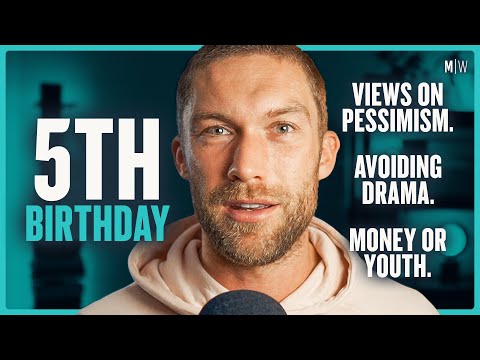
14 Lessons from 5 Years Of Modern Wisdom
Chris Williamson (host)
In this episode of Modern Wisdom, featuring Chris Williamson, 14 Lessons from 5 Years Of Modern Wisdom explores five Years, Fourteen Lessons: Success, Meaning, And Being Enough Chris Williamson reflects on five years of hosting Modern Wisdom, distilling 14 key lessons about language, success, cynicism, status, time, and self-worth. He explores how a richer vocabulary deepens experience, why many high performers are driven by insufficiency, and how cynicism functions as a protective but toxic worldview. He contrasts grind versus ease, work versus drama, money versus time, and ultimate versus proximate evolutionary motives. Throughout, he urges listeners to reclaim agency, lower the bar for presence, and recognize how far they already are from the "norm" by simply choosing to grow.
Five Years, Fourteen Lessons: Success, Meaning, And Being Enough
Chris Williamson reflects on five years of hosting Modern Wisdom, distilling 14 key lessons about language, success, cynicism, status, time, and self-worth. He explores how a richer vocabulary deepens experience, why many high performers are driven by insufficiency, and how cynicism functions as a protective but toxic worldview. He contrasts grind versus ease, work versus drama, money versus time, and ultimate versus proximate evolutionary motives. Throughout, he urges listeners to reclaim agency, lower the bar for presence, and recognize how far they already are from the "norm" by simply choosing to grow.
Key Takeaways
Expand your vocabulary to expand your world.
Having more precise and varied words lets you turn vague mental ‘smells’ into concrete thoughts, improving both self-understanding and communication; working on spoken language in particular increases your capacity to experience life with more depth.
Get the full analysis with uListen AI
Interrogate whether your ambition is fueled by insufficiency.
Many high achievers were conditioned to feel lovable only when successful, so they chase goals as an anesthetic for not feeling enough; if success hasn’t fixed that feeling yet, more success probably won’t, so examine whether there’s a shorter route to the life you want by removing internal obstacles instead of just pushing harder.
Get the full analysis with uListen AI
Reject cynicism as a pseudo-pragmatic defense mechanism.
Cynicism often masks fear of hope and fear of failure, allowing people to avoid trying by pre-declaring everything doomed; choosing hopeful, agentic engagement—without blind optimism—creates a more energizing, effective way to face challenges.
Get the full analysis with uListen AI
What got you here won’t get you there—shift from grind to grace.
Early on, meticulous control and heavy cognitive effort are useful, but with experience you must learn to trust intuition and subconscious skill (wu wei), or your old hyper-rational habits become a prison that caps your growth and drains you.
Get the full analysis with uListen AI
Stop outsourcing self-worth to status, comparison, and external metrics.
Using follower counts, income, or beating specific rivals as your barometer makes you perpetually vulnerable—like the perennial Mr. ...
Get the full analysis with uListen AI
Trade less of your present for a hypothetical future payoff.
If your future self would give up all their wealth just to be your age again, then today’s time is more valuable than all the money you’ll earn; reconsider how much happiness and presence you sacrifice now in the hope of a later life you may already be able to live in simpler form.
Get the full analysis with uListen AI
Recognize your deep evolutionary drives without being ruled by them.
Our immediate reasons (it tastes good, they’re attractive, I’m supporting friends) and ultimate evolutionary reasons (calories, good genes, reduced mating competition) can coexist; learning to laugh at being ‘evolution’s marionette’ helps you work with your wiring instead of denying or resenting it.
Get the full analysis with uListen AI
Notable Quotes
“Failure can make you miserable, but I'm not sure that success will make you happy.”
— Chris Williamson
“If your drive comes from a fear of insufficiency, and you continue to disprove those fears with success in the real world, yet the feeling of insufficiency persists, what makes you think that the answer to this problem is more success?”
— Chris Williamson
“Cynicism is a psychological protector. Its role within the system is to protect you against experiencing anything bad... The upside of never trying is never having to feel the pain of failure.”
— Anonymous YouTube commenter (quoted by Chris Williamson)
“When I'm 50, I'd trade everything I own to be 33, my current age, again. Which means right now is more important than all the wealth I'll ever accumulate.”
— Alex Hormozi (quoted by Chris Williamson)
“If you can't be happy with a coffee, you won't be happy with a yacht.”
— Naval Ravikant (paraphrased by Chris Williamson)
Questions Answered in This Episode
How can I practically expand my day-to-day vocabulary and speaking agility without turning it into another perfectionist project?
Chris Williamson reflects on five years of hosting Modern Wisdom, distilling 14 key lessons about language, success, cynicism, status, time, and self-worth. ...
Get the full analysis with uListen AI
In what specific areas of my life am I trading present happiness for future success, and is that trade actually necessary?
Get the full analysis with uListen AI
Where is cynicism secretly protecting me from trying, and what would a hopeful but honest alternative look like?
Get the full analysis with uListen AI
Which habits or control strategies once helped me succeed but now limit my growth because I’m afraid to trust intuition and let go?
Get the full analysis with uListen AI
If I stopped comparing myself to the very top performers and instead compared myself to the true average, how would that change my sense of progress and self-worth?
Get the full analysis with uListen AI
Transcript Preview
... say that the challenges that we face are insurmountable and that we are individually or collectively frolicking toward an inescapable apocalypse. I'm absolutely not going to spend my final moments with some buzzkill mood hoover telling me about how they knew that this would happen all along. That's not the person I want to be around. (wind blows) Hello, everybody. Welcome back to the show. It is a five-year anniversary episode. Didn't plan on doing this, but I thought it might be nice to kind of recap some of the lessons that have taken a little bit longer to sink in, some of the things that have come about as a byproduct of actually doing the show, some of the insights that I've gained from going from somebody who was 29 and broadly lost and kind of didn't really understand himself all that well, to now someone who is 34 and a tiny little bit less lost, and still doesn't understand himself perfectly, but does a little bit better. Uh, so I thought that this might be an interesting insight into my journey and some of the things that I've really relied on over the last five years. It goes without saying that I didn't intend to be doing this in five years time, I just wanted to start a show and see what would happen. And, I mean, that's one lesson to take away straightaway, which is, you are going to struggle to predict the outcomes that occur if you continue to do something for a very, very long period of time. It's really hard to work out what that exponential curve of just constant iteration. Rogan calls it, uh, "building a mountain with layers of paint," and you just don't know how big that's going to get. And then you look back and you go, "Wow, that's 600 episodes or 1,000 blog posts," or however many tens of thousands of hours it is playing the violin or whatever you do. But yes, gonna get into some of my favorite lessons from the last five years on the show. We might as well get started. First one is, "A richer vocabulary means a richer life." This is a quote from Ludwig Wittgenstein, "The limits of my language mean the limits of my world." This has been something that I've relied on an awful lot during the show because I always loved vocabulary and language and trying to be as colorful as possible or precise as possible, using the words that I actually meant to to describe the thing that I'm meaning to describe. And "The limits of my language mean the limits of my world," is a really lovely description because when you have an idea that's in your brain, up until the point at which it forms itself into something a bit more concrete, which is usually language, unless you're great at interpretive dance or something, it's going to be language that you use to try and convey that, not only to other people, which is important, but more importantly to yourself. Up until the point at which you take an idea in your head and form it into words, it remains a notion, right? It just... it's this ephemeral, difficult to define, sort of cloudy, wishy-washy, I can't grab ahold of it, type sense, right? You just... it's this sort of... it's like a smell. You have a smell of an idea. But when it's in word form, it's more concrete. You can refine it, you can actually see it and, and break it down. Which means that if you have a broader vocabulary, if you have more words with which you can describe the things that are going on inside of your mind, you can actually describe them more effectively. And given the fact that it goes from wishy-washy to concrete when you put them into words, it actually allows you to experience a richer type of life. You can either keep everything in your brain, keep it in ephemeral notion smell world, and never have to grapple with the fact that your language is imprecise, or you can expand your vocabulary, really, really get accurate with what you're trying to describe, and then you can play around with ideas much more effectively. And this also ties in to something that I've been a big fan of since starting the show, which is working on my speech. So it's not just about being able to put the words down on paper. I mean, who... when was the last time that you wrote half a page of anything? U- unless you were a doctor, probably 10 years ago. So speech is going to be, for the most part, the medium through which you convey these ideas. And this is another degree of difficulty, right? Because not only do you now need to have the words in your vocabulary, you also need to have the verbal agility to be able to get from idea to brain to mouth, repurposed with the word that you need out, riding the crest of "now." It's an unbelievably difficult thing to do. And then you form this face shape that vibrates air that hits somebody's ear that causes them to understand what you mean. I mean, language generally is just fascinating. But the point here remains that if you can expand your capacity with regards to vocabulary and with regards to speech in specifics, you're going to be much more satisfied, I think. And I- I've certainly felt a lot more satisfied as that world has expanded, as I've been able to use more and more accurate and precise language to describe the things that are inside of my head. It's allowed me to see and experience the things that I'm going through with greater depth, not just for communicating it to other people, but also for myself. So, uh, I guess the lesson to take from that is to focus on exposing yourself to new types of words, to not just read something that's easy or always contemporary or always pop culture-y. I've got here, uh, The Melancholy Death of Oyster Boy (laughs) by Tim Burton, which is poetry. Uh, and this is from my speech coach, and he's been getting me to do poetry because it's got these sort of weird rhythms to it. And, um, it's great. Uh, I learned the word bivalve the other day, which is, I think, kind of like a clam. Or yeah, it must be because he's an oyster, obviously. Uh, but just... it's cool. So expose yourself to new words, and it means that you'll have a richer existence. That's the TL;DR.Next one, the tension between success and the desire to feel like we're enough. So this is something that I see in pretty much every successful person that I'm friends with. Um, this includes myself, but even people that are, you know, further up the, uh, mountain of success than me by a distance, it's a problem that almost everybody deals with. So, success is a strange thing, and the reason is presumably we want success because we think that a more successful life is going to bring us more happiness and more meaning and more fulfillment, but the problem is that we sacrifice the thing that we want, which is happiness, for the thing which is supposed to get it, which is success. Failure can make you miserable, but I'm not sure that success will make you happy. And one of the most common dynamics that I've seen among high performers is parents want their child to do well, so they encourage their child to do well by praising them when they succeed and criticizing them when they fail, but what that causes is the child to learn that praise and admiration are contingent on succeeding, and that lesson metastasizes through early adulthood into "I am only worthy of love and acceptance and belonging if I succeed." And being powered by this internal feeling of insufficiency, that can drive a human to do an awful lot of things. You can achieve a hell of a lot because you're prepared to outwork and outhustle and- and- and outsuffer everybody else because they're not running just toward a life that they want, but you're also running away from a life that you fear. And success and progress can ameliorate these feelings of insufficiency. You're constantly getting a new hit of dopamine as you reach the next goal. Therefore, success and progress becomes prioritized above everything else. Not only have you been programmed in the past by, uh, parental conditioning and, uh, previous success, it is also the, uh, anesthetic that kind of balms over the pain of insufficiency as well. And don't get me wrong, like, lots of high performers do genuinely love the work that they do, that there are out there, I'm sure, tons of people who are driven by a well-balanced simple desire to maximize their time on this planet, and not everybody that is a high performer is trying to fill some existential void inside of them. But if I was to place a bet, I would guess that the majority of high performers are driven by a fear of insufficiency rather than some perfectly balanced holistic desire to be better, and I think on average that high achievers are more miserable than the normal person. That was a question that I've asked a bunch of different big name coaches, and they all seem to say the same thing, which is, yes, high performers on average. Michael Gervais, who was the guy that they brought in to fix Felix Baumgartner, the dude that parachuted from the edge of space, he was struggling with, uh, claustrophobia inside of this suit, which was gonna go however many, like, 150,000 feet in the air. Um, he was struggling. Every time he got in, his heart rate was super high, his blood pressure was super high. He just wasn't able to perform, and they brought him in to fix it. And he, so he's worked with a ton of NFL teams, he's worked with everybody, right? The guy that fixed the man that jumped from the edge of space's mentality said most high performers are miserable. So what does it mean that the people who we admire the most are the ones who sometimes have the least desirable internal states? And also, if the pursuit of success is in an effort to make us happy, and in the pursuit of success we make ourselves miserable, why not just shortcut the entire process and just be happy? I- I- I don't know if that's even possible because external accolades do count for a lot, and I also don't think that getting rid of all of your worldly possessions and retreating into a cave in the woods is an optimal strategy. I think some degree of external material success is important because it makes us feel validated and it satiates our desire for status and respect, but external success isn't going to fill an internal void. And I came up with another broscience, uh, idea of insufficiency adaptation, which is if your drive comes from a fear of insufficiency, and you continue to disprove those fears with success in the real world, and yet those feelings of insufficiency persist, what makes you think that the answer to this problem is more success? If your drive comes from a fear of insufficiency, and you continue to disprove those fears with success in the real world, yet the feeling of insufficiency persists, what makes you think that the answer to this problem is more success? It's probably not, right? It- it- it's probably something more deep-seated. It's going to be more difficult for you to fix this problem than simply the next trophy or the next award or the next zero on your bank balance, and I- I think there is no clean answer here, right? The- the world is messy and every human is hopelessly irrational when compared with what rationality actually looks like. You also don't need to let go of every success goal, but I do think spending some time working out whether there is a shorter, more direct route to the life that you want by removing obstacles rather than pressing harder on the accelerator might be a good question to ask yourself. "Am- am I overcomplicating life?" Is something that (laughs) I find myself asking quite a lot. Like, do I need all of these things, to do all of these things, do I need all of these possessions? Do I need to... What is it that genuinely brings me joy?... what am I doing that doesn't contribute toward that? And which of these things actually don't serve anything at all? Maybe they're just patterns that I've inculcated through habit, or paths of least resistance, or the way I've dealt with trauma in the, in the past. Or, or again, this, this, uh, sense of insufficiency, this void that needs filling. Again, like you might be listening to this and going, "I don't get any... I, all of my success comes from this perfectly balanced place." And I mean, fair play, if that's you. Um, but I would, I would estimate that you are in the minority, and a very fortunate one, so you know, count your blessings if that's true. And if you resonate with that story, which is this sense of not being enough gets salved, it's- it's- it's fixed by the, uh, anesthetistic, uh, uh, solution, uh, that comes with success and progress. Um, work out how much of the success overcomplicates life, and how much of it actually contributes to your happiness. Okay, next one. This is from James Clear, "People get so caught up in the fact they have limits that they rarely exert the effort required to get close to them." "People get so caught up in the fact they have limits that they rarely exert the effort required to get close to them." This was tied in with something that I... It took me four years and 10 months to actually realize, and it was a conversation with Michael Malice toward the backend of last year that really put a name to it. And you'll have had this happen before where you've got this idea or problem or concept that you're, you're really trying to wrestle with. You need to find a model for why it exists or what it is, and you're- you're coming up with all of these different ideas and you're searching. And then after a while, you realize that it was a super obvious term or word that existed and you were already aware of, and you just didn't realize that that was the thing that you were referring to all along. The, again, the, "The limits of my language mean the limits of my world." Uh, and the word that I was looking for was cynicism, right? It's the reason that I have a problem with YouTube comments sometimes, it's, uh, one of the things that I rail against and dislike most on the internet. It's one of the biggest turnoffs in terms of finding new friends for me. Uh, it's one of the reasons that I moved out to America. Uh, I, you know, it is so awful and destructive and boring, and it was cynicism, and that was the word that I was looking for all along. And this is why, for the people that are watching on YouTube, I'm so grateful for the audience that I've managed to build, because you guys are, for the most part, not that cynical. You are very reasonable, s- very insightful, take your time to watch and, and, um, listen to the arguments that are being put forward by someone, even someone that you might not like or don't agree with before you actually spout out some half-baked opinion. And I mean, this was shown, the Stephen Shore episode that was, whatever, a couple of weeks ago, that had people opening up about, uh, difficulties in becoming a mother or a father or letting things go or it being too late or fears for the future. And these are just random people on the internet contributing on a platform which isn't exactly known for its depth and nuance. Uh, and that made me feel very proud. So, for those of you that are doing that, uh, thank you. And that also was what sparked my insight around cynicism, uh, was two comments on the episode with Malice, and Malice is talking about, uh, A Reason To Hope, right? So, the Soviet Union, uh, the famines, the sort of brutality of their entire process throughout m- all of the 1900s basically, um, would have been a good justification that the bad guys are always going to win, that the world is not going to get better, that there is basically nothing we can do, and yet they didn't win. And yet, it- it did end up being fixed. It was a problem that we could surmount, and that is his reason for hope, his justification for hope, that coming back from the worst that the world has ever had, to actually something that we wanted, t- t- th- the good guys won, in his opinion. And yet there was two comments on that that just really nailed what I've been thinking about cynicism. So, quote, "Cynicism, as Michael espouses it, is 1,000% a guarded response. You're setting yourself up against disappointment. The worst, most obnoxious, black-pilled cynics are pretty much always heartbroken by their own experiences and terrified to hope. It's more comfortable to get fatalistic and call it pragmatism. The cope is framing hope as pathetic and embarrassing and optimism as delusion, which is projection on their end. It's sour grapes at an existential (laughs) level. If everything sucks and everyone is horrible and reality is disappointing, and you know that for a fact, it's the people acting like things can be better that are dumb/delusional/the problem." And that's so, such a beautiful, perfect dissection of the exact tenor that I dislike on the internet. And there was a second comment which said, "Cynicism is a psychological protector. Its role within the system is to protect you against experiencing anything bad. It is a preemptive strike against a perceived threat. If I tell myself that all women are bad, then I'm less likely to seek a relationship with women, and as a consequence, I'm never going to feel the pain of rejection. If I tell mi- myself that everything is shit or that things will never get better, then I am excused of ever having to try at anything. The upside of never trying is never having to feel the pain of failure." I mean, that's, fuck it, that was better than anything that me or Malice said (laughs) on the episode, so to those two commenters, thank you very much. Um, and it just, it really synthesized for me that this culture of cynicism and pessimism is one of the things that I'm most trying to rail against. I want a community and a movement of people who see the good in the world and who are agents of change for themselves and for the people that are around them, the people who take control, people who face down big challenges with a grin on their face because of the chance that they might win. Right? This is the energy that I want for 2023. I don't want blind optimism, but I want blue sky self-belief. And I back myself and so should you. I don't think that w-... pessimism or cynicism is cool or fun to be around. And like, okay, let's even say that I'm wrong, right? Say, that the challenges that we face are insurmountable and that we are indeli- individually or collectively frolicking toward an inescapable apocalypse. I'm absolutely not going to spend my final moments with some buzzkill mood hoover telling me about how they knew that this would happen all along. That's not the person I want to be around, right? And this agentic, highly sovereign trend among people is probably the single most common factor between all of the friends that I've accumulated, all of the people that I've resonated with, all the people that I've got on with the most. And it just seems to be that those are the ones who win. Those are the ones who deal with challenges the best. So you can have the, the pessimism viewpoint if you want, if that's the way that you want to go about the world, but I don't think cynics are having that much fun and I don't think that insulating yourself from failure by guaranteeing it individually is particularly cool. Uh, and again, even if it is the case that everything's going to hell in a handbasket, like, I don't wanna be with you, man. Like, I don't wanna spend my time with you. So that was a big... a really, really big insight that kind of, (sighs) like, optimism really is, is something that I've been aiming toward for a long time, and yet it took me f- four years and 10 months to, uh, reverse engineer the word hope into, (laughs) into a podcast. Anyway, next one, the vestigial pattern bias, "The successful deliberate appro- approaches we learn during our development can become a prison which stops us from becoming more free flowing and at ease when we are developed. The tools that got you from naught to 50 are not the same ones that will get you from 50 to 90 or 90 to 95, but we found success with this approach in the past so we cling on to an overly rational, deliberate approach. We hope that applying pure cerebral horsepower to a situation will fix it without realizing that our subconscious has aggregated the thousands of hours of experience that we've clocked up now, and not using that experience is keeping us in the same league that we've always been in." So this is something that I see very heavily in business, and I've also seen it in kind of any practical pursuit where you have a lot of direct control over what's going to go on. So if you're a business owner or if you're somebody who is, uh, growing a platform, anybody that's trying to do a physical pursuit, there will be a, uh, series of sort of very deliberate steps that you go through. Uh, you may be, uh, overbearing, some would say, or, um, you may struggle to relinquish control within a business, let's say, right? You've always done this in the past, this is the way that things have always been done, uh, and you s- very much struggle to pass this on to somebody else, you delegate down. You, you can't bear to see somebody else do it because they're gonna do it slightly wrong. What you don't realize is that that was great when your business was first starting out, but it's absolutely terrible when you're trying to scale it. And the same thing goes for, let's say that you do a podcast and let's say that you struggle to relinquish control over ad reads or the audio edits or whatever it might be. You are going to cap how much work you can do because you're bouncing off the limit of the number of hours in a day, and also you struggle to be more free flowing and encapsulate, um, all of the experience that you've got and be able to use that rather than having to be so deliberate. You know, if you've done something a thousand times, you can afford to actually be a bit more creative and maybe after you've learned the rules, perhaps even break some of the rules, but until you know the rules it's very difficult to break them. That's not breaking them, that's just not understanding how to play the game. So Iain McGilchrist, guy that wrote The Master and His Emissary, fantastic, (sips drink) really great insight. Um, had a conversation with him and it was at a interesting time last year because I was really, really digging into this tension between, uh, cognition and intuition, right? This sort of battle between the two, uh, and letting go of thinking and relying on feeling to make decisions and guide your actions, and this is very much his domain, and it relates to what we were talking about before, because when you first start out doing anything you have very little useful experience to rely on. So instead, many people, a lot of the sort of people that will listen to a podcast like this one, will rely on just straight up cerebral horsepower. They, you'll out-think and out-obsess and out-work the competition in order to become more effective, and this cognitive deliberate strategy will work great because it's an area of, uh, effectiveness that only a small number of people can get to. It's very effortful, but it is very effective. And the interesting challenge is what happens a few years later when you've accumulated some experience, because now is the time when you can stop being so deliberate and you can start being more effortless and natural and graceful with how you conduct your pursuit of choice. An example of this was, uh, Iain McGilchrist looked at the, uh, motorbike races on the Isle of Man, uh, Time Trial, and they discovered... Uh, so this, this time trial, for the people that don't know, the Isle of Man's a, a tiny little island, um, off the coast of Britain. They race on streets, not like Miami streets, they race on country roads, B-roads with sheer cliffs and dry stone walls and potholes and right-hand turns. This is not purpose built... This isn't purpose built to be a normal road, this is, like, bad roads to just drive down, let alone to race down at 200 miles an hour. And Iain looked a- at these races and realized that they're operating at a speed where their conscious processing doesn't have time to kick in, so the...... a big chunk of the race is done exclusively on instinct. They're not thinking, "Shift down, turn left, little bit of brake, get back on the power." They are (laughs) ... they are doing all of this just, like, back of the brain, and the, the goal is actually to switch off the front of the brain. And there's an ease, and speed, and wisdom available from our gut which gets shut down when we rely on this more cognitive, rational approach for everything that we do. This is also what I learned from Edward Slingerland, the guy that wrote Drunk. He's saying that switching off your, uh, PFC, your prefrontal cortex, is actually one of the best things that you can do for creativity, because as soon as you try to focus really, really hard, there are certain areas of the brain that are great for creativity that get shut off. So, there is this interesting challenge that you may be facing, and I know that I do very regularly, which is the period after you've accumulated experience but before you've learned to rely on your gut. And this is something that I've memed as, "The chasm of cognitive effort." So, you've ingrained a habit of conscious control for years and years, and this habit has been rewarded with success, reinforcing it and making it seem like a very effective strategy. But just like when Tiger Woods had to configure his entire golf swing from scratch to go from being one of the best in the world to the very best, sometimes there is a ceiling to your current approach. What got you here won't get you there. And Confucius talks about this really, uh, interesting kind of reprogramming when realizing wu wei, which is, uh, natural action. It's, uh, sort of thinking without thinking. Quote, "In the early stages of training, an aspiring Confucian gentleman needs to memorize entire shelves of archaic texts, learn the precise angle of which to bow, and learn the lengths of the steps with which he is to enter a room. His sitting mat must always be perfectly straight. All of this rigor and restraint, however, is ultimately aimed at producing a cultivated but nonetheless genuine form of spontaneity. Indeed, the process of training is not considered complete until the individual has passed completely beyond the need for thought or effort." So, the next stage of your development might not be more effort, but more ease. It might be less grind and more grace. And this chasm of cognitive effort is something that certainly a lot of my friends and myself get stuck in, right? That you can (sighs) really struggle to let go of a strategy which gave you success in the past. I know if I'm faced with a challenge that if I apply tons of cerebral horsepower to it, it'll go away. Problem is, that doesn't scale. You can't do that for everything for the rest of time. I mean, you can. You, you could do that, but it's going to restrict how far you can get because it's not very scalable, it's not very leverageable, it's very effortful, it's going to tire you out, it isn't easily delegated. You know, all of this ties together into letting go, just finding a little bit more ease. And that chasm of cognitive effort and clambering back out of it, um, one increasingly more easy, uh, handhold at a time is something that I think is quite important. (Clicks tongue) Next one. I watched a great video where, uh, Charlie Munger was... It'll be one of those end of year, uh, report things. He gives an AGM. Him and Warren Buffett give these talks, and he's always sat on stage with a can of Coke. And he said that what drives the world isn't greed, it's envy. And the quote was, "Our lives are objectively the best humanity has ever had. Yet, complaining and dissatisfaction are high as ever. Humans don't want their lives to just be better. They want them to be better than their neighbors, and their parents, and the people they see on social media. In this way, a highly connected life is influencing your expectations and envy through comparison." So, you can imagine that you would track your status in a local tribe and in a small hierarchy like that, it was super important ancestrally because you need to know where you sit. And the problem is that we haven't learned how to knock that switch off even though we are comparing ourself essentially with seven billion other people on the internet. And if the Theodore Roosevelt quote, which is, "Comparison is the thief of joy," was right, in a world where we can compare more, it'll commensurately be one with less happiness, right? If you have more comparison, which will drive more envy, not greed, more envy... You're trying to play keeping up with the Joneses, you're using this ancient programming to try and check where you are in the status hierarchy, and you're now (laughs) competing with an entire globe, uh, an entire civilization of humans. Perhaps understandably, your feelings of insufficiency are going to continue to arise, especially if you're one of these people who was taught when you were a kid that praise is really only worthy of praise and, uh, uh, feeling of belonging and feeling like you're enough is contingent on what it is that you do and achieve. This can all kind of congeal into a pretty negative worldview, um, or one, at the very least, which is, uh, very externalized. It's not about you, it's not about what you can do, it's about what you do compared with everybody else. It's not about your pursuits, it's about how good your pursuits are compared with everyone else. I always think about this. There's a, an interesting story to do with the Mr. Olympia, uh, competition. So, one of the challenges that you have if you want to become Mr. Olympia is you need to beat the second place guy, or you need to beat the next best guy in order to be able to come first. So, if you mistime it and you are in the same era as Dorian Yates or Arnold Schwarzenegger or Ronnie Coleman or Jay Cutler, these legends of the sport-You can still be unbelievably good, you can be world class, you can be better than world class. You could be the best in the world ever, minus one. You could be the second best in the world that's ever been in this sport and if you time it wrong, you're always going to be second. And this is the problem of using any external metric of success to gauge your own self-worth, that you are inevitably outsourcing your own sense of self-worth. You're crowdsourcing it to the world around you (inhales) and that's going to lead to problems. You are going to encounter a world which is pretty indifferent, doesn't really care about what you want, that could be very poorly timed for what you're trying to achieve, and you will suffer. Next one. "Do you want to be known for your work or your takes?" So this is from Andrew Huberman, and this was something I'd been thinking about for ages, and again, it took somebody else's language (laughs) to, um, put this into words for me. So, quote, "Advice I got early in my career: Don't over engage in any controversy unless you are willing to stake your entire reputation on it. Rather, keep focused on discovering new things and creating, or else you will become known for the controversy and nothing else. There is no going back." That's Huberman. So this desire for drama, this compulsion that people have, this gravitational pull that they have to inject themselves into culture war topics, or whatever it might be, is alluring, right? And don't get me wrong, like, I'll, I'll talk about Grammarly and ChatGPT using, like, progressive words 'cause it's funny. There is a degree of game-playing that everybody does and I'm by no means immune from that. However, there are some people for whom that is their life. They... You can tell it's what gets them... They, they have been subsumed by the drama, so much so that it has completely taken over their personality. There is no one home apart from them being a vehicle for the culture war. That is not the person that I want to be. I don't want to be known for the drama. I want to be known for my ideas and the work that I do and the people I talk with and the conversations that I have. And (laughs) sometimes those two will cross over, right? Like, that's totally fine. But you can imagine the world in which someone just basically becomes a puppet for whatever. They're like a cuck for drama, right? They're simping for drama. If there's any opportunity to interject themselves into a remotely cantankerous conversation online, they'll do it because they see it as an opportunity to gain some easy clout because people are naturally drawn to drama, even where there isn't any. And that's the people that create it out of nowhere. Not only, I mean, is it... It makes the internet a worse place to be and these are the precisely the sorts of people that I mute, even the ones that are very big and well-known. But also, it makes me feel, uh, beyond annoying, being annoying, it makes me feel pity for them. I, I really, really feel bad for what their normal home life must be like. What's it like being married to someone that exists like this? It's something that I don't want. And then I realized that one of the reasons that I'd been holding back a little bit in terms of that whole kind of very bombastic, out there, flashy communication, which for a long time, right, as a club promoter coming up, for anybody that remembers, uh, my, uh, Facebook from back in the day, it was flagrant call-outs of people that were competitor promoters about, like, some guy's hostess that one of the lads that worked for us had got with last week, but they work for a different company. It was, um, your, uh, comments about their club night, comments about their c- like, anything that I could find, right, that I thought would rile somebody else up. So going from that world to this one might not feel like, "Oh, wow, you discovered that not being a dick on the internet is a, a game-changing way to retain some sanity." Like, okay, yeah, perhaps that's not amazing news for everybody. But for me and for a lot of people, I think, that have been in a world where they did exist in the cesspool of causing drama on the internet, uh, it is quite a big realization. And another thing that I realized is that if you want to get people on side with whatever argument or movement it is that you believe, if you really, really understand human nature, you don't want to trigger a tribal response. Like, if you genuinely understand the way that human behavior works, if you make somebody feel silly or you ridicule them, they will dig their heels in so much more tightly. And they're not coming over to your side, even... They're, they're going to be more brazen. They, they, they're gonna be reinforced in their beliefs even more, right? So I learned that triggering a tribal response is antithetical to having an effective behavior and belief-changing message. It's nowhere near as sexy for me or for the guests that I speak to to heavily caveat, right? "It seems to be the case that..." "In my best estimation, it seems..." "It may be based on the evidence and the research that..." Da-da-da-da-da-da. Like, it's nowhere near as sexy to do that than to just come storming out of the gates and make some black and white accusation about the way that the world is. And this is the same whether you're having a conversation at work, whether you're trying to have a negotiation with your partner. It is nowhere near as cool to do that. Now, when you're talking on the internet, you want to try... Well, some people like the idea of coming across as this, like, flaming warrior of, of truth that's just slicing through things with this sword of insight. But for the most part, almost all situations are messy and chaotic, and it very rarely is as cut and dry. So it isn't as sexy to caveat heavily, which the guests do and which I do a lot as well.... but when it comes to really important subjects, the most compelling arguments, I think, are the gentler ones. They're the ones where if I'm going to try and convince somebody, or if you need to try and convince somebody, that maybe population collapse is a topic that they should take seriously, uh, that maybe, um, men falling behind in education and employment is of concern, not only to men, but also to women and to society and to the civilization at large, perhaps these are important topics. If you steam in and start accusing girls of being hypergamous thots and sluts and idiots and, like, you don't care about men, what do you think the outcome of that is going to be? Do you think that that's going to be effective behavioral change? Do you think that that's going to convince people who already disagree with your point of view? Or might taking them through things one step at a time be better? Now maybe this is just the stage that I'm at. Maybe in five years time, if I eat a bit more liver and my testosterone doubles, I'm just gonna be (laughs) a flagrant, like, flaming warrior, the same as everybody else. But, um, at the moment, I prefer this approach. I think that it definitely seems to be more effective at convincing people of novel, new, um, insights and, and, and changing their opinions, and also stepping through things very, very gently, like this. It seems to have worked well for a lot of the people that I respect. Most of the people who I think have a really great approach to their public online persona, th- one that I like and one that if you were working in an office, if you were trying to manage a home, if you're trying to be a part of a sports team, I could see as not only being more effective, but protecting your sanity. Like, you are, you are going to bring on yourself way more (laughs) , uh, psychological distress by making yourself a lightning rod for the politics in your sports team, or the politics in your kids' school, or the rows in your argument, or the disagreements in your office. Just stepping through things, that doesn't mean backing down. That just means not steaming in with, like, insults and, and backhanded, passive-aggressive comments and stuff. That's not the way to go. So anyway, that's where I'm at at the moment. Give me five years and I might be exactly, I might have descended into the muck and the mire, the same as everybody else. But for now, that's where I'm at. Okay, next one. (sips drink) So this is a really, really great insight from Alex Hormozi. He says, "When I'm 50, I'd trade everything I own to be 33, my current age, again. Which means right now is more important than all the wealth I'll ever accumulate. You'd give it all to live again today." All of the money that he makes, he's already worth 100 million or something, all of the money that he makes between now and 17 years time, he would trade all of that in 17 years time to be his age right now, which means all of the money that he makes is less important than the, the experiences that he has in front of him. That's a pretty heavy realization, right? And related to what we were talking about earlier on, that happiness and success trade, we trade the thing that we want, which is time, for the thing which is supposed to get it, which is money. We give up time to make money so that we can finally have more time when we have enough money. We give up happiness to achieve success so that we can have more happiness when we achieve enough success. This, yet again, comes back to the, is there a quicker route to the life that I want to have? Am I making money because I think that making money is the thing that I need to do in order to make myself happy? But when I actually assess the standard of living that I need to be at, what I realize is that I'm already there, or I'm not going to be far off within the space of the next five years. So actually driving myself into the ground or having all of these different side hustles which don't fire me up, maybe I don't need to do that. Now, if they are things that genuinely fire you up, fantastic. Lean into them as much as you want. And if they, on the byproduct, earn you a ton of money, then even better. It is very difficult for you to separate out and distill apart how much of this is something that you want to do and how much of this is something which is a byproduct of social norms and the influence of, of society at large. Right? You, everybody else values tons and tons of money. Why shouldn't you? I mean, you know, the, the classic hustle and grind mentality of it's great to earn a million dollars because it's way easier to turn one into 10 than it is to turn 100 grand into 10. Really? Is that ... Is, is ... So just endless, never stopping monetary growth is your primary goal in life. I don't know. I mean, for me, that's not the way that I see things. I'm fortunate that I didn't come from money, which means that everything feels like a bonus and anything over a graduate job feels like an insane amount of money, so... And I also understand that people come from different backgrounds. There are people who grew up either in wealth or in families that felt like they treated gifts as their primary mode of, uh, showing love. And again, if that's you, you have the opportunity to deprogram that, in part. I don't know how heritable materialism is, but there will be some movement that you have. You have some control over reprogramming this, and your life will be way, way better if you stop judging yourself based on the number of zeros in your bank account, and it means that you can actually choose to do the thing that you want to do more effectively because you're not beholden to sacrificing happiness for money or sacrificing time for money. Time is the thing that we want. Money is the thing that's supposed to get it by finally giving us enough money to have time, and we sacrifice that time in order to achieve it. It's so circular. Anyway, there's a concept called nexting.... which I was recently introduced to and it is a single-word descriptor of one of my favorite speeches from Sam Harris ever, so I'm gonna read that to you now. Quote, "As a matter of conscious experience, the reality of your life is always now, and I think that this is a liberating truth about the nature of the human mind. In fact, I think there's probably nothing more important to understand about your mind than that if you want to be happy in this world. The past is a memory. It is a thought arising in the present. The future is merely anticipated, it is another thought arising now. What we truly have is this moment, and this. And we spend most of our lives forgetting this truth, refuting it, fleeing it, overlooking it. And the horror is that we succeed. We manage to never really connect with the present moment and find fulfillment there because we are continually hoping to become happy in the future, and the future never arrives. It is always now. However much you feel you need to plan for the future, to anticipate it, to mitigate risks, the reality of your life is now. Even when we think we're in the present moment, we're, in very subtle ways, always looking over its shoulder, anticipating what's coming next. We're always solving a problem, and it's possible to simply drop your problem, if only for a minute, and enjoy whatever is true of your life in the present." Maybe all of the things, or at the very least many of the things that we do, are an attempt to give ourselves a good enough reason to just be here, existing in the present moment. So, being choked during sex stops the chatter of our mind, as does drugs, as does alcohol, and fighting, and reading, and dancing on the beach as a DJ plays a set. The goal as awakened humans should be to lower the height of the bar of stimulus that you need so that you can be present without having any of these inputs, right? You shouldn't need to have a perfect psychopharmacological cocktail of drugs and best friends and nature and sound and everything in order for you to just have an excuse to be here in the present moment. Does it help for you (laughs) to not be in a complete nightmare scenario with a ton of worries and a, a concern straight around the corner? Yes, it does. Would it be easier to be super present if you're on top of Everest? Yes, it would. But in between those two situations, you need to try and find a way to just be present and enjoy the moment right now. You're not going to live peak experiences every single day. And there's a quote from Naval which I love which is, "If you can't be present with a coffee, you won't be present with a yacht." Bastardized it a little bit, it's, uh, "If you can't be happy with a coffee, you won't be happy with a yacht." But, "If you can't be present with a coffee, you won't be present on a yacht," right? What gives you the impression that your problems will be fixed by more money, right? If more success continues to come along, the imposter adaptation thing, if more success continues to come along and doesn't fix your problems of feeling like an imposter, it's got nothing to do with more success. And the same thing goes for if you can't be present in the moment, no matter what it is that you're doing, what makes you think that a bigger house or more money or more followers online is going to be that answer? And you can think about how many times your presence has been hijacked by fears or worries or hopes for the future or problems or regrets or victories around problems of the past. As you flee from boredom before it even rears its head with the screen in your pocket, you are so averse to time without distraction that all of us have become addicted to solving problems, so much so that we create problems purely for the purpose of solving them. But what we truly have is this moment. Letting go of that desire, that requirement to always be in motion, to always be in conflict is very, very difficult, but it's something that I am, um, trying quite hard to do. Okay, next one. Uh, where are we here? Oh, this is brilliant. So, a little bit of evolutionary psychology, and I've always been thinking about this, this one quote that I've brought up a ton of times on the show that you're probably familiar with to do with happiness and becoming aware, there is a relationship between why you do things now, in the moment, and what their purpose is long term evolutionarily, and I only learned about this a couple of weeks ago, and it's called proximate and ultimate reasons for human behavior. So, Dr. Tanya Reynolds came on the show, uh, and she said that "natural selection favors certain behaviors but doesn't necessarily favor us having explicit awareness of why we do what we do." "Natural selection favors certain behaviors but doesn't necessarily favor us having explicit awareness of why we do what we do." So, in order to properly understand human behavior, we have to understand both the ultimate and the proximate explanations. So, ultimate explanations are concerned with why a behavior exists and proximate explanations are concerned with how it works. So, uh, proximate would be the more immediate reason to do a behavior, so sex feels good and gives you pleasure and love. Ultimate would be the reason why the behavior was shaped that way by evolution, so it creates offspring who continue your genetic line, right? Immediate and long term. The behavior here is the same, right? It's still just sex. The explanations for it though are based on different sets of factors that incorporate physiological versus evolutionary motivations, and the reason that this is interesting is because some of the responses that I'd seen to conversations around evolutionary psychology, so-I told Schultz that a non-negligible contributor to the reason that the body positivity movement gets so much intense support from skinny women is because it reduces these skinny womens' mating competition from bigger women by BMIing them out of the dating pool, which means less competition for potential partners. And some women, perhaps unsurprisingly, um, took issue with my explanation, and I can see why, 'cause it's a, a pretty ungracious characterization of their support of the body positivity movement, saying like, "No, Guy, you're reading way too much into it. This isn't what I think about at all. I, I just want to support my friends." I'm like, look, the proximate and ultimate explanations aren't at odds with each other. They actually support each other. Indeed, they, they live very much in harmony. They're just at different levels of perspective and abstraction. So other examples might be, um, why we like fats and sugars in our food. The proximate would be that it tastes good. The ultimate would be that it provides ancestrally rare energy rich in high calories and sustenance which should improve our chances of survival. Um, why would we like symmetrical faces in our partners? The proximate would be they look attractive. The ultimate would be symmetrical faces are genetically harder to create and they indicate better quality of genes which will be passed on for our future potential offspring. The reason to and the reason for these actions aren't counter to each other, right? So revisiting that quote from Tanya, "Natural selection favors certain behaviors but doesn't necessarily favor us having explicit awareness of why we do what we do," one problem here with having the veil of ultimate explanation ignorance lifted from our eyes is it makes us feel a lot less agentic. It's less in control of our own desires. We're more cynical and contrived and manipulative. That's how it can make us feel. And, you know, it, someone might say, "I don't mind preferring partners with symmetrical faces, but as soon as I realize that this preference is essentially my desires being puppeted like evolution's marionette, it feels less virtuous and self-chosen," right? It, it's the same reason why, um, the women who I, uh, suggested may be supporting the body positivity movement for more than just the reason of wanting their friends to feel okay now have to face down the less noble idea that maybe they're not perfectly altruistic friend/supporters. Maybe there are some, uh, rather awkward, uh, motivations going on inside, and you go, "Well, look, I..." You don't get to control those parts of you in the same way as you rai- uh, uh, you somehow being, uh, an immoral person because you have small feet or because you have blue eyes or something. Like, it's just these are the precepts that are inside of us. So the answer to this discomfort, which I think a lot of people feel, and I apologize for all of the conversations about evolutionary psychology which does reveal this veil of ultimate, uh, behavior explanation. I think the best answer that I've found so far is to find play. Like, you have to laugh at the absurdity of being a sovereign creature who feels like they have their own will, but is driven by millennia-old preferences to help you survive and reproduce. Like, you just, you have to find a way to make this funny or else you're going to cry yourself to sleep, and that quote that I absolutely adore, "Ultimately, happiness comes down to choosing between the discomfort of becoming aware of your mental afflictions or the discomfort of becoming ruled by them." You have the choice. I mean, people... You will have friends who perfectly just waltz through life. They don't really end up challenging themselves with concerns of whether they're self-actualizing or anything else. Are they, are they living a happier life? Very well they may be. But as with Pandora's box or squeezing toothpaste out of a tube, once it is out, it is not going back in, and if you're the sort of person that I imagine listens to this kind of content for an hour already, you are the kind of person for whom it is going to be very difficult to unsee things that you've seen. So as soon as you realize that your reasons for your behavior might not be quite as noble as you thought, you need to learn more in order to be able to transcend and include that, right? The, the only alternative is to exist in this sort of awful middle ground where you know that you're maybe... your, uh, noble (laughs) behaviors aren't quite as noble as you thought, and just allow yourself to, to, what, ignore them? To, to kind of exist with this paradox going on? You're not going to close the loop on, okay, what does this mean? How do I, how do I include the fact that I have both ancient programming and sort of modern-day sovereignty blended with each other? How do I, how do I make this work together? And the best solution that I've found is to just laugh about it, to just b- find it funny that you are a rider on top of an elephant, right? And you can p- pretend that you're driving the car and, or driving the elephant, (laughs) and getting it to go where you want, but for the most part, you're at the mercy of the elephant. So okay, like, allow the elephant to go. Learn how to have a good relationship with your elephant (inhales) and just laugh about it. Okay, next one. So this is a passage from Turning Pro, and this was pretty formative given that this episode was inspired by doing five years of this podcast. Uh, Turning Pro was a turning point for me. I read it three years ago at the start of the pandemic, and I actually read... Sorry, I read The War of Art, which is Steven Pressfield book, and then Turning Pro is a chapter in The War of Art which he then turned into a sequel, and they're both great, and you can get both of them by going to chriswillx.com/books. That is a list of 100 books that you should read before you die, and it'll explain why I like them in a little bit more detail, and there's links to go and get them, and there's also 98 other books that you can crack on with. Um...The quote says, "the amateur is a narcissist. He views the world hierarchically. He continually rates himself in relation to others, becoming self-inflicted if his fortunes rise and desperately anxious if his star should fall. The amateur sees himself as the hero not only of his own movie, but in the movies of others. He insists, in his mind if nowhere else, that others share this view." That self-inflated if his fortunes rise and desperately anxious if his star should fall, is exactly what I was saying before to do with the externalizing of your self-worth to whatever the markets or the follower counts or the, uh, other competitors on the Mr. Olympia stage or the girls at the bar or the people at work say or behave or judge you as. Right? You have to find somewhere more firm to stand than exclusively outsourcing your own sense of self-worth to the whole world around you. It is going to end up with you being dragged around at the mercy of the market, and other peoples' heads are a wretched place for your self-worth to live. I can promise you this as somebody who found an awful lot of pleasure and took an awful lot of pride and desperately wanted to be liked by people, that there is no amount of other peoples' praise, uh, which is gonna fill that void. Like, it has to come from within. It straight up has to come from within. Now it can be supported and buttressed by people and good friends and all the rest of it, but it's you. It's, it's you. First and foremost, it's you. Um, and like I say, I read that, I read that book three years ago, and that, that was when we went from two episodes a week to three a week, and I really decided, okay, I'm gonna try my best at this podcast thing and, and really try and commit myself. And I got a speech coach and I got a, um... Me and Dean settled into a much more rigorous, uh, routine with how we would get things done, and I learned YouTube and, uh, all of these other bits and pieces. But it was a commitment, and, um, that's why I, I'm always going to have a big affinity for the ideas in Turning Pro. And, um, yeah, that externalizing of the inflating and anxious cycle really hit me. Like, you do not want to outsource your sense of self-worth to the people that are around you. You cannot allow yourself to be buffeted around at the mercy of things that aren't under your control. You are built to achieve whatever it is that you're trying to achieve. You're more resilient, you're more attentive, you're more mindful. You are enough to do whatever the thing is that you're trying to do. You do not need certification from the world at large that you are enough. You already are. And that is something that took so, so long for me to, to get to grips with. And I mean that, uh, Hormozi quote which I, someone got ahold of and made into a video and went just bananas on the internet, which is funny because it was me quoting someone else to someone else, uh, and that was the thing. (laughs) It wasn't anything I'd come up with. Uh, but Hormozi who says, uh, "You do not build self-confidence by shouting affirmations in the mirror. You build it by having a stack of undeniable proof that you are who you say you are. Outwork your self-doubt." That is how you learn that you are worthy. Like, just continue to do things that make you proud of yourself. Integrity building, pride inducing, good, honorable, virtuous behavior. Keeping promises to yourself, getting up on time when you said that you would do, doing hard things when you should, having difficult conversations when you should, telling the truth even when it's difficult. Those are the things that are going to make you feel very proud of yourself. Okay, where are we at? An hour... Coming up on an hour. Let's do two more. Okay, so, uh, the Tocqueville Paradox. This is from Gwenda Bogle, uh, friend/one of the big fanboy moments I... This is another thing, right, by the way. As, um, whatever you want to say, like thought leaders or, or interesting people on the internet become democratized and there's more and more of them, you will have the opportunity to become friends with someone who you are both genuinely actually friends with and also a massive fanboy over their work. And this is a strange middle ground that I don't think used to exist. So previously the people that, um, created things that were well known and worthy of renown, uh, would be out of the reach of almost everybody and the small group of people that they were friends with, um, would... It, it would be a problem that only a few people would encounter. Whereas now, someone like Gwenda, right, who is just a, a really phenomenal writer, great SubStacker, but just a normal bloke, right? Like he's not, he's not a Jordan Peterson or anything like that. Uh, and we speak pretty regularly and yet I obsessively read every single thing that he writes. So it's kind of like, it's kind of like being, being your mate's biggest fan at the same time. It's just a bizarre world. I don't know if that even makes sense, but it's just, it's an odd world. Anyway, uh, this is something that he taught me about called the Tocqueville Paradox. "As the living standards in a society rise, people's expectations of the society rise with it. The rise in expectations eventually surpasses the rise in living standards, inevitably resulting in disaffection and sometimes populist uprisings." So, you can imagine that, um, concept creep, which is as a problem becomes ever rarer, you need to expand the definition in order to be able to keep the problem the same level. So racism, let's say. By pretty much any quantifiable metric, racism appears to have declined over the last 100 years, and yet if you were to listen to certain media outlets, they would suggest that racism is as bad as it's ever been or maybe even worse. It wouldn't be surprising if-... headlines from certain news articles would say something like, uh, "It, it's 1816 all over again." I don't know what year it is, whatever the, whatever the bad year is that they don't like, 1764, whatever the, whatever that year was that they don't like. (sighs) That it's that year all over again. They concept creep that out, which relates to the Tocqueville paradox as the living standards rise, people's expectations rise with it. So you can see when you blend these two concepts together, that what you end up with is natural... uh, a natural sense of disaffection. "Hang on, the world was supposed to be getting better, but it's not getting better as well as I wanted it to. I now feel aggrieved and out of place, and I'm upset. Why hasn't this happened?" This encourages a victimhood mentality. You can see exactly how this would create that downstream from it. Living standards are rising, expectations rise, expectations continue to rise because imagination is unbound and sadly, you know, GDP and the amount of space that we have to give you a nice new living room isn't, therefore, you're going to find a problem. You're gonna find a problem with your education, with your employment, with your place in society, with your status, with your partner, with everything that it is. That's gonna cause you to feel disaffected. That's going to cause you to feel cynical, relating back to what we said earlier on. You know, "The world cannot give me what I want, therefore, there must be a problem with the world and not with me. Therefore, nothing is ever going to go well," as opposed to, "Sometimes things just do go well, and I don't get to see them." I have a negativity bias because it's easier for us and more important for us as humans to identify the things that go wrong rather than things that go right. (sighs) And, yeah, that is a good prophylactic to where I think when you can't understand why people are getting so vociferous online, so, so, um, detached from your experience of the world or what you think their experience of the world should be, i.e. one which is positive, uh, this is a very nice protection strategy. You go, "Okay, right, Tocqueville paradox suggests that people's expectations can outstrip the reality's ability to deliver it to them, and concept creep means that they're going to find problems where there aren't any, because that is the way that they can continue to complain and achieve victimhood within, uh, certain categories." It makes you feel a little bit less insane, or at least it, it did for me. So, I hope it helps. Uh, last one, right? (laughs) Uh, you cannot underestimate how normal the normies are. The reason that I put this in is, a lot of my friends and a lot of you guys as well I would guess are going to see yourself and compare yourself up against the absolute killers within whatever cohort you like, whatever pursuit it is that you are trying to achieve and do well in. So if you are big into discipline and motivation season, right, you're gonna compare yourself to Jocko and Goggins. If you're big into, um, speech and, uh, recall and intellectual ideas, you're gonna compare yourself to Sam Harris and Jordan Peterson. If you're big into debating, you're gonna compare yourself with Alex O'Connor and, and Ben Shapiro. Your ability to understand how far you are from almost every normal person is completely skewed by only ever looking up at who's stood on the top of the mountain that you're trying to climb at the moment. (laughs) Just by being the sort of person that listens to podcasts, right? Just by that. Forget what it is that you listen to. You can listen to the, like, the most inane, pointless podcast in the world, just by doing that, just by having a desire for slightly slower than TikTok velocity content consumption, you're already separating yourself out from the pack. I think, uh, if I was to make a guess, if you are the sort of person that goes to the gym three times a week, you're probably in the 0.01% of fitness enthusiasts on the planet. Maybe more, maybe even more so than that. Like, that is how ridiculously... And this is if you go in and you half-ass it, right? You, you go in and you just sort of float around, you do a few sets, you get a bit of a sweat on, and you're out within 45 minutes. If you do that three times a week, you are in such a rarefied elite strategy, uh, uh, uh, uh strata of people. I think it's important for you and me and everybody within this world to remember just how rare and odd it is to spend this much time being curious about yourself and about the world. The fact that you decide to work on yourself, the fact that you hold yourself to high standards and you care about things like telling the truth or finding agency or, or, uh, fulfilling your potential or, or paying it forward, these are really, really, really difficult, sometimes evolutionarily, uh, disadvantageous, effortful, challenging, tough things to do. And you are deciding to do them, and that's fucking cool, right? That is something that everybody should be proud about. And the difference between the center of the normal distribution and where you are is absolutely fucking massive, and you cannot understand just how far away from that you are. Even, uh, e- even on your worst days, you are still so much further ahead. And I think realizing that, living in that growth, abundance mentality is a, a good way to continue to give yourself a sense of hope and reassurance and confidence that you're moving in the right direction. Anyway, I'm gonna leave it there. I love you all. For five years, nearly 600 episodes, uh, insane. Thank you very much. Thank you for making it to the end. Uh, chriswillx.com/books if you want to get 100 life-changing books that you should read before you die. It's got summaries about why I liked them and links to go and buy them. And that's it. I'll see you at year 10. (instrumental music plays) What's happening, people? Thank you very much for tuning in. If you enjoyed that episode, then press here for a selection of the best clips from the podcast over the last few weeks. And don't forget to subscribe. Peace.
Install uListen to search the full transcript and get AI-powered insights
Get Full TranscriptGet more from every podcast
AI summaries, searchable transcripts, and fact-checking. Free forever.
Add to Chrome