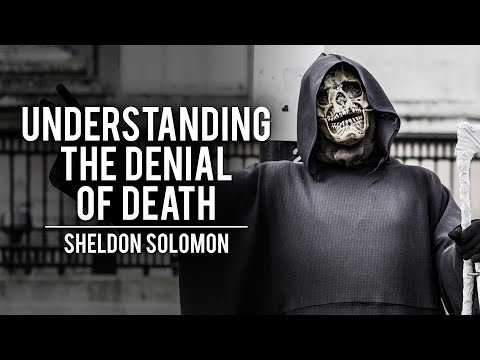
Does A Fear Of Death Drive Everything We Do? | Sheldon Solomon | Modern Wisdom Podcast 240
Sheldon Solomon (guest), Chris Williamson (host), Narrator, Narrator, Narrator
In this episode of Modern Wisdom, featuring Sheldon Solomon and Chris Williamson, Does A Fear Of Death Drive Everything We Do? | Sheldon Solomon | Modern Wisdom Podcast 240 explores how Death Anxiety Shapes Culture, Politics, Consumerism, and Our Selves Sheldon Solomon, drawing heavily on Ernest Becker’s work, argues that uniquely human awareness of mortality creates a deep, often unconscious death anxiety that underlies much of individual behavior and social life.
How Death Anxiety Shapes Culture, Politics, Consumerism, and Our Selves
Sheldon Solomon, drawing heavily on Ernest Becker’s work, argues that uniquely human awareness of mortality creates a deep, often unconscious death anxiety that underlies much of individual behavior and social life.
To manage this terror, humans construct and defend cultural worldviews that give life meaning and provide self-esteem, but this same mechanism fuels prejudice, violence, political authoritarianism, environmental harm, and consumerism.
Solomon reviews decades of experimental evidence showing that subtle reminders of death intensify in‑group favoritism, out‑group hostility, support for charismatic strongmen, materialism, and existing psychological disorders.
He contends that consciously confronting mortality—rather than repressing it—can reduce these malignant effects and help people live more authentically, joyfully, and cooperatively.
Key Takeaways
Death anxiety silently shapes everyday beliefs and behaviors.
Humans manage the terror of knowing we will die by embracing cultural worldviews (religions, nations, ideologies) that promise meaning and value; most of this regulation happens unconsciously, influencing everything from identity to politics.
Get the full analysis with uListen AI
Cultural worldviews both protect and endanger us.
Worldviews reduce existential fear by providing meaning and self-worth, but when those worldviews feel threatened by differing beliefs, people often respond with defensiveness, denigration, or even violence toward out-groups.
Get the full analysis with uListen AI
Reminders of death amplify prejudice and authoritarianism.
Experiments show that subtle mortality reminders make people favor their own group more, dislike outsiders more, and become more supportive of charismatic, ‘strong’ leaders who promise security and national greatness.
Get the full analysis with uListen AI
Consumerism and environmental neglect are tied to mortality fears.
When reminded of death, people report needing more money, prefer luxury goods, and even pay more for symbolic legacies (like naming a star), while simultaneously distancing themselves from nature and caring less about environmental protection.
Get the full analysis with uListen AI
Death anxiety intensifies existing psychological vulnerabilities.
Mortality reminders don’t just change attitudes; they exacerbate pre‑existing issues—making depressed people more depressed, phobic people more fearful, and generally magnifying whatever psychological difficulties are already present.
Get the full analysis with uListen AI
Numbing ourselves with trivialities is a common defense.
Following Kierkegaard and Heidegger, Solomon notes that many people ‘tranquilize themselves with the trivial’—through passive entertainment, shopping, or relentless busyness—to avoid confronting deeper existential questions.
Get the full analysis with uListen AI
Consciously facing mortality can enrich life rather than diminish it.
Solomon argues that bringing death anxiety into awareness—not obsessively, but courageously and honestly—can reduce its hidden, destructive effects and enhance awe, gratitude, authenticity, and compassion.
Get the full analysis with uListen AI
Notable Quotes
“In our finest moments, it is just the sheer joy of being alive, the spontaneous exuberance of wallowing in the mystery of life that I think is what makes life most worthwhile.”
— Sheldon Solomon
“If you're smart enough to know that you're here, you're also smart enough to know that like all living things, you too will someday die.”
— Sheldon Solomon (paraphrasing Kierkegaard and Becker)
“If a way to the better there be, it comes from taking a close look at the worst.”
— Sheldon Solomon (quoting Thomas Hardy)
“When the angel of death sounds his trumpet, the pretenses of civilization are blown from men's heads into the mud like hats in a gust of wind.”
— Sheldon Solomon (quoting George Bernard Shaw)
“You can banish death, but you can never banish chance.”
— Sheldon Solomon (summarizing Ernest Becker’s argument about immortal life still being fragile)
Questions Answered in This Episode
If death anxiety subtly drives so many destructive behaviors, what practical steps can individuals take to confront mortality in a healthier, more conscious way?
Sheldon Solomon, drawing heavily on Ernest Becker’s work, argues that uniquely human awareness of mortality creates a deep, often unconscious death anxiety that underlies much of individual behavior and social life.
Get the full analysis with uListen AI
How can societies preserve the meaning and cohesion that cultural worldviews provide without turning them into sources of prejudice, violence, or authoritarian politics?
To manage this terror, humans construct and defend cultural worldviews that give life meaning and provide self-esteem, but this same mechanism fuels prejudice, violence, political authoritarianism, environmental harm, and consumerism.
Get the full analysis with uListen AI
In an age of transhumanism and potential life extension, how might our psychological defenses and social structures change if physical death were radically delayed or transformed?
Solomon reviews decades of experimental evidence showing that subtle reminders of death intensify in‑group favoritism, out‑group hostility, support for charismatic strongmen, materialism, and existing psychological disorders.
Get the full analysis with uListen AI
What would education, parenting, or mental health treatment look like if they explicitly incorporated an understanding of terror management theory and death anxiety?
He contends that consciously confronting mortality—rather than repressing it—can reduce these malignant effects and help people live more authentically, joyfully, and cooperatively.
Get the full analysis with uListen AI
How can people distinguish between genuine self-development and existentially driven ‘tranquilization with the trivial’ in the modern self-help and productivity culture?
Get the full analysis with uListen AI
Transcript Preview
I don't think it is good for us or for humanity to lose track of the fact that in our finest moments, uh, it is just the sheer joy of being alive, the spontaneous exuberance of wallowing (laughs) i- in the mystery of life that I think is what makes life, uh, most worthwhile. But, yeah, but it's also dreadful to be alive and to know it because u- unless you're a child or cognitively impaired, if you're smart enough to know that you're here, you're also smart enough to know that like all living things, you too will someday die. And Ernest Becker's point is that that unwelcome realization, the, the worm at the core of the human experience, as William James put it, that that was the most significant psychodynamic event in the history of the human species.
Are we gonna talk about death today?
Um, I believe that we will. Uh, hopefully not for the sake of death per se, but in the interest of enhancing life.
How does death enhance life?
Well, uh, at our best, the existentialists tell us since time immemorial, um, it is necessary to come to terms, uh, with the most basic fact of human existence, and that is that, uh, l- that we, like all living creatures, are o- are of finite duration. And, um, theologians, philosophers, you know, people just sitting on a rock, uh, back in the... in, in antiquity have wrestled, frankly, uh, with this idea. Um, uh, you know, every other form of life is unperturbed, uh, by the reality that, uh, o- of finitude, um, but we necessarily are. A- and, uh, the claim very simply is that whether we're aware of it or not, death anxiety, um, pervades every aspect of our existence, a- and malignant manifestations of death anxiety are arguably responsible directly or indirectly, uh, for a considerable proportion of human foibles. And so, the claim is that both for the benefit of ourselves as individuals to, to get the most out of life, as well as for the benefit of society in general, yeah, it is necessary both individually and collectively to come to terms with our mortality.
What are some of the manifestations of how they can malignantly manifest?
Yeah. S- so great question. I'll back up a little bit just to give folks, um, some detail that the work that we do, um, is, is derived from a cultural anthropologist, Ernest Becker, who in the 1970s, uh, won a Pulitzer Prize for a book called The Denial of Death. A- and, uh, what Becker argued, uh, you know, very simply i- is that, um, yeah, humans are like all other living things. Uh, you know, Darwinian wise, that, uh, we are biologically predisposed to want to survive in the interest of self-preservation and, and for reproduction. Um, and yet, uh, we're different than other creatures. And without being overly arrogant, the claim is that our, our huge forebrain, uh, gives us the capacity to think abstractly and symbolically, uh, to the point where we can even imagine stuff that doesn't yet exist and then have the audacity to take our dreams and render them real. And that could not be more uplifting, uh, to me. Um, uh, I, like Otto Rank, you know, Freud's boy, who said, "Humans make the unreal real." A- and we don't wanna lose track of the fact that all other creatures, uh, have to, uh, accept the world in the form in which they encounter it. You know, I get it. Spiders, uh, make webs, beavers make dams, bees make hives, a- and they've been doing it quite well for hundreds of millions of years. Yeah, but they don't imagine a flying machine like da Vinci, you know, in the 1500s or 1400s, uh, or, and then actually, you know, centuries later, we're flying around in what was originated in somebody's imagination. All right. All great so far, uh, until... and still great, um, when, when, uh, Ernest Becker says, "Okay. Uh, let's now move to Kierkegaard, the Danish existential philosopher who said, 'You know, people are so smart that we realize that we're here.'" A- and, uh, and of course, humans, w- we take this for granted. You know, you wake up every day and you're like, "Here I am. I woke up." Or, you know, you're walking down the street. You're like, "Here I am, walking down the street." Or it can get even crazier than that. "Here I am, walking down the street, thinking about that I'm walking down the street." So, uh, it... you know, you could be, "Wow. Now I'm thinking about that I'm thinking about that I'm walking down the street," until you have to turn into the nearest pub to extricate yourself from this (laughs) perseverating cycle o- of annoying, uh, self-focus. Well, so what? You know, Kierkegaard said, uh, you know, "If you're smart enough to know that you're here," uh, which he insisted requires a sophisticated cognitive apparatus to render yourself the object of your own subjective inquiry, then you're gonna experience two uniquely human emotions, awe and dread. A- and Kierkegaard's like, "L- wait a minute. It's awesome to be alive and to know it."...that, that's just great. That's why if you get to choose between being a person and a potato-
Install uListen to search the full transcript and get AI-powered insights
Get Full TranscriptGet more from every podcast
AI summaries, searchable transcripts, and fact-checking. Free forever.
Add to Chrome