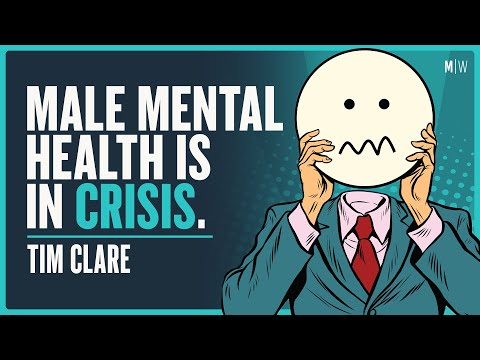
The Crippling World Of Men’s Anxiety - Tim Clare
Tim Clare (guest), Chris Williamson (host)
In this episode of Modern Wisdom, featuring Tim Clare and Chris Williamson, The Crippling World Of Men’s Anxiety - Tim Clare explores inside Men’s Anxiety: Panic, Biology, Masculinity, And Real Recovery Author Tim Clare describes his lived experience of crippling panic attacks and how it drove him to investigate anxiety through neuroscience, psychology, and thousands of research papers.
Inside Men’s Anxiety: Panic, Biology, Masculinity, And Real Recovery
Author Tim Clare describes his lived experience of crippling panic attacks and how it drove him to investigate anxiety through neuroscience, psychology, and thousands of research papers.
The conversation unpacks what panic attacks actually feel like, how they function in the body and brain, and why they evolved, drawing on CO₂ studies, breathing physiology, and threat circuits.
They explore how exercise, diet, inflammation, childhood trauma, and social support interact with anxiety, emphasizing that anxiety is multi-causal and deeply contextual rather than a single defect in the brain.
A major theme is masculinity and identity: why traditional “men don’t get anxious” beliefs worsen outcomes, and how genuine understanding, exposure to feared situations, and embracing uncertainty can gradually dismantle anxiety’s grip.
Key Takeaways
Panic attacks are often misread as heart attacks or “going insane,” but are largely driven by breathing and CO₂ regulation.
Over-breathing and hyperventilation can cause cerebral vasoconstriction and oxygen delivery problems, producing dizziness, derealization, and terror that feel life-threatening but are physiological misfires rather than imminent death.
Get the full analysis with uListen AI
Anxiety is not one thing with one cause; it’s more like a “headache” with many possible origins.
Genetics, chronic inflammation, diet, sleep, childhood trauma, learned threat responses, and social context all contribute differently for different people, so no single intervention or explanation fits everyone.
Get the full analysis with uListen AI
Exercise helps some anxiety sufferers, but the evidence is nuanced and the short-term experience often feels worse before it feels better.
Most exercise–anxiety studies use non-clinically anxious, exercise-tolerant volunteers and vague definitions of “exercise”; still, regular movement tends to improve stress hormone regulation, metabolic health, and recovery from stress spikes, even if it doesn’t “cure” anxiety outright.
Get the full analysis with uListen AI
Diet and inflammation modestly shift anxiety risk, rather than providing instant cures.
Mediterranean-style diets, healthy weight, and physical activity all tend to reduce chronic inflammation, which is bidirectionally linked with anxiety and depression; for a subgroup, anti-inflammatory strategies can significantly reduce symptoms.
Get the full analysis with uListen AI
Childhood adversity reshapes developing threat circuits but does not doom you to lifelong anxiety.
Early trauma can alter amygdala–hippocampus development and shift when and how we learn safety vs. ...
Get the full analysis with uListen AI
Traditional masculine norms (“men must be stoic and self-sufficient”) make anxiety and PTSD outcomes worse.
Men who believe they must not be anxious are less likely to admit distress, seek help, or talk honestly, creating an ongoing clash between their inner reality and self-image that intensifies suffering and delays effective treatment.
Get the full analysis with uListen AI
Recovery demands both exposure to fear and a willingness to live with uncertainty, supported by feeling genuinely understood.
Avoidance and safety behaviors prevent the brain from updating its threat models; intense, well-structured exposure (sometimes with pro-plasticity drugs) can rapidly recalibrate fear responses, but meaningful change usually begins when someone feels heard, validated, and no longer alone with their experience.
Get the full analysis with uListen AI
Notable Quotes
“Reading the explanation of what a panic attack is is kind of like licking a photograph of an ice cream.”
— Tim Clare
“When you are on the floor having shoved a towel in your mouth to try and cover the sound of you screaming so your baby daughter doesn't hear… I think it's impossible for anyone, no matter what their relationship to masculinity, to feel diminished by that.”
— Tim Clare
“When you're depressed, if you stop leaving the house, you stop receiving data on what it's like to leave the house.”
— Tim Clare
“You don't get to not make a habit. You only get to choose which type of habit you want to make.”
— Chris Williamson
“Anxiety craves certainty. It submits to authority. We want people just to tell us what to do. And the way out… is uncertainty.”
— Tim Clare
Questions Answered in This Episode
How can men challenge harmful masculine norms around anxiety without feeling like they are abandoning important parts of their identity?
Author Tim Clare describes his lived experience of crippling panic attacks and how it drove him to investigate anxiety through neuroscience, psychology, and thousands of research papers.
Get the full analysis with uListen AI
Given the complexity of anxiety’s causes, how should someone prioritize where to start: therapy, exercise, diet changes, medication, or exposure work?
The conversation unpacks what panic attacks actually feel like, how they function in the body and brain, and why they evolved, drawing on CO₂ studies, breathing physiology, and threat circuits.
Get the full analysis with uListen AI
What are practical ways to reduce safety behaviors in everyday life without triggering overwhelming panic or shutdown?
They explore how exercise, diet, inflammation, childhood trauma, and social support interact with anxiety, emphasizing that anxiety is multi-causal and deeply contextual rather than a single defect in the brain.
Get the full analysis with uListen AI
How can someone who grew up in a genuinely dangerous environment learn to distinguish real threats from outdated fear responses?
A major theme is masculinity and identity: why traditional “men don’t get anxious” beliefs worsen outcomes, and how genuine understanding, exposure to feared situations, and embracing uncertainty can gradually dismantle anxiety’s grip.
Get the full analysis with uListen AI
If feeling understood is so central to recovery, what can friends, partners, or communities concretely do to provide that kind of validating support?
Get the full analysis with uListen AI
Transcript Preview
... but when you are on the floor having shoved a towel in your mouth to try and cover the sound of you screaming so your baby daughter doesn't hear because you don't want her to be afraid in sort of two rooms away while your wife looks after her, I think it's impossible for anyone, no matter what their relationship to masculinity, to feel diminished by that.
(wind blowing) What is your expertise? What gives you license to write a book about anxiety?
So, the awful truth is, (laughs) is, is that I was sitting down having written sort of a couple of novels and thinking, "What can I write about?" And I'd written non-fiction before, and I was like, "What am I an expert?" Well, because like you say, like when you're pitching something, whether it's like an article or a book, one of, one of the four pitch lines, you know, it's like, "This is a story about this," or, "I wanted to look into this. The reason why I'm the person to do this, and you shouldn't get a better known celebrity to do it instead, is 'cause this is my area of expertise." And I was like, "What am I an expert on?" And it was like, "Well, I'm mentally ill, like, (laughs) I guess. Like, I'm really anxious." Like, I was like, at the time, like I had a two-year-old daughter. Um, she's still, she's just older now. I still have a daughter, she's just older. But, um, and I, I was really struggling with, like, severe anxiety and panicked that was like, I was having panic attacks every week. S- sometimes I was having multiple ones a day that would, like, put me on the floor, and I'd have several a day over like a three-day period. And I was like, "This is taking... This is just like, this is unlivable." And also, you know, in my work I do doing like a creative writing podcast, I'd started to have like neuroscientists on. I'd started having psychologists on. I studied like four years of psychology back in school, but I'm not like qualified. My background is in, in writing. But I, I, I'd spoken to these guys and had some really interesting beginning talks about the brain and, you know, the differences when they put like writers in an MRI scan- fMRI scanner and stuff like that. And so I was like think... And then we signed my daughter up to a developmental s- study where they started studying her brain and the development of kids at different ages. And I got to take her in and see, they put this thing called an fNIRS on her, which is, it's like a portable scanner in a kind of skull cap. It looks like a Medusa fright wig. They stick it on her head. She looked like, uh, like, uh, well, she looked like a cross between Medusa, and this is like a very deep cut nerd reference, but like, uh, when Patrick Stewart plays like Locutus out of the Borg, she looked like one of the Borg. She had like one eye, red eye piece on that, um, tracks her vision. And I was seeing on a computer different parts of her brain lighting up, uh, because of something called the BOLD response, the blood-oxygen-level-dependent response showing different parts of her brain, uh, as different levels of demand wanted more or less oxygen. And I was like, "I'm watching my daughter think." We are at a level now where psychology and neuroscience, we can like look inside people's heads. And I'm like, "There's got to..." Like, I only get access to this because we signed up to this study, but I'm like, "There's got..." I now know I, there's researchers out there who are willing to speak to me, uh, for some reason. And I guess the reason, the thing was I just wanted to get well. And I was like, "Well, if I say I'm writing a book, these people are gonna open their doors to me."
Install uListen to search the full transcript and get AI-powered insights
Get Full TranscriptGet more from every podcast
AI summaries, searchable transcripts, and fact-checking. Free forever.
Add to Chrome