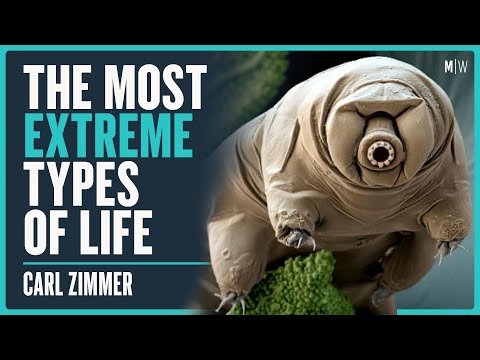
What Are The Weirdest Types Of Life? - Carl Zimmer | Modern Wisdom Podcast 394
Carl Zimmer (guest), Chris Williamson (host)
In this episode of Modern Wisdom, featuring Carl Zimmer and Chris Williamson, What Are The Weirdest Types Of Life? - Carl Zimmer | Modern Wisdom Podcast 394 explores carl Zimmer Explores Life’s Strangest Forms And Redefines Being Alive Carl Zimmer and Chris Williamson explore why defining “life” and “death” is so scientifically and philosophically messy, despite how intuitively obvious they seem to humans and other animals.
Carl Zimmer Explores Life’s Strangest Forms And Redefines Being Alive
Carl Zimmer and Chris Williamson explore why defining “life” and “death” is so scientifically and philosophically messy, despite how intuitively obvious they seem to humans and other animals.
They examine edge cases—cryptobiotic tardigrades, shape-shifting snakes, maze‑solving slime molds, death-aware primates, and ambiguous entities like viruses—that challenge standard biological definitions.
The conversation extends to weird possible alien life (silicon, non‑water solvents), competing theories of life’s origins on Earth, and medical complexities like brain death and organ donation.
Zimmer concludes that instead of arguing over static definitions, science needs a true theory of life, akin to how chemistry replaced pre‑modern “definitions” of water with molecular understanding.
Key Takeaways
Definitions of life are fragmented and context-dependent.
Biologists, philosophers, and agencies like NASA all use different working definitions, revealing that “life” serves multiple purposes—from medical decision-making to astrobiology—and resists a single, tidy description.
Get the full analysis with uListen AI
Basic life–death recognition is widespread in animals and deeply intuitive in humans.
Species from fish to primates adjust behavior around corpses or biological motion, and humans possess a felt sense of being alive that can break down in rare conditions like Cotard Syndrome, where people insist they are dead.
Get the full analysis with uListen AI
Some organisms effectively pause life, challenging metabolism-based definitions.
Cryptobiotic species such as tardigrades can dry out, vitrify their internal components into a protein “glass,” halt detectable metabolism for decades, then fully revive—defying simple alive/dead binaries.
Get the full analysis with uListen AI
Intelligence and memory don’t require brains or bodies like ours.
Slime molds, single giant cells without nervous systems, solve mazes, optimize paths between food sources, and use chemical “trails” as an externalized memory, showing that problem-solving is a general feature of life, not just brains.
Get the full analysis with uListen AI
Medical definitions of death are partly social and ethical constructs.
The adoption of brain death criteria, driven in part by organ transplantation needs, demonstrates that when biological states are ambiguous, societies negotiate where to draw the line between life and death.
Get the full analysis with uListen AI
Viruses sit at the boundary of life and force us to refine our criteria.
They lack self-sustaining metabolism and depend on host cells, yet evolve under Darwinian rules and can carry complex functions like photosynthesis genes, making them central test cases for any serious theory of life.
Get the full analysis with uListen AI
A robust theory of life may be more valuable than more definitions.
Zimmer, echoing philosopher Carol Cleland, argues that definitions without a deeper theory are like medieval definitions of water; what’s needed is a unifying framework—potentially informed by alternative and extraterrestrial life—rather than endless semantic battles.
Get the full analysis with uListen AI
Notable Quotes
“You could argue that we don’t really have a deep conceptual understanding of life either.”
— Carl Zimmer
“Life doesn’t really care about our absolutes that way.”
— Carl Zimmer
“They’re just on pause, and can stay on pause for decades, maybe centuries.”
— Carl Zimmer (on cryptobiotic tardigrades)
“You don’t need a brain to be intelligent because these slime molds are literally solving math problems with no need of a brain.”
— Carl Zimmer
“Don’t try to define life. Definitions are pointless… What we really need is a theory of life.”
— Carl Zimmer, summarizing philosopher Carol Cleland
Questions Answered in This Episode
If our intuitive sense of being alive is so unreliable (as in Cotard Syndrome), how should that change the way we morally and legally define death?
Carl Zimmer and Chris Williamson explore why defining “life” and “death” is so scientifically and philosophically messy, despite how intuitively obvious they seem to humans and other animals.
Get the full analysis with uListen AI
Do organisms in cryptobiosis, with no detectable metabolism, force us to abandon metabolism as a core criterion for life?
They examine edge cases—cryptobiotic tardigrades, shape-shifting snakes, maze‑solving slime molds, death-aware primates, and ambiguous entities like viruses—that challenge standard biological definitions.
Get the full analysis with uListen AI
Should viruses be formally included within “life” for evolutionary and ecological theory, even if they fail some traditional biochemical definitions?
The conversation extends to weird possible alien life (silicon, non‑water solvents), competing theories of life’s origins on Earth, and medical complexities like brain death and organ donation.
Get the full analysis with uListen AI
How might discovering a truly alien biochemistry—different genes, solvents, or energy systems—reshape our current concepts of biology and evolution?
Zimmer concludes that instead of arguing over static definitions, science needs a true theory of life, akin to how chemistry replaced pre‑modern “definitions” of water with molecular understanding.
Get the full analysis with uListen AI
What would a genuine, testable theory of life need to explain that current ad hoc definitions and checklists cannot?
Get the full analysis with uListen AI
Transcript Preview
Let's put it this way. There are other species that can recognize things that are alive and are not alive. That doesn't mean that they have, like, a deep conceptual understanding of life. But, you know, you could argue that we don't really either. (laughs) You can see different behaviors that animals have in response to living and dead things. You can see that, uh, that some animals are, are very good at recognizing biological motion, that is the movement of living things, and can distinguish that from the movement of things, you know, like rocks or something that are moving but are not alive. And that's really important for a lot of species.
Carl Zimmer, welcome to the show.
Thanks for having me.
It's an interesting thing talking about life and what it constitutes, right? Because I think a lot of people have heard about discussions to do with euthanasia and assisted suicide, and is this person really alive, what does it mean, philosophical arguments to do with is somebody in a coma, uh, discussions around abortion, what constitutes life during, um, childbirth and, and beforehand. And yeah, it's an interesting, an interesting area. It seems like it sort of coalesces a lot of big questions that people have.
Uh, it really does. Um, a- and, but at the same time, uh, for as important as it is, um, there hasn't been really all that much, um, thinking among scientists about, you know, life with a big capital L. I mean, when we talk about life, w- what do we really mean? Um, and so what's really astonishing is that, you know, you can find plenty of definitions of life, uh, in the scientific literature, um, but there are different definitions. And I find if I, if, uh, I start talking about life with a scientist, um, they might very well have a definition and it's different from the one I heard from the last person. Um, so y- you have this situation wh- which is really strange. I mean, imagine like in chemistry people didn't agree on what an atom is. I mean, (laughs) that would be kind of problematic. And yet we're in this situation where scientists who study life, life in different forms, they just, they really don't agree on what it is they're talking about.
Why is it so messy?
Um, you know, that's a good question. I think, uh, part of the problem is that, uh, i- is, is that sometimes we're trying to get at different things when we use the same word. So, you know, um, there are these, uh, issues about end of life, you know. So, um, is someone who's on a ventilator, are, are they alive? Um, and so we start to talk about, um, uh, you know, brain death as being sort of the definition of the end of life. Um, but that's really the end of one person's life, um, you know, their state of being alive. Um, whereas other people want to say, "Okay, um, you know, a snake and a tree and me, we, we all have something in common that's different than a rock. Um, what am I gonna call that?" And people will say, "Well, that's life." And so it's a, and so it can be a way of trying to pull things together into s- and trying to figure out what they have in common. Um, but, you know, e- but even then you get yourself into trouble because then, you know, you think you kind of have a nice little category of things that are alive and then someone comes along with something else, like a virus, and then everyone starts yelling all over again. Um, so, so it's, it, it's a, it's marvelously prone to lead to big arguments.
Install uListen to search the full transcript and get AI-powered insights
Get Full TranscriptGet more from every podcast
AI summaries, searchable transcripts, and fact-checking. Free forever.
Add to Chrome