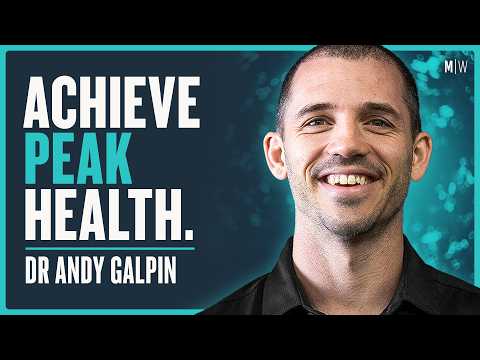
Supercharge Your VO2 Max & Protect Your Heart - Dr Andy Galpin
Chris Williamson (host), Dr Andy Galpin (guest), Narrator
In this episode of Modern Wisdom, featuring Chris Williamson and Dr Andy Galpin, Supercharge Your VO2 Max & Protect Your Heart - Dr Andy Galpin explores boost VO2 Max, Fix Sleep, And Dramatically Extend Healthspan, Explained Simply Dr. Andy Galpin explains which physical metrics most strongly predict longevity and quality of life, highlighting VO2 max, leg and grip strength, muscle mass/quality, and balance/proprioception, alongside avoiding obesity, metabolic disease, and sleep disorders.
Boost VO2 Max, Fix Sleep, And Dramatically Extend Healthspan, Explained Simply
Dr. Andy Galpin explains which physical metrics most strongly predict longevity and quality of life, highlighting VO2 max, leg and grip strength, muscle mass/quality, and balance/proprioception, alongside avoiding obesity, metabolic disease, and sleep disorders.
He traces the rise of VO2 max in popular health culture, debunks the idea of “magic” interval protocols, and lays out practical, flexible ways to integrate VO2-max-focused conditioning into a normal training week without becoming a protocol-obsessed purist.
The conversation then pivots deeply into sleep: why consumer trackers often mislead, how real sleep labs assess quality, how environment, breathing, CO₂, fitness, and nutrition interact to shape sleep, and why over-optimization can itself cause insomnia.
Galpin emphasizes resilience over perfection—using concepts like sleep banking, minimalist but strategic breathwork or NSDR, and matching “baker vs cook” personalities to the right level of precision—so people can sustainably improve cardiovascular fitness and sleep without becoming fragile or neurotic.
Key Takeaways
Prioritize VO2 max and leg strength as top physical longevity levers.
Large datasets show VO2 max and leg strength out-predict traditional risk markers (cholesterol, blood pressure, diabetes markers) for all-cause mortality and post-surgery prognosis; improving these should be a central health goal.
Get the full analysis with uListen AI
There is no magic VO2 max protocol—intensity and consistency matter most.
Whether it’s 20s-on/40s-off, 4x4 ‘Norwegian’ intervals, mile repeats, or other HIIT structures, almost all formats work if you go truly hard in the high-intensity bouts and perform them regularly; protocol debates are mostly distraction.
Get the full analysis with uListen AI
Design VO2 training around your actual limiter, not generic zones.
People fail VO2 tests for different reasons—heart/lung strain vs local muscular fatigue vs technique; identifying why you ‘quit’ guides whether you need more long steady work, short maximal intervals, muscular endurance, or technique changes.
Get the full analysis with uListen AI
Structure conditioning weekly by intensity tiers instead of rigid weekdays.
Galpin suggests rotating through: (1) very hard, short VO2 work (e. ...
Get the full analysis with uListen AI
Sleep tracking can both help and harm; scores aren't the whole story.
Consumer wearables sample infrequently and can’t diagnose sleep disorders or measure depth of sleep stages, so high scores may coexist with clinical sleep problems; in some people, fixation on scores triggers anxiety (orthosomnia) and worsens sleep.
Get the full analysis with uListen AI
Aim for resilient sleep, not a fragile, over-optimized routine.
If your 90-minute wind-down and perfect environment become prerequisites, you lose adaptability; instead, build a robust system that still performs well with travel, disrupted routines, or short nights, using techniques like occasional sleep restriction and portable environmental cues.
Get the full analysis with uListen AI
Use environment, breathing, and carbs to upgrade sleep before supplements.
Galpin emphasizes controlling bedroom CO₂, temperature, and noise, using nasal-breathing/NSDR ‘mini-naps’ during the day, and adding a modest carbohydrate bolus in the evening (or a small pre-bed snack like fruit/kiwi) to stabilize blood sugar and improve sleep continuity and next-morning alertness.
Get the full analysis with uListen AI
Notable Quotes
“It takes shockingly little effort to see big VO2 max benefits—sometimes just 20 seconds, a few times a day, if you’re unfit.”
— Dr. Andy Galpin
“There is absolutely no magic protocol. You either do more work over time, or you do less work that really hurts.”
— Dr. Andy Galpin
“I don’t want to create the most optimized sleepers; I want to create the most resilient sleepers.”
— Dr. Andy Galpin
“Most people are made more sick by trying to be optimal than they would be by embracing their slightly suboptimal habits.”
— Chris Williamson
“If you don’t know the rules of the game, you can’t play loosely with them—you’re just guessing.”
— Chris Williamson
Questions Answered in This Episode
How can an average, time-pressed person most efficiently raise their VO2 max without burning out or hating training?
Dr. ...
Get the full analysis with uListen AI
If my wearable shows ‘good’ sleep scores but I still feel exhausted, what concrete steps should I take to determine whether I have a hidden sleep problem?
He traces the rise of VO2 max in popular health culture, debunks the idea of “magic” interval protocols, and lays out practical, flexible ways to integrate VO2-max-focused conditioning into a normal training week without becoming a protocol-obsessed purist.
Get the full analysis with uListen AI
How do I figure out whether my VO2 limitation is central (heart/lungs) or peripheral (muscles/technique), and how would that change my training plan?
The conversation then pivots deeply into sleep: why consumer trackers often mislead, how real sleep labs assess quality, how environment, breathing, CO₂, fitness, and nutrition interact to shape sleep, and why over-optimization can itself cause insomnia.
Get the full analysis with uListen AI
At what point does attention to optimization—sleep, nutrition, protocols—start doing more psychological harm than physical good, and how can I recognize that in myself?
Galpin emphasizes resilience over perfection—using concepts like sleep banking, minimalist but strategic breathwork or NSDR, and matching “baker vs cook” personalities to the right level of precision—so people can sustainably improve cardiovascular fitness and sleep without becoming fragile or neurotic.
Get the full analysis with uListen AI
What practical methods can I use to ‘sleep bank’ before a period of travel, big projects, or new parenthood to minimize performance decline?
Get the full analysis with uListen AI
Transcript Preview
Talk to me about the metrics that matter most for health, in your opinion. We've got an unlimited amount of data that we can access from wearables and beds and, and breath work and CO2 tolerance tests and everything else. What are the ones that you think are most important?
Yeah, sure. I think the easiest way to start this is go over a very large picture and then to stop us from being very general the entire time, which is sometimes a bit boring, I'll let you pick whichever one you want to go hardest into, uh, there. So when we start looking at things, uh, from the perspective of how long you're going to live and how well you're going to live, most people are pretty keen on that idea now and those things are different and it's not just about living a long time and you want to live well. So what's that mean? Well, we actually can pull from multiple datasets here in the sense that it's everything from your sense of connection to the world, your sense of purpose, uh, social belongings. Those things are incredibly important and depending on the papers you, you pull from, some could argue those are the top predictors of how long. Now, mental health and such is not my expertise, so I, I will hopefully not spend all of our time on that. But we have to acknowledge those... The way you asked the question, that is a, a true and honest answer. It is the things that go into making you feel like a sense of purpose and belonging. That's great. Independent of that, in terms of your physical health, now we can just really run through the gamut of, what does your body have to do to survive and perform well, right? Well, it has to have some functionality of cardiorespiratory fitness. Easy metric we talk about here very often and people are, are really keen to this fact now which makes me smile because for 25 years when I've been screaming this and no one cared and, and like the Podcastistan universe took over about three years ago and I'm like, "Well great." (laughs) Now it's out there. So VO2 max is a, a very strong predictor of how long you're going to live, uh, from the, from that perspective. Other research, uh, is gonna look at things like physical strength, both your grip strength and your leg strength. Also very, very important. Backing down from that, now you have things like muscle quality, overall muscle size. Of course you have negative regulators. So what I mean by that are these are things you don't want to have. So as I've been going through this, I realize, realize I've been giving you things that you want to make sure are high, and you have a whole subset of things you want to stay away from. Obesity, you don't wanna have metabolic disease, you don't wanna have sleep disorders, you don't wanna have that. So I tend to leave that stuff. I, I always forget to mention that. But yeah, like don't have any of those, and then be fit, be strong and maintain a sense of, of proprioception. And so if you look at the research on things like brain aging, what's critically clear is you don't wanna lose your sense of smell. You don't wanna lose your sense of vision or your hearing because those are all tied into the global idea of proprioception, and that is a fancy way of saying your body's ability to understand where it is in space. This is translated often into things like balance. Okay, so if you were to, to look at the research on fall prevention, it's very clear you do not wanna fall and have an accident after the age of 60. That's... And I don't mean to be a bit dramatic here but it's, it's quite literally almost a death sentence, uh, if you fall and break a hip or something like that after the age of 60. Well, what causes that? Pure accidents. But then outside of that, it is things like loss of balance. Then once you lose the balance you have a lack of foot speed or hand speed to get your hand in the right position to brace yourself from a fall, and then if you do do that, it's the lack of eccentric strength to stop yourself from hitting the ground and collapsing and smashing a bone. And so I just sprayed you with a whole bunch of stuff to answer your question but from just the physical side of the equation, those are generally the things we're looking at in terms of an exercise scientist's perspective. I don't really spend much time in my career honestly on medical stuff. I'm not a medical doctor. Go talk to Peter Attia or Gabrielle Lyon if you wanna know about ApoB4. Like I don't care about those things at all. Uh, I, I look at the human performance side of the perspective on that question.
Install uListen to search the full transcript and get AI-powered insights
Get Full TranscriptGet more from every podcast
AI summaries, searchable transcripts, and fact-checking. Free forever.
Add to Chrome