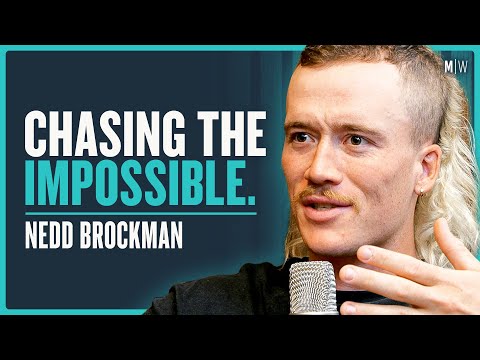
Pushing The Boundaries Of Mental Toughness - Nedd Brockman
Chris Williamson (host), Nedd Brockmann (guest)
In this episode of Modern Wisdom, featuring Chris Williamson and Nedd Brockmann, Pushing The Boundaries Of Mental Toughness - Nedd Brockman explores ned Brockman Redefines Mental Toughness With Brutal 1,000-Mile Run Endurance athlete Ned Brockman talks with Chris Williamson about completing a 1,000-mile run around a 400m track in 12.5 days, after previously running across Australia and doing 50 marathons in 50 days while working full-time.
Ned Brockman Redefines Mental Toughness With Brutal 1,000-Mile Run
Endurance athlete Ned Brockman talks with Chris Williamson about completing a 1,000-mile run around a 400m track in 12.5 days, after previously running across Australia and doing 50 marathons in 50 days while working full-time.
He details the extreme physical and psychological toll of the event: severe sleep deprivation, injuries, hallucination-like loops, and post-event PTSD-style aftershocks, all while fundraising over $5 million for homelessness charity Mobilise.
Ned explains that running is just his tool for driving social change and encouraging others to 'live, give, and get uncomfortable,' not an identity or ego play, and he addresses criticism from purists and media who conflate his efforts with toxic masculinity.
The conversation broadens into how we frame suffering, the importance of how you *do* hard things (not just whether you finish), authenticity, bullying, emotional coping mechanisms, and using voluntary discomfort to grow without needing traumatic life events.
Key Takeaways
Voluntary discomfort can be a powerful engine for personal growth and social impact.
Ned uses extreme running as a tool, not an end in itself—he chooses brutally hard challenges to discover his limits, inspire others to move, and raise money and awareness for homelessness rather than to collect records or accolades.
Get the full analysis with uListen AI
How you experience a challenge matters as much as whether you complete it.
Both men emphasize that ticking the box (finishing the run, delivering the tour) is only part of the story; the inner experience—presence, joy, gratitude, and how you treat others while you suffer—is a crucial frontier to optimize, not just raw performance.
Get the full analysis with uListen AI
Sleep is a non-negotiable in ultra-endurance; toughness can’t override biology.
Ned’s attempt to chase the record while sleeping 1–2 hours a night nearly broke him: resting heart rate at 110 in bed, nosebleeds, and near-collapse forced his team to override him, proving grit cannot fully compensate for chronic sleep deprivation.
Get the full analysis with uListen AI
Breaking huge goals into micro-structures makes the impossible psychologically manageable.
To handle 1,000 miles on a 400m track, Ned invented ‘master laps’ (two laps in each lane, reversing direction each time) and hourly distance targets, turning thousands of monotonous laps into cognitively digestible chunks that he could face hour by hour.
Get the full analysis with uListen AI
Resilience built from hardship can be healthy, but unexamined pain can drive you indefinitely.
Chris notes that many positive traits—work ethic, independence, endurance—often grow from old wounds like bullying, but if you never examine the underlying hurt, you risk a lifetime of beautiful coping mechanisms that never resolve the root issue.
Get the full analysis with uListen AI
You can pursue excellence without pretending there’s only one ‘right’ way to do it.
The discussion of Nadal/Djokovic/Federer, Ross Edgley, Russ Cook and Will Goodge highlights that elite performers succeed with radically different styles and personalities, so copying someone else’s formula wholesale rarely beats tailoring an approach to your own wiring.
Get the full analysis with uListen AI
Authenticity is a skill that requires practice and often clashes with social expectations.
Both men reflect on how hard it is to ‘just be yourself’—whether that’s a jovial guy suffering on a track or an obsessive podcaster on stage—because layers of social pressure, criticism, and internal narratives make honesty and congruence something you must actively cultivate.
Get the full analysis with uListen AI
Notable Quotes
“The only way out is through. The only way out is to get this thing done, and the only way to get this thing done is to put one foot in front of the other.”
— Ned Brockman
“Life is you don’t know what’s coming tomorrow, so let’s set this thing up, let’s do it, let’s get it done.”
— Ned Brockman
“It’s not just about winning, it’s about how you win, and the story that you tell yourself and the experience that you go through.”
— Chris Williamson
“I want people to live, give, get uncomfortable. That’s all my message is.”
— Ned Brockman
“Lots of the things that you’re most ashamed of, the dark sides of your personality, your insecurities, your fears, are just the other edge of the strengths that you love most in yourself.”
— Chris Williamson
Questions Answered in This Episode
How do you personally decide when suffering is productive growth versus reckless self-destruction in these kinds of challenges?
Endurance athlete Ned Brockman talks with Chris Williamson about completing a 1,000-mile run around a 400m track in 12. ...
Get the full analysis with uListen AI
If you could redesign the 1,000-mile run purely for a better *inner* experience (joy, presence, connection) rather than speed, what would you change?
He details the extreme physical and psychological toll of the event: severe sleep deprivation, injuries, hallucination-like loops, and post-event PTSD-style aftershocks, all while fundraising over $5 million for homelessness charity Mobilise.
Get the full analysis with uListen AI
Do you worry that resolving some of the deeper emotional drivers behind your endurance feats might reduce your motivation to take on extreme challenges?
Ned explains that running is just his tool for driving social change and encouraging others to 'live, give, and get uncomfortable,' not an identity or ego play, and he addresses criticism from purists and media who conflate his efforts with toxic masculinity.
Get the full analysis with uListen AI
What would an evidence-based, scalable version of Ned’s Uncomfortable Challenge look like for people who aren’t runners or athletes at all?
The conversation broadens into how we frame suffering, the importance of how you *do* hard things (not just whether you finish), authenticity, bullying, emotional coping mechanisms, and using voluntary discomfort to grow without needing traumatic life events.
Get the full analysis with uListen AI
How should we balance critiques about ‘toxic toughness’ with the clear need for more resilience and voluntary discomfort in modern, comfortable societies?
Get the full analysis with uListen AI
Transcript Preview
Matt Brockman, welcome to the show.
Hey, bro. How are you, mate?
Good. Thank you for coming last night.
Thank you for having me. It was, uh, it was a fun night. I didn't know what to expect, as I told you last night. But it was a, uh, I feel like a lot of people felt a lot in that room.
Mm.
I, when I saw you, it felt like all the energy was on you. Like, it's quite a intense, I think, environment, that stuff. But yeah, it was really cool. I, uh, loved to hear all the questions and the answers. It was great.
Fuck, yeah. Thank you.
Yeah.
Talk to me about what you've just finished doing recently. This is the first time we've actually got to sit down on a podcast and talk about it since you completed everything.
Yeah. I'm a bit, a bit traumatized to be honest, so it's a bit, um... It's, it's good, I'm excited to talk about it. It's been, as you said, I've just haven't really chosen to do it because I'm, um... I guess I wanted to process it a bit. But yeah, ran 1,000 miles around a track, uh, in what was hoping to be 10 and a half days, but ended up, uh, a bit longer than that just due to a few, um... Probably being a bit under-ready for it, but still, uh, completed it in 12 and a half days. Fastest person to ever do it since I've been alive, which is a pretty cool stat. Um, I've only been alive for 25 years, so there's a few guys that did it before that, but... Um, yeah, ended up, uh, 130K a day around a 400-meter athletics track for 12 and a half days.
Why decide to do that particular event?
Um, a culmination of a few things. I, I ran across Australia two years ago, um, and kind of felt this, like, uh, desire to wanna keep doing these things and, and push my body, that, you know, the more discomfort you put yourself through, the better of a person or, you know, more of a person you become. Um, and off the back of that, I knew I wanted to do something every one or two years and, uh, thought about running across the length of the UK. Uh, 'cause I hear a lot of people have done that. Uh, bit too hilly for me, so I chose, uh, stupidly 1,000 miles around a track. Um, and yeah, I didn't really think too much about it. I don't really think too much about these things. I'm, I feel like anyone who takes these on are usually a bit older. They're usually, you know, 45, 50, have done 25, 30 years of running prior. I only started, uh, three and a half, four years ago. Um, so I think my naivety and stubbornness kinda go hand-in-hand. Um, but yeah, then got to, got to the start of this year and went, "Well, I'm gonna do this, gonna lock it in." And I do a lot of stuff with homelessness, um, and wanted to align the two and ended up, yeah, ended up finishing it in 12 and a half days, which throughout the period, throughout that time, I've, I don't think I've ever, um, felt as much pain as I did in that 12 and a half days.
Install uListen to search the full transcript and get AI-powered insights
Get Full TranscriptGet more from every podcast
AI summaries, searchable transcripts, and fact-checking. Free forever.
Add to Chrome