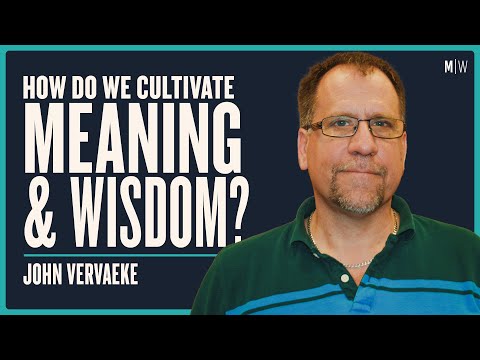
Creating A Life Of Meaning & Wisdom - John Vervaeke | Modern Wisdom Podcast 294
John Vervaeke (guest), Chris Williamson (host), Narrator
In this episode of Modern Wisdom, featuring John Vervaeke and Chris Williamson, Creating A Life Of Meaning & Wisdom - John Vervaeke | Modern Wisdom Podcast 294 explores john Vervaeke on Meaning, Wisdom, and Reclaiming the Sacred in Life John Vervaeke and Chris Williamson explore the modern ‘meaning crisis’ and why humans need more than information and productivity to flourish. Vervaeke explains his framework of relevance realization and four kinds of knowing, showing how our cognitive strengths also create self-deception and suffering. They discuss practices and ‘ecologies of practice’—mindfulness, dialog, ritual, Tai Chi, Stoicism—that cultivate wisdom, awe, and a renewed sense of the sacred. The conversation closes with how individuals can change amid unsupportive environments and Vervaeke’s vision for cultural transformation beyond political solutions.
John Vervaeke on Meaning, Wisdom, and Reclaiming the Sacred in Life
John Vervaeke and Chris Williamson explore the modern ‘meaning crisis’ and why humans need more than information and productivity to flourish. Vervaeke explains his framework of relevance realization and four kinds of knowing, showing how our cognitive strengths also create self-deception and suffering. They discuss practices and ‘ecologies of practice’—mindfulness, dialog, ritual, Tai Chi, Stoicism—that cultivate wisdom, awe, and a renewed sense of the sacred. The conversation closes with how individuals can change amid unsupportive environments and Vervaeke’s vision for cultural transformation beyond political solutions.
Key Takeaways
Abandon the fantasy of a final, perfect life-solution.
Vervaeke argues there is no permanent equilibrium between self and environment; like evolution, our cognitive ‘fittedness’ must keep adapting. ...
Get the full analysis with uListen AI
Train relevance realization, not just information intake.
Our core cognitive challenge is not lack of data but selecting what is relevant from an overwhelming information field. ...
Get the full analysis with uListen AI
Develop all four kinds of knowing, not just the intellectual.
Modern culture overvalues propositional knowing (facts, beliefs) and neglects procedural (skills), perspectival (situational awareness, presence), and participatory knowing (identity and belonging). ...
Get the full analysis with uListen AI
Use an ecology of practices that correct each other.
No single practice is sufficient; each has strengths and blind spots. ...
Get the full analysis with uListen AI
Reclaim awe and reverence to reconnect with the sacred.
Experiences of awe open us beyond ego and fixed frames, but need the virtue of reverence to be integrated rather than become overwhelming. ...
Get the full analysis with uListen AI
Prioritize dialog and community that aim at wisdom, not just agreement.
Authentic dialogue (dialogos) helps us transcend our own perspective by internalizing others’ viewpoints and co-creating insight. ...
Get the full analysis with uListen AI
Aim for cultural, not merely political, solutions to the meaning crisis.
Vervaeke is skeptical that state or market mechanisms can restore wisdom and meaning. ...
Get the full analysis with uListen AI
Notable Quotes
“There is no final solution to how you should shape yourself to the environment, or how you should shape the environment to you.”
— John Vervaeke
“Somehow, you're intelligently ignoring most of the information and zeroing in on what's relevant.”
— John Vervaeke
“We are never wise, we are always lovers of wisdom.”
— John Vervaeke (via Socrates)
“A buddy is somebody you enjoy doing something with. A friend is somebody that is committed to you becoming wiser, and you are committed to them becoming wiser.”
— John Vervaeke
“You are a finite creature surrounded by infinite complexity. Of course you're going to be scared.”
— Chris Williamson
Questions Answered in This Episode
How can I design a realistic ‘ecology of practices’ in my own life that balances mindfulness, embodiment, and dialog without becoming overwhelming or performative?
John Vervaeke and Chris Williamson explore the modern ‘meaning crisis’ and why humans need more than information and productivity to flourish. ...
Get the full analysis with uListen AI
In what concrete ways can I notice when my relevance realization is misfiring—when I’m obsessing over the wrong ‘salient’ things—and how do I course-correct in the moment?
Get the full analysis with uListen AI
What would it look like to reintroduce awe and reverence into a secular, rationalist worldview without sliding into superstition or dogma?
Get the full analysis with uListen AI
How can someone navigate the loss or reshaping of relationships when their pursuit of wisdom and meaning creates a growth gap with friends, partners, or family?
Get the full analysis with uListen AI
If political solutions are insufficient, what are practical first steps for ‘stealing the culture’ in my local context—at work, online, or in my immediate community?
Get the full analysis with uListen AI
Transcript Preview
There is no final solution to how you should shape yourself to the environment, or how you should shape the environment to you. There is no final way. I know this sounds paradoxical, but we always have to be perpetually hungry for insight and for that adaptive evolution of our cognitive fittedness to the environment. (wind blows)
I, I've heard you say that people often study what is most lacking in their lives. Is this true for you with regards to awakening from a meaning crisis?
Yeah. Yeah, it is. Uh, that was, uh, when I was in grad school. I had a friend, and he said, uh, "People went into psychology often to study what they were lacking." And so I study relevance (laughs) and meaning, (laughs) which, uh, uh, and there's, yeah, there's definitely existential truth. Um, I, I'm very much about trying to understand, uh, how we c- are connected to ourselves, to each other, to the world, um, in ways that really matter to us and, uh, and to others. And, um, yeah, that's because I very much suffered, um, my own personal version of a meaning crisis. And this, this task of sifting through all of the available information to find the relevant information has been something that I've needed to go- get better at in my own life. Um, so yeah, in some ways, um, I am, uh, (laughs) I, I, I am the, the proverbial doctor trying to cur- cure his own disease. Yes.
You professionalize the personal challenge. I mean, being honest from my side with this show as well very much, I took a big left turn, uh, when I, just before I started it, and I needed to find answers. I didn't even know what the questions were, but I just wanted some sort of answers. And I think, uh, often you can actually end up bearing pretty, pretty good fruits from that. One of the things that I've been really interested in over the last couple of years has been evolutionary psychology.
Yes.
And I find that to be an interesting intersection between your work and that.
Mm-hmm.
Uh, given that we're biological creatures, why do we need meaning structures? Like, it seems like our default setting as humans is so far away from what's optimal for flourishing and pursuing wisdom and meaning and flow, that why do we have to do all this work? Like is it, is it just a mismatch with our genes being there to make us effective and not happy? Is it a weird quirk of having a phenomenological experience of being like a human? What's going on?
Well, there's a lot there. Um, there's two points I'd wanna pick up on. Uh, there's one is, I think there's a, a, an implicit standard, uh, and I don't mean this in any accusatory fashion, but I think there's an impl- implicit standard behind your question, um, that I'd like to, uh, explicate and perhaps challenge. And then, we also face the issue that we are not just biological creatures, we're cul- we're cultural creatures. And, and that, that has an important, um, i- impact. But let's do the first one first. Um, why does meaning matter so much? Well, we, we really tried in psychology for 40 years to not deal with meanings, the beha- uh, the behaviors period. And we thought, no, what we could do is we could just look at observable behavior and, and the, you know, the obs- uh, the observable properties of the stimulus and just get those chains. And, you know, and we had Watson and we had Skinner and we had 100, literally 100,000 of hours on working with the rats. Um, and it turned out it doesn't work. And that's why there was this thing in the 50 called the Cognitive Revolution. Because, by and large, you don't respond to the physical properties of a stimulus. You respond to, well, I'll, I'll use it vaguely here and then we'll make it sharper as we go along, you respond to the meaning. So I can shout fire, which is an acoustic stimulus, and you'll run from the room. You can see yellow flame, totally different stimulus, and you'll run from the room. You can smell the smoke, totally different stimulus, and you run from the room. Why are all the behaviors the same even though the stimuli are so different in their physical properties? Well, because they all mean the same thing to you. But here's the way to get at the meaning. They're all relevant to you in a particular way, right? Of all the information available to you, right, and, and th- this is what you have to get right from the beginning. There is an astronomically vast amount of information available to you at all time, both with- both without in the environment and within your long-term memory. It's never full. You never go, "Nope, can't take any more in," right? And so, you have a vast amount, and yet out of all of that, you have to do this coordinated search between these two and zero in on the relevant information. And what's happening, right, for you or even the, uh, you know, right, any other organism, when, in all those instances of the fire is you're grasping the relevant information that it, right, that you need in order to solve your problems. So you are framing the environment in a particular way. So I want ... When I say you're responding to the meaning, I don't want you to hear like semantic meaning. I don't want you to h- I'm n- I'm not ... That's, that's only one species of what I'm talking about. We, we do use words to zero in on our attention. But way before, and all the other organisms don't use words, we had to develop the intelligent capacity to pay attention in the right way. And so, that ability is fundamentally adaptive. And, and I don't mean just that it makes us more adaptable. What I mean is, how it unfolds is in an adaptive process. So what I've proposed, um, is, and this is following up on the work of Evan Thompson and work I've done with other people, that our ability to do that is deeply analogous to how evolution works. Evolution works by creating a large variation in the population, right? And then it puts selective pressure and it winnows it down, and then the variation comes out of that again, and it winnows it down, and you get, right, this feedback cycle of reproduction with change. I argue, and the theory that I've worked, and, and I'm talking about this at many levels, complex and recursive, so don't hear it overly simplistically. Your brain is doing the same thing.It's opening up attention for various possibilities. That's why you get distracted. But it's also f- slamming your attention in to try and select, that's why you can get fixated. And you are constantly trying to go between fixation and distraction, fixation and distraction, and it's your daily life. And you say, "Why can't I just get to the perfect place?" Because there is no such thing. And that's the standard I wanna challenge, right? You can get an optimal grip, you can get an equilibrated state for right here, right now in this environmental context, but all species go extinct. To pick up on the biological analogy, there is no final solution to how you should shape yourself to the environment or how you should shape the environment to you. There is no final way. So we, we, we have to, uh, uh... I know this sounds paradoxical, but we always have to be perpetually hungry for insight and for, right, that, that adaptive evolution of our cognitive fittedness, uh, to the environment. And so looking... O- and one of the things I think we need to give up, and this is (laughs) where I get into m- many arguments with a lot of people, we need to give up the idea of perfection as what we're seeking, that what we're trying to do is get to some final state where... Like, why is it so difficult? Why can't I just get to the final state where everything works and I have that optimal fit? Well, you would have to be in an absolutely unchanging, in all dimensions, environment. And you know where you don't absolutely want to be? You don't wanna be (laughs) in that environment. So y- you're right, you're, you're basically committed to the fact that relevance realization is an open-ended evolving process. And what I've, what I've been trying to do in some of my work, especially with the help of Chris Masterpietro, is to shift our sense of what is most meaningful, wh- what I call sacredness, off of a perfection and onto this, this ongoing evolution of your evolvabilities. So that's how I would, uh, answer the first part. The second part is, as I said, this isn't just going on biologically, right? Yeah, so biology has shaped me, so I'm a particular size. So notice my hand is shaped because parts of the environment are shaped so that (laughs) I can actually pick up parts of those environment that are graspable to me and I can make tools, right? And so biology and evolution have shaped me, but you know what culture does? You know, culture teaches me how to use objects that it has shaped, so we constantly fit together. But culture isn't standing still either. And then your, as I just said, your own dyn- dynamic cognition is constantly doing that too. So I think when you put it that we're cultural beings, you have to see that we are opera-... This, this goes back to Plato. We are operating at... Although it go also in modern work by Christopher Honey, n- a gr- great neuroscientist. We're, we're, we're working at many different scales, because adaptivity isn't a one-shot deal. There's what's adaptive now, there's what's adaptive little bit broader context, what's adaptive... Right? And those are in trade-off relationships, right? So I'm wired to gorge on sugar and fat and I eat the chocolate cake, but the problem is in this environment, chocolate cake is too available. And so (laughs) I, I better look for more long term goals of health, right? Et cetera. And so that fact that we exist at multiple levels, that we're cultural, and that our adaptivity is an unfinished ho-... You can't finish it. This is not a finishable project. That's how you ha- that's how I, uh, I would suggest you have to reframe it.
Install uListen to search the full transcript and get AI-powered insights
Get Full TranscriptGet more from every podcast
AI summaries, searchable transcripts, and fact-checking. Free forever.
Add to Chrome