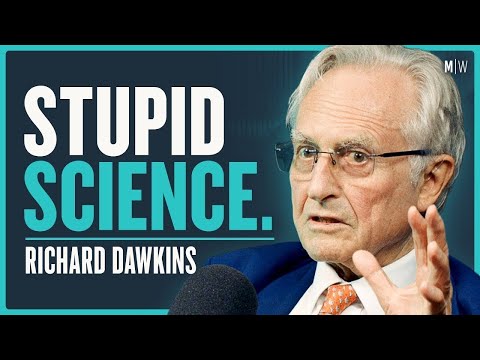
Race, Science, Religion & Evolution - Richard Dawkins
Chris Williamson (host), Richard Dawkins (guest), Narrator
In this episode of Modern Wisdom, featuring Chris Williamson and Richard Dawkins, Race, Science, Religion & Evolution - Richard Dawkins explores richard Dawkins Dissects Religion, Race, Sex, Evolution and Human Destiny Richard Dawkins discusses the modern resurgence of religious identity, arguing that trends like cultural Christianity or new spiritual ‘crutches’ say nothing about truth and are psychologically patronizing to humans. He explains religion as a convergent psychological response to uncertainty and our deep craving for agency, story, and personification before science provided better explanations.
Richard Dawkins Dissects Religion, Race, Sex, Evolution and Human Destiny
Richard Dawkins discusses the modern resurgence of religious identity, arguing that trends like cultural Christianity or new spiritual ‘crutches’ say nothing about truth and are psychologically patronizing to humans. He explains religion as a convergent psychological response to uncertainty and our deep craving for agency, story, and personification before science provided better explanations.
He contrasts race and sex, insisting that race is a genetic spectrum created by many small additive genes, whereas biological sex is fundamentally binary, defined by gamete size, with true intermediates vanishingly rare. Dawkins then defends evolution against growing online skepticism, highlighting molecular genetics, fossils, and biogeography as mutually reinforcing evidence for common descent.
The conversation also touches on population trends, consciousness, behavioral genetics, and the ethics of embryo selection and gene editing, where Dawkins differentiates between eliminating serious genetic diseases and more controversial ‘positive’ eugenics. He closes with reflections on early human ancestors, island dwarfism, and his upcoming book inspired by the biological art of Ernst Haeckel.
Key Takeaways
Religious ‘crutches’ underestimate human capability to live without superstition.
Dawkins argues it is disrespectful to assume humans need religion or similar belief systems to cope with life’s meaning or uncertainty, citing many people who felt liberated—not emptied—when they abandoned faith.
Get the full analysis with uListen AI
Religion likely emerges convergently from our craving for agency and narrative.
Across cultures, humans personify natural forces and invent agents (gods, spirits) to explain events; Dawkins links this to our ancestral need to detect predators and enemies, and modern psychology’s findings on pattern-seeking under uncertainty.
Get the full analysis with uListen AI
Biological sex is best defined by gamete size and is effectively binary.
He distinguishes sex from race by grounding sex in anisogamy—large gametes (eggs) vs. ...
Get the full analysis with uListen AI
Race is a spectrum produced by many small genetic effects, not discrete categories.
Skin color differences arise from numerous ‘polygenes’ with additive effects, so while each gene is Mendelian, their combined impact looks like smooth blending, making ‘race’ more of a continuum than a hard boundary.
Get the full analysis with uListen AI
Evolution is strongly supported by converging evidence from DNA, fossils, and geography.
Dawkins cites hierarchical patterns in molecular genetics, consistent fossil sequences, and geographically constrained lineages (e. ...
Get the full analysis with uListen AI
Embryo selection to avoid severe genetic disease is ethically distinct from designer traits.
He sees little moral issue with using IVF and genetic screening to avoid conditions like hemophilia, but acknowledges greater controversy—and political baggage—around selecting for height, intelligence, or musical talent.
Get the full analysis with uListen AI
Consciousness remains a deep mystery, though social cognition may be key.
Dawkins admits biology lacks a clear theory of consciousness, but is sympathetic to ideas that self-awareness evolved to model other minds in complex social environments, even if many survival tasks could be done by unconscious ‘p-zombie’ systems.
Get the full analysis with uListen AI
Notable Quotes
“Cultural Christianity means nothing… it doesn't mean we believe it. That's what's important, is whether you believe it or not.”
— Richard Dawkins
“I think it's rather demeaning to humanity to suggest they need anything like that… why denigrate humanity in that sort of way?”
— Richard Dawkins
“Sex really is a binary, just about the only binary we've got in human biology.”
— Richard Dawkins
“It's exactly the wrong way around, because race really is a spectrum when sex isn't.”
— Richard Dawkins
“You cannot be sane and not seek some kind of explanation for [life’s] prodigious complexity. And if it's not evolution, it's got to be presumably God.”
— Richard Dawkins
Questions Answered in This Episode
If humans don’t ‘need’ religious or spiritual crutches, what practical frameworks can help people who feel a genuine loss of meaning after leaving faith?
Richard Dawkins discusses the modern resurgence of religious identity, arguing that trends like cultural Christianity or new spiritual ‘crutches’ say nothing about truth and are psychologically patronizing to humans. ...
Get the full analysis with uListen AI
How should public discourse handle the tension between the biological reality of sex as largely binary and the social/political debates around gender identity?
He contrasts race and sex, insisting that race is a genetic spectrum created by many small additive genes, whereas biological sex is fundamentally binary, defined by gamete size, with true intermediates vanishingly rare. ...
Get the full analysis with uListen AI
Where should ethical lines be drawn between using embryo selection to prevent severe diseases and using it to enhance traits like intelligence or athleticism?
The conversation also touches on population trends, consciousness, behavioral genetics, and the ethics of embryo selection and gene editing, where Dawkins differentiates between eliminating serious genetic diseases and more controversial ‘positive’ eugenics. ...
Get the full analysis with uListen AI
Given the convergent psychological roots of religion, is it realistic to expect a long-term, large-scale decline in supernatural beliefs, or will they continually re-emerge in new forms?
Get the full analysis with uListen AI
What kind of empirical evidence or theoretical structure would a convincing biological theory of consciousness need to provide to move beyond current philosophical deadlock?
Get the full analysis with uListen AI
Transcript Preview
What do you make of this recent rise of cultural Christianity, given that you were a big part of popularizing atheism over the last few decades? It seems like, uh, have we already forgotten that? Is this sort of coming back around?
Cultural Christianity means nothing. Um, we're all cultural Christians if we were brought up in a Christian culture. And, and I was, and you, you probably were as well. Um, it doesn't mean anything at all. It doesn't mean we believe it. That's what's important, is whether you believe it or not. And I don't believe a word of it, but it is a simple matter of fact that I'm brought up in a Christian culture, so I'm a cultural, cultural Christian.
It seems that there are, uh, gradations of belief now. I think, uh, people that you might not have expected to have, uh, used it so much, Jordan Petersons of the world, the Russell Brands of the world, the Andrew Tates of the world. Uh, uh, uh, I think is it Latin Mass that is one of the quickest growing, um, denominations, especially for young people? And it's an en- an entire, uh, ceremony that no one, unless you're educated in Latin, that nobody can understand. So, beyond just the moniker of cultural Christianity, it seems like some kind of religious belief is increasing.
Of course, it's, uh, an advantage to be in Latin that nobody can understand, 'cause if you can understand it, you realize what nonsense it is. (laughs)
Uh, th- some people would say that the reason that they like it is that it's got this sort of, uh, uh, like a pomp and s- and, and ceremony and, uh, it makes them feel connected to sort of the roots of what's going on.
Yes, I get that.
Mm.
I can imagine that.
Mm. But it does seem, it's interesting to me that what was rebellious and sort of revolutionary and a, a bit kind of, uh, cutting edge was the atheism, uh, conversation only not so long ago. And there has been, uh, some rebranding, whether it's, uh, uh, men getting their passports and, and talking about wanting to convert to Islam, which I think would've been a very surprising thing to have heard, or, uh, Christianity too. It seems like that's the, uh, on-trend, du jour way to live your life.
You follow trends in society. I'm not that interested in trends in society. I'm interested in what's true. And if there are trends this way, trends that way, that'll be different in, in a few years' time anyway.
Mm-hmm. I do think that they are leading indicators of what we may see, uh, in future.
That is possible, or, or the reverse.
Also true as well. I think, uh, we spoke about this last night, and obviously, uh, I do need to call it out. We had a great conversation on stage for 60 minutes and then another 30, uh, so some-
Install uListen to search the full transcript and get AI-powered insights
Get Full TranscriptGet more from every podcast
AI summaries, searchable transcripts, and fact-checking. Free forever.
Add to Chrome