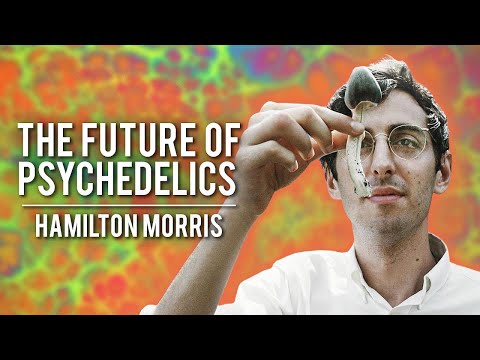
Hamilton Morris - Creating The Future Of Psychedelics | Modern Wisdom Podcast 284
Hamilton Morris (guest), Chris Williamson (host), Narrator
In this episode of Modern Wisdom, featuring Hamilton Morris and Chris Williamson, Hamilton Morris - Creating The Future Of Psychedelics | Modern Wisdom Podcast 284 explores hamilton Morris Envisions Psychedelics As Tools To Reconnect Modern Life Hamilton Morris discusses how his intertwined careers in chemistry, journalism, and filmmaking are driven by curiosity and a desire to make complex drug science visually and intellectually accessible.
Hamilton Morris Envisions Psychedelics As Tools To Reconnect Modern Life
Hamilton Morris discusses how his intertwined careers in chemistry, journalism, and filmmaking are driven by curiosity and a desire to make complex drug science visually and intellectually accessible.
He argues that chemistry is unfairly marginalized compared to physics and astronomy, partly due to cultural fear of 'chemicals' and psychoactive substances, despite chemistry shaping every aspect of daily life.
A major focus is the role of psychedelics: their capacity to enrich life, catalyze near‑death‑like gratitude, and foster social connection, alongside the importance of respect, dosage precision, and sustainable sourcing (e.g., synthetic 5-MeO-DMT vs. toad venom).
Morris advocates broad drug liberalization paired with education, seeing psychedelics as potential antidotes to digital disconnection and social cruelty, and predicts the next decade will bring major scientific, medical, and cultural advances in psychedelic use.
Key Takeaways
Treat psychedelics as powerful, optional enrichments rather than necessities or miracles.
Morris frames psychedelics like music or love—unnecessary for survival but capable of profoundly enriching perception, gratitude, and emotional life when used responsibly and by psychologically stable individuals.
Get the full analysis with uListen AI
Respect set, setting, and narrative as core determinants of psychedelic outcomes.
Experiments from Timothy Leary’s colored-LSD milk to modern toad-venom stories show that priming, mythology, and expectations dramatically sculpt the experience, often more than subtle chemical differences themselves.
Get the full analysis with uListen AI
Prioritize sustainable, honest sourcing over invented spiritual traditions.
Morris distinguishes long-standing indigenous practices (e. ...
Get the full analysis with uListen AI
Approach all drug use with technical precision and deep respect.
He emphasizes exact dosing, purity, and understanding metabolism, noting that most harms arise from ignorance, black-market distortions, and cavalier attitudes—contrasting sharply with his own cautious, lab-informed approach.
Get the full analysis with uListen AI
Reframe drug policy around freedom, education, and harm reduction, not prohibition.
Morris opposes criminalizing drugs, comparing regulation to how we handle cars or radioactive materials: manage risk through rules, accountability, and information rather than blanket bans that fuel violence, panic-buying, and more dangerous patterns of use.
Get the full analysis with uListen AI
Use drug liberalization as a catalyst for community, science, and personal growth.
He imagines futures like cannabis community gardens and home cultivation of psychoactive plants and fungi, arguing these could increase interest in art, therapy, and science while reconnecting people to nature and each other.
Get the full analysis with uListen AI
Recognize that media narratives and social media dynamics warp our view of drugs and each other.
From tabloid scaremongering about 'meow-meow' to online cruelty and offense archaeology, Morris suggests that better media literacy and empathy—possibly aided by psychedelic perspectives—are essential to a healthier cultural relationship with drugs and public discourse.
Get the full analysis with uListen AI
Notable Quotes
“Chemistry is happening immediately around us, inside us, in front of us, controlling every aspect of our reality all the time—and it’s considered boring.”
— Hamilton Morris
“Consciousness will be explained by science in the way that life has been explained by science, but in being explained it will be explained away.”
— Hamilton Morris
“Psychedelics can dramatically enrich your life in the same way that music and art and love and a lot of other technically unnecessary things can.”
— Hamilton Morris
“People are disconnected from the drugs that they use, they're disconnected from the food that they eat, they're disconnected from almost every aspect of their lives.”
— Hamilton Morris
“Maybe bad things will happen, but that’s the price of freedom and I think that as a culture we will mature and evolve to navigate that freedom.”
— Hamilton Morris
Questions Answered in This Episode
How might widespread, carefully supervised psychedelic experiences realistically change online behavior and the current culture of public meanness?
Hamilton Morris discusses how his intertwined careers in chemistry, journalism, and filmmaking are driven by curiosity and a desire to make complex drug science visually and intellectually accessible.
Get the full analysis with uListen AI
Where should we draw ethical lines between respecting indigenous traditions and advocating more sustainable synthetic or cultivated psychedelic sources?
He argues that chemistry is unfairly marginalized compared to physics and astronomy, partly due to cultural fear of 'chemicals' and psychoactive substances, despite chemistry shaping every aspect of daily life.
Get the full analysis with uListen AI
If consciousness is not a single 'thing' but a useful label, how should that shift the goals of neuroscience and psychedelic research?
A major focus is the role of psychedelics: their capacity to enrich life, catalyze near‑death‑like gratitude, and foster social connection, alongside the importance of respect, dosage precision, and sustainable sourcing (e. ...
Get the full analysis with uListen AI
What practical steps could cities or communities take now to pilot Morris’s ideas, like cannabis community gardens or sanctioned psychedelic circles?
Morris advocates broad drug liberalization paired with education, seeing psychedelics as potential antidotes to digital disconnection and social cruelty, and predicts the next decade will bring major scientific, medical, and cultural advances in psychedelic use.
Get the full analysis with uListen AI
How can educators and communicators make chemistry as emotionally compelling and visible as black holes and particle colliders are in popular science?
Get the full analysis with uListen AI
Transcript Preview
I think that there are a lot of dark psychological trends in our society. People are spending all of their time in front of computers. People are, they're not reading, they're detached from certain aspects of reality, they're disconnected from each other, and I think that they're disconnected from the drugs that they use, they're disconnected from the food that they eat. They're disconnected from almost every aspect of their lives, and I think that drugs could have far-reaching positive effects. (rocket ship roaring)
If you meet someone at a party for the first time and they ask, "What do you do?" What's your answer?
It depends on what I'm doing at the time because I, I do a number of different things. If I'm directing a TV show, then I'll say, "I direct a TV show." If I'm writing, I'll say, "I'm writing an article," or, "I'm doing research on this story for a magazine piece," or something like that. And if I'm primarily doing chemistry, I'll say, "I'm doing chemistry right now."
(laughs)
"I'm doing some chemistry."
(laughs)
So, (laughs) that's, it just depends on what I'm doing, 'cause I do different ... I've tried to balance these three components of my life and, as best I can, not only balance them, but allow them to feed off of each other and integrate them into each other in an interesting way. So, I think that's actually been very helpful.
What ties those three things together?
I think curiosity and a desire to investigate the natural world, to understand the world. Um, that's certainly a huge goal of chemistry is to understand the natural world. It's been the focus of almost every article I've ever written, whether it's about crime or chemistry or psychoactive drugs, to try to understand things, phenomena, how they happen, what happened in the past, what's happening now. And filmmaking is the same thing as well, to try to document things, to characterize them, to understand things that are mysterious.
I think I've heard you say before that a lot of chemistry is in not superbly accessible formats, a lot of it's in quite sort of difficult to understand written words, and that was one of the reasons why you enjoy doing the filmmaking as mu- as well, to make it a bit more accessible.
Oh, yeah. Absolutely. I mean, it, it's kind of amazing to me, given how many people have cameras and the existence of YouTube and the existence of this international chemistry community, how many basic chemistry things seem to have never been filmed before. Like, I was talking with a, uh, a chemist acquaintance in Australia a couple nights ago who's doing this really cool project of trying to synthesize this substance called cubane. Uh, have you ever heard of this before?
No, what is it?
Uh, this, uh, for chemists, this is, like, one of the coolest things ever created. It's a cube made of carbon, so it's, it's, uh, eight carbon atoms that are connected in a cube, and it's very, very hard to do that because carbon doesn't want to have 90-degree angles, it's a very strained, uh, bond for a carbon atom. And this guy is doing it in his garage, which I just think is so cool. And, uh, but this is, like, a very famous chemical. It's in, uh, most textbooks and I was thinking, "I've never seen a photograph of cubane." I don't know if cubane has ever been photographed before. I don't know if, you know, like, there's a lot of industrially-important, academically-important reactions that basically are visually unknown to people. They have no idea what they actually look like. And so that was another big part of it, is, is like one of the, you know, one of the, I think the most amazing things that I have learned from years of doing lab work is that chemistry is beautiful and th- and having the ability to bring that beauty to people, to show them, you know, well, you might see methamphetamine synthesis as this exclusively negative thing or you're only thinking about it in terms of its potentially destructive effect on society. But what about the, the beauty of a solvated electron? I mean, it's pretty remarkable.
Install uListen to search the full transcript and get AI-powered insights
Get Full TranscriptGet more from every podcast
AI summaries, searchable transcripts, and fact-checking. Free forever.
Add to Chrome