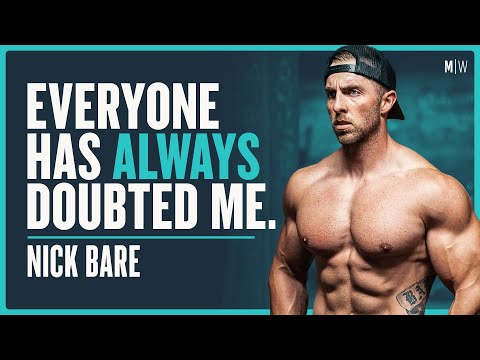
Consistently Good Not Occasionally Great - Nick Bare
Nick Bare (guest), Chris Williamson (host)
In this episode of Modern Wisdom, featuring Nick Bare and Chris Williamson, Consistently Good Not Occasionally Great - Nick Bare explores consistent Effort, Shifting Priorities: Nick Bare On Enduring Success Nick Bare discusses how a decade of disciplined consistency—rather than flashes of brilliance—built his athletic achievements and his Bare Performance Nutrition (BPN) brand. Using his progression from a four-hour marathoner to a 2:48 finisher, he illustrates the power of slow, patient compounding in running, business, and life. He and Chris Williamson explore impending fatherhood, redefining success, avoiding burnout, hiring and culture, and why values and intentional trade-offs matter as responsibilities grow. The conversation emphasizes that what gets you from zero to 75 in life or business won’t get you from 75 to 100—you must evolve, delegate, and deepen your foundations.
Consistent Effort, Shifting Priorities: Nick Bare On Enduring Success
Nick Bare discusses how a decade of disciplined consistency—rather than flashes of brilliance—built his athletic achievements and his Bare Performance Nutrition (BPN) brand. Using his progression from a four-hour marathoner to a 2:48 finisher, he illustrates the power of slow, patient compounding in running, business, and life. He and Chris Williamson explore impending fatherhood, redefining success, avoiding burnout, hiring and culture, and why values and intentional trade-offs matter as responsibilities grow. The conversation emphasizes that what gets you from zero to 75 in life or business won’t get you from 75 to 100—you must evolve, delegate, and deepen your foundations.
Key Takeaways
Consistently good beats occasionally great over the long term.
Bare argues that life is an endurance event: trying to be spectacular all the time leads to burnout, while being reliably good—showing up daily, stacking small wins—builds lasting progress in fitness, business, and personal growth.
Get the full analysis with uListen AI
Pressure and public accountability can enhance performance if you embrace it.
By announcing goals (like a sub-2:50 marathon) to his audience and documenting the process, Bare creates external pressure that he turns into motivation, reinforcing preparation, confidence, and follow-through.
Get the full analysis with uListen AI
Success requires accepting trade-offs and deciding in advance what will suffer temporarily.
Drawing on concepts like ‘4,000 Weeks,’ they suggest intentionally choosing what you’ll be worse at for a season—such as letting fitness or social life dip—to honor higher priorities like family, a new baby, or a critical business phase.
Get the full analysis with uListen AI
Scaling a business hinges more on people and culture than on tactics.
Bare emphasizes hiring for traits and culture fit over credentials, developing people continuously, and building ‘talent density’ so that rules and micromanagement can be minimized while trust and ownership increase.
Get the full analysis with uListen AI
What got you here won’t get you there—your strategy must evolve.
The solo “do everything yourself” hustle works early on, but becomes a ceiling later; to move from 75 to 100, you must delegate, rely on others, and stop over-identifying with past methods and achievements.
Get the full analysis with uListen AI
Clarity of values and definition of success is non-negotiable.
Bare roots decisions in integrity, transparency, faith, service, and defines success as legacy and presence with family rather than just money or fame; without a personal definition, you end up chasing others’ metrics by default.
Get the full analysis with uListen AI
Start before you think you’re ready; ignorance of risk can be an asset.
He credits his younger ‘ignorance’—starting a supplement company without fully understanding the risks—as a key advantage that got him moving while smarter peers were paralyzed by over-analysis.
Get the full analysis with uListen AI
Notable Quotes
“Life is this massive endurance event where if you try to be occasionally great all the time, you're gonna burn out, but if you keep going consistently good and you just keep moving forward... that builds endurance.”
— Nick Bare
“Doubt is only dangerous when you start doubting yourself.”
— Nick Bare
“You can go really fast alone, but you can go so much further together.”
— Nick Bare
“The tools that got them here are not the same ones that are gonna get you there.”
— Chris Williamson
“If a man knows not where he goes, no wind is favorable.”
— Chris Williamson (paraphrasing Aristotle)
Questions Answered in This Episode
How can someone practically identify where they need to shift from ‘occasionally great’ to ‘consistently good’ in their own life?
Nick Bare discusses how a decade of disciplined consistency—rather than flashes of brilliance—built his athletic achievements and his Bare Performance Nutrition (BPN) brand. ...
Get the full analysis with uListen AI
What specific systems or boundaries could help maintain presence with family while still pursuing ambitious business and athletic goals?
Get the full analysis with uListen AI
How do you distinguish between healthy external accountability (sharing goals publicly) and unhealthy pressure or identity attachment?
Get the full analysis with uListen AI
What concrete steps can a solo operator take to begin delegating without feeling like they’re losing their ‘edge’ or quality standard?
Get the full analysis with uListen AI
How should someone go about defining their own vision of success and core values if they’ve only ever followed societal or external expectations?
Get the full analysis with uListen AI
Transcript Preview
Life is this massive endurance event where if you try to be occasionally great all the time, you're gonna burn out, but if you keep going consistently good and you just keep moving forward, you know there's gonna be obstacles. There's gonna be speed bumps. There's gonna be resistance. There's gonna be hills, but just keep driving through it consistently. It's not always gonna be fun. It's gonna suck, it's gonna hurt, but that builds endurance and when you look back over a period of time, you think, "I actually made some progress through this because I was consistently good rather than trying to be or look occasionally great."
Nick Bare, welcome to the show.
Thank you for having me. Thank you for having me in the Bare Performance Podcast studio.
Thank you for having me here.
It go... Dude, it go- it goes both ways right now.
(laughs) How'd you get on with your recent marathon?
Oh, dude, it was great. I ran, uh, a 2:48:11, two hours 48 minutes, 11 seconds. The goal was to run sub-2:50. Um, that's coming off of... So to give some context, my first marathon was in 2018. This was a three-hour, 57-minute marathon, full sufferfest. My second marathon a year later was four hours, 15 minutes. I got worse, and I told people, "I'm just not a runner. It's never gonna happen." And then I finally committed to and stopped believing that, and after an Ironman I said, "I wanna run my first sub-three-hour marathon." And I went a- I went through the process and journeying and trained for it, and I, I failed. I ran three hours, 24 minutes. I realized it was a lot harder than I thought. I wasn't respecting that time. I went back into another prep and I ran a two-hour, 56-minute, 27-second marathon. This was last January. And, uh, then I realized, "What's holding me back? The only thing that's holding me back is me." So I said, "I'm gonna run a sub-2:50." And we did it. We prepped, we went through the process, went through the journey, stacked the bricks, did the workouts, showed up to Buffalo, New York with all the confidence in the world and crossed that finish line, two hours, 48 minutes, 11 seconds.
How'd it feel?
It felt... Uh, it's o- it's one of those things, like, you... I interviewed Matthew McConaughey a few months ago, and he said, "Nothing is unbelievable." He hates the word "unbelievable." Unbelievable? It happened. It happens. It's going to happen. So whenever I cross, like, a finish line, this could be a finish line that's actually physically there or, you know, a goal that I've set. When you cross it, looking back, when you set that goal or that objective and you go through the process, if you have the confidence knowing you're going to do it, you're gonna do it. You just need to put in the work now. So when I crossed the finish line, I wasn't like, "Holy crap! Sub-2:50." It was... You know, I knew after mile three I was gonna do it. Like, you know how you're feeling that early on in the race. So it was... It felt really good because there was a lot of weight on the shoulders because I share my goals with the entire world or my audience who- for whoever's watching. I gotta tell people months before it happens, "This is what I'm going to do. Now I'm going to document and show you how I'm going to get there." So then when it's finally time for me to be tested, yeah, there's a lot of weight on my shoulder that I carry. But I think that pressure also provides some power in how I'm going to perform race day.
Install uListen to search the full transcript and get AI-powered insights
Get Full TranscriptGet more from every podcast
AI summaries, searchable transcripts, and fact-checking. Free forever.
Add to Chrome