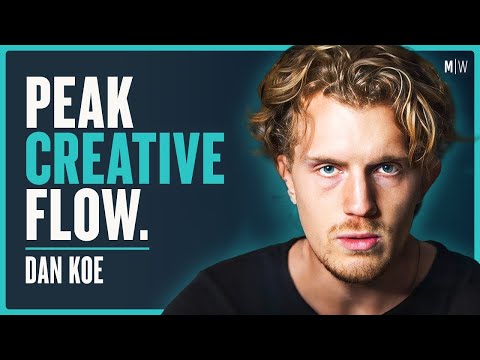
How To Design Your Life For Peak Creativity - Dan Koe
Chris Williamson (host), Dan Koe (guest)
In this episode of Modern Wisdom, featuring Chris Williamson and Dan Koe, How To Design Your Life For Peak Creativity - Dan Koe explores designing A Life Where Creativity, Simplicity And Obsession Thrive Together Chris Williamson and Dan Koe explore how to deliberately design a life that maximizes creativity without burning out productivity or simplicity. They argue that boredom is a powerful signal: most people anesthetize it with distractions instead of channeling it into building meaningful projects. The conversation reframes hard work, showing why what you work on and how you structure your environment and seasons of intensity matter more than sheer effort. They also dig into uncertainty, trade‑offs, writing and creative practice as tools for figuring out what you want from life and moving toward it deliberately.
Designing A Life Where Creativity, Simplicity And Obsession Thrive Together
Chris Williamson and Dan Koe explore how to deliberately design a life that maximizes creativity without burning out productivity or simplicity. They argue that boredom is a powerful signal: most people anesthetize it with distractions instead of channeling it into building meaningful projects. The conversation reframes hard work, showing why what you work on and how you structure your environment and seasons of intensity matter more than sheer effort. They also dig into uncertainty, trade‑offs, writing and creative practice as tools for figuring out what you want from life and moving toward it deliberately.
Key Takeaways
Channel boredom into building, not passive consumption.
Boredom naturally defaults to low‑effort distractions like scrolling and Netflix; deliberately redirecting that energy into building your body, business or a project prevents entropy and creates momentum.
Get the full analysis with uListen AI
Hard work alone is overrated; leverage and direction matter more.
Spending a year working hard on a book doesn’t entitle you to a specific income—results depend on the leverage of the activity, the problem it solves, and how effectively you distribute and position it.
Get the full analysis with uListen AI
Live in intentional ‘seasons’ of lostness, curiosity, intensity, and consistency.
After big goals you’ll often feel lost; if you resist distraction, you move into curiosity, then an intense building phase, and finally a consistency phase where you systematize and sustain a higher baseline without chasing unsustainable peaks.
Get the full analysis with uListen AI
Simplify by aggressively prioritizing and being willing to quit misaligned pursuits.
Curious, capable people can overcommit to too many skills and hobbies; try things, but quickly drop what clashes with your higher‑priority goals or lifestyle instead of spreading your attention thin.
Get the full analysis with uListen AI
Design your environment so discipline is the default, not a constant fight.
Making it hard to be undisciplined—removing junk food from the house, keeping your phone away in the morning, batching comms—reduces temptation and preserves attention for deep creative work.
Get the full analysis with uListen AI
Use uncertainty and problem‑solving as your compass for life direction.
You don’t need a lifelong master plan; start by solving the most pressing problem in front of you, define what you absolutely don’t want (anti‑vision) and what you roughly do want, then iterate as better problems emerge.
Get the full analysis with uListen AI
Write (or create) regularly to clarify thinking and retain what you learn.
Writing is organized thinking on paper and a force multiplier for any skill; a simple weekly newsletter or private Substack gives your ideas somewhere to go, forces synthesis, and makes insights and learning stick.
Get the full analysis with uListen AI
Notable Quotes
“Most people's lives are determined by how they choose to cure their boredom.”
— Dan Koe
“What you work on is significantly more important than how hard you work.”
— Chris Williamson
“Productivity is highly dependent on creativity; when you separate them, both lose their impact.”
— Dan Koe
“You aren’t disciplined because you keep putting yourself in environments that give you a chance to be undisciplined.”
— Dan Koe
“There are no solutions, there are only trade‑offs.”
— Chris Williamson
Questions Answered in This Episode
If I audited how I currently cure boredom, what would it reveal about my trajectory, and what could I choose to build instead?
Chris Williamson and Dan Koe explore how to deliberately design a life that maximizes creativity without burning out productivity or simplicity. ...
Get the full analysis with uListen AI
Where in my life am I working very hard on low‑leverage tasks, and how could I redesign that effort toward higher‑impact work?
Get the full analysis with uListen AI
Which season am I in right now—lostness, curiosity, intensity, or consistency—and what’s the most appropriate next move for this phase?
Get the full analysis with uListen AI
What specific activities, relationships, or habits am I willing to ‘suck at’ or deprioritize for the next 6–12 months to allow real focus?
Get the full analysis with uListen AI
If I wrote an honest anti‑vision of my 85‑year‑old life, what patterns and behaviors today would I need to stop or change immediately?
Get the full analysis with uListen AI
Transcript Preview
"Most people's lives are determined by how they choose to cure their boredom." What's that mean?
(laughs) Oh, man. Uh, the story of that came from my friend, my YouTube editor. We were out getting dinner one night and he said he wanted to start a company called Bored. Like, you know, just a little passion project. And it was because he had been bored for so long in his life that he... The only options that he saw were to do the typical things that you do when you're bored. You scroll on your phone, maybe you watch Netflix, you hang out with friends. There, there isn't really something to build towards, right? And so I kind of ideated that with him for a decent amount of time because the reason he wanted to start that specifically was to give people... Help people create a project that they could work on that would help cure their boredom. And so that kind of ties into, uh, another tweet I wrote where if you're bored, build. So build your body, build your business, build anything really. Just focus that, uh, boredom towards something that isn't... It isn't giving the opportunity for entropy to take hold.
Mm-hmm. You'll know Parkinson's law, work expands to fill the time given to it. This almost feels like it could be Coase law, which would be life expands to fill the boredom given to it.
What's funny is that I- I have a Coase law, but it was for-
You need a second one.
(laughs) Yeah. It was for creative work. So, uh... Man, what was it? It was something along the lines of the same thing where it's creative work... The, the work expands. The results expand to fit the time allotted for completion, where my whole thing with that is since I didn't have a job for too long, I- I'd worked part-time jobs for quite a while, but I was freelance pretty quickly out of a job. And what I started to realize is that when you progress through freelance work, and then I got introduced to social media and digital products, physical products, other things that I just wasn't aware of at the time, it was very interesting how I could make so much more without increasing the amount of work that I did.
Mm-hmm. Yeah, that is interesting. So just to round out the boredom thing, I th- it, it kind of feels to me like if you don't have something to take up your time, your habits and your behavior will sort of default to the path of least resistance.
Yeah.
Is that fair to say?
Absolutely.
Yeah, interesting. Okay, what about hard work? Do you think there's a delusion around hard work?
Uh... By delusion, I would say misconception or, uh, poorly (laughs) poorly fabricated expectations in your head, where if you work hard on one thing for a specific amount of time, you aren't necessarily... You don't deserve something that someone else has gotten by doing that specific thing. So as an example, if you spend one year writing a book, that is a lot of hard work, but that doesn't mean that you deserve $100,000 a year for doing that specific thing, right? And so since we... Most of us, or quite a few of us, we go to school, we get a job, and we... That, that frames our mind in quite a few different ways. One being that we tie a specific amount of work or a specific amount of hours of work each week to a specific number on a paycheck, when that doesn't necessarily have to be the case, and the thing that can trip you up there is you bring that mindset over into your creative work or building your own thing, and you work very hard, but then you get discouraged when (laughs) you don't get the same amount of results or you get substantially less until you pull the levers that allow you to make substantially more.
Install uListen to search the full transcript and get AI-powered insights
Get Full TranscriptGet more from every podcast
AI summaries, searchable transcripts, and fact-checking. Free forever.
Add to Chrome