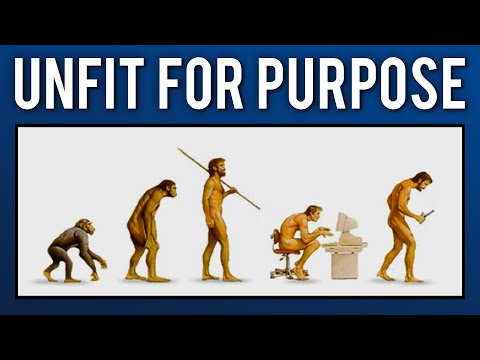
When Human Evolution Collides With The Modern World | Prof. Adam Hart | Modern Wisdom Podcast 192
Chris Williamson (host), Adam Hart (guest)
In this episode of Modern Wisdom, featuring Chris Williamson and Adam Hart, When Human Evolution Collides With The Modern World | Prof. Adam Hart | Modern Wisdom Podcast 192 explores evolved For Savannah, Living With Smartphones: Why Humans Feel Misfit Chris Williamson and Prof. Adam Hart explore how our Stone Age biology collides with a rapidly changing modern world, creating mismatches that drive stress, addiction, disease and social dysfunction.
Evolved For Savannah, Living With Smartphones: Why Humans Feel Misfit
Chris Williamson and Prof. Adam Hart explore how our Stone Age biology collides with a rapidly changing modern world, creating mismatches that drive stress, addiction, disease and social dysfunction.
They discuss how slow genetic evolution cannot keep pace with sub‑generational technological and environmental change, forcing us to manage problems culturally instead of biologically.
Topics include social media and Dunbar’s number, tech addiction, the hygiene/old friends hypotheses, chronic stress, human violence, and the evolutionary roots of emotions.
Hart argues that understanding ourselves as evolved animals—while leveraging our uniquely powerful brains and foresight—is essential if we want to redesign modern life to better fit human nature.
Key Takeaways
Modern environments change far faster than human genes can adapt.
Technological, social, and urban changes now happen within years or decades, while meaningful evolutionary change requires many generations; as a result, we must rely on cultural norms, policy, and personal strategies—not biology—to cope.
Get the full analysis with uListen AI
Our social brains are overloaded by digital networks that exceed evolved limits.
Dunbar’s number suggests we can manage only a few hundred meaningful relationships, yet online platforms expose us to thousands of shifting interactions, amplifying comparison, rumination, and mental health issues unless we deliberately curate, mute, and block.
Get the full analysis with uListen AI
Smartphones and social media hijack ancient reward systems.
Variable rewards (likes, notifications, messages) exploit the same dopamine pathways that evolved for food and sex, making phones slot‑machines in our pockets; adding friction—separate devices, no‑phone zones, digital sunsets—can reduce compulsive use.
Get the full analysis with uListen AI
Rising inflammatory and allergic diseases reflect lifestyle, not just cleanliness.
The popular “hygiene hypothesis” is oversimplified; evidence supports the “old friends” idea that reduced exposure to diverse microbes, animals, and outdoor environments—smaller families, more indoor life—disrupts immune education, even as basic hygiene remains crucial.
Get the full analysis with uListen AI
Chronic low‑level stress turns a life‑saving system into a long‑term hazard.
Fight‑or‑flight responses evolved for acute threats, but modern micro‑stressors—email, news, finances, notifications—keep stress hormones elevated, contributing to poor sleep, inflammation, and disease; intentionally removing stimulation and reconnecting with nature can help recalibrate.
Get the full analysis with uListen AI
Humans come from an unusually violent primate lineage, but also evolved brakes.
Many mammals kill conspecifics and primates are especially violent, yet humans have psychological mechanisms (emotions like shame, social norms, law) that restrain aggression; understanding both tendencies is key to addressing issues from bar fights to domestic abuse.
Get the full analysis with uListen AI
To navigate the future, we must consciously “outgrow” our default settings.
Evolution tuned us for the present, not for long‑term planetary stewardship; by learning how our biases work (e. ...
Get the full analysis with uListen AI
Notable Quotes
“We’re an evolved animal that’s pretty good, but we’ve built a world that often clashes with what we’re built for.”
— Adam Hart
“We’ve had tens of thousands of years to learn the rules face‑to‑face; we’ve had about ten years to work out the rules online.”
— Adam Hart
“The devices we hold in our hands are like slot machines designed for our brains.”
— Adam Hart
“Stress is a lifesaver in the short term, but if you live in it constantly it becomes a long‑term killer.”
— Adam Hart
“Evolution isn’t going to get us out of this; we’re going to have to get us out of this.”
— Adam Hart
Questions Answered in This Episode
How could we redesign social media platforms so they align better with our evolved social capacities instead of exploiting their weaknesses?
Chris Williamson and Prof. ...
Get the full analysis with uListen AI
What practical steps can individuals take to increase exposure to beneficial ‘old friends’ microbes without abandoning modern hygiene and safety?
They discuss how slow genetic evolution cannot keep pace with sub‑generational technological and environmental change, forcing us to manage problems culturally instead of biologically.
Get the full analysis with uListen AI
In what ways might we measure and manage chronic micro‑stress at a societal level, not just as a personal wellness issue?
Topics include social media and Dunbar’s number, tech addiction, the hygiene/old friends hypotheses, chronic stress, human violence, and the evolutionary roots of emotions.
Get the full analysis with uListen AI
How should we think about ‘curing’ or mitigating violence without eroding traits like courage, assertiveness, or self‑defense that may share overlapping roots?
Hart argues that understanding ourselves as evolved animals—while leveraging our uniquely powerful brains and foresight—is essential if we want to redesign modern life to better fit human nature.
Get the full analysis with uListen AI
Given our difficulty in valuing future selves and future generations, what kinds of institutions or cultural norms could help humanity make genuinely long‑term decisions?
Get the full analysis with uListen AI
Transcript Preview
(wind blowing) Are you feeling fit for purpose this evening?
(laughs) To be honest, at the moment, I'm not sure I'm feeling fit for purpose at any given point, but I'll give it a go.
(laughs)
(laughs)
That's fantastic. So, uh, today we're talking about human evolution and what happens when it collides with the modern world, the imbalance between sort of who we are and where we exist, right?
Yeah, exactly. That, that, that's what the book is, is fundamentally about. Basically, we're, we're an evolved animal and we're pretty, we're pretty ge- decent, right? We're a pretty good evolved animal. We, we fit very well to the world and we've achieved global dominance as a consequence. But we have created now a modern world environment that, that seems to clash. And we've got lots of problems in the modern world that we can trace back to our evolutionary heritage to greater or lesser extents. Sometimes it's quite a playful thesis, sometimes it works quite nicely, but we can see those evolutionary echoes in the modern world. So that's the, that's the kind of overall idea.
How much of an imbalance is there between humans and the modern world? 'Cause sometimes I think that I'm doing pretty all right, and then sometimes I feel a bit like an alien.
Yeah, I think, I think we have to understand that we've changed the world in such a massive and dramatic way, in some cases over the last decade. I mean, if you think about it, we're having a conversation here over Skype. Um, I've got my Twitter feed open. We can talk about things going viral and social media stress and FOFO and all that sort of stuff. Th- this would have been meaningless t- ten- even 10 years ago, and tha- and that's just in one small aspect of our life. If, if we look across, across the piece, I mean, COVID-19 has exposed, of course, how globally, um, connected we all are. You know, we got used to the idea of going on flights and moving around. The world now is a very different place from what it was a generation before. And of course, if we look back over the last 100 years or so, it's, it's a very different place. So we've, we've always changed our environment, that's, that's almost a, a feature of humanity. But the changes that we produce now and the environment that many of us now live in and what we call the modern world is a very, very different world from, well, even a century ago, but actually the world in which we, we evolved. You know, if we look at our sort of post-agricultural revolution ancestors 10,000 years ago and we compare it to our lives now, it's a very, very different sort of setup. Although, of course, many aspects of it are also the same. So it's, it, it is a different world that we live in, and I think we have to accept that.
Install uListen to search the full transcript and get AI-powered insights
Get Full TranscriptGet more from every podcast
AI summaries, searchable transcripts, and fact-checking. Free forever.
Add to Chrome