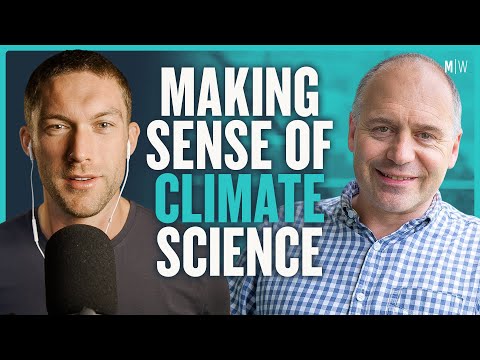
Why Is Climate Science So Disputed? - Richard Betts
Richard Betts (guest), Chris Williamson (host)
In this episode of Modern Wisdom, featuring Richard Betts and Chris Williamson, Why Is Climate Science So Disputed? - Richard Betts explores why Climate Science Divides Us: Models, Morals, and Trade‑offs Climate scientist Richard Betts explains that the core physics of climate change is widely accepted; most disagreement stems from how severe future impacts will be and what responses societies should take. He outlines how climate models work, their accuracy and limits, and the roles of CO2, water vapour, and ecosystem feedbacks like global greening. The conversation explores projected warming scenarios, potential tipping points, and the ethical and practical goals of climate action, including human habitability, biodiversity, and intergenerational responsibility. Betts and Williamson also examine political tensions around development, COP negotiations, activism, nuclear power, and how to communicate climate risks without shaming people or ignoring economic realities.
Why Climate Science Divides Us: Models, Morals, and Trade‑offs
Climate scientist Richard Betts explains that the core physics of climate change is widely accepted; most disagreement stems from how severe future impacts will be and what responses societies should take. He outlines how climate models work, their accuracy and limits, and the roles of CO2, water vapour, and ecosystem feedbacks like global greening. The conversation explores projected warming scenarios, potential tipping points, and the ethical and practical goals of climate action, including human habitability, biodiversity, and intergenerational responsibility. Betts and Williamson also examine political tensions around development, COP negotiations, activism, nuclear power, and how to communicate climate risks without shaming people or ignoring economic realities.
Key Takeaways
Most scientists agree on the basics; the real disputes are about response.
Greenhouse gases, human-driven CO2 rise, and observed warming are not seriously contested in mainstream science; disagreement focuses on how urgent the problem is and what mitigation or adaptation strategies to pursue.
Get the full analysis with uListen AI
Climate models are imperfect but have successfully predicted long‑term trends.
While day-to-day weather is chaotic beyond a few days, models can reliably project long-term warming patterns; early models from the 1960s–70s predicted late‑20th‑century warming with reasonable accuracy.
Get the full analysis with uListen AI
CO2 drives lasting change, amplified by feedbacks like water vapour and vegetation.
CO2 lingers for decades to centuries and is the main human-boosted greenhouse gas; warming increases water vapour (a powerful greenhouse gas) and alters plant growth, which can both absorb CO2 and potentially weaken under future stress.
Get the full analysis with uListen AI
Staying below about 2–3°C still implies serious, long-lived impacts.
Even in moderate scenarios, we likely lock in substantial sea-level rise via glacier and partial ice-sheet melt, expose hundreds of millions to dangerous heat, and heavily stress cold-adapted ecosystems and cultures.
Get the full analysis with uListen AI
Climate policy is inseparable from development, equity, and historical responsibility.
Developing nations want cheap energy and higher living standards, noting that rich countries industrialized using fossil fuels and now outsource emissions; this shapes contentious negotiations over who cuts what and who pays for adaptation.
Get the full analysis with uListen AI
System-level changes matter more than small individual tweaks, but both interact.
Shifting power systems (e. ...
Get the full analysis with uListen AI
Effective climate communication should avoid shame and emphasize constructive solutions.
Betts suggests positive, creative actions and clearer narratives about why changes—like new cycle lanes—exist, so people connect local inconvenience to shared benefits rather than feeling blamed or coerced.
Get the full analysis with uListen AI
Notable Quotes
“Very few people, if any, contest the basic fundamental science of climate change; the deepest controversy is about what this really means and how urgent it is to reduce emissions.”
— Richard Betts
“We are now in a state where we are able to see that the early predictions of climate science are broadly coming true.”
— Richard Betts
“We want to have a good and happy and fulfilling and comfortable life for everybody on Earth, and that requires a certain level of living standards which we have historically relied on fossil fuels to achieve.”
— Richard Betts
“I would be surprised if we could achieve the targets without nuclear energy… I think the problem is so severe that we need to throw everything at it.”
— Richard Betts
“Nobody likes to be told what to do, and nobody likes to be shamed about what they're doing. I much prefer things which are more positive and creative.”
— Richard Betts
Questions Answered in This Episode
If most scientific disagreement is about policy rather than physics, what processes or institutions could help societies debate climate responses more constructively?
Climate scientist Richard Betts explains that the core physics of climate change is widely accepted; most disagreement stems from how severe future impacts will be and what responses societies should take. ...
Get the full analysis with uListen AI
How should we weigh short-term development needs of poorer countries against long-term global climate risks without repeating historical injustices?
Get the full analysis with uListen AI
What level of uncertainty about tipping points like the Greenland ice sheet or the Amazon is acceptable before policy must assume a worst‑case scenario?
Get the full analysis with uListen AI
How can climate communication better connect local inconveniences (like traffic from new cycle lanes) to global benefits in a way that feels fair and motivating?
Get the full analysis with uListen AI
Given the trade-offs around nuclear waste and accident risk, what combination of energy sources realistically balances reliability, safety, cost, and rapid decarbonization?
Get the full analysis with uListen AI
Transcript Preview
We want to have a good and happy and fulfilling and comfortable life for everybody on Earth. That requires certain level of living standards, which we have historically relied on fossil fuels and the use of the land to achieve. But now we're recognizing that the way we've done that in the past is ultimately not sustainable in the long term. But, at the same time, you can't rip that away immediately because we rely on it so much. (wind blowing)
I wanted to try and have a conversation with you to work out how there is so much disagreement about climate science. Just people are prepared to accept that eating too much makes you fat. Well, not everyone, but most people that are sane do. Uh, smoking causes cancer. But climate science seems to probably be one of the most contested areas that I've seen. So for the people that aren't familiar with you and your background, what are your credentials and what do you do?
So I'm a climate scientist at the Met Office, which is the UK's National Weather Service and Climate Service, and I'm also a professor at the University of Exeter. Uh, so I trained as a physicist. Uh, I have, uh, a master's in meteorology and a PhD in meteorology. Uh, and I've worked in the Met Office's Climate Research Department, the Hadley Centre, uh, for nearly, nearly 30 years. So I've been working on the climate modeling and then bringing in observations and these days applying it to risk assessments to, to understand what we might have to do in response to climate change.
And the Intergovernmental Panel on Climate Change, what is the role of that? What's the duty of that?
So, uh, yeah, so I'm a lead author on one of the, well, several of the reports by the, uh, Intergovernmental Panel on Climate Change, the IPCC. The role of that, uh, is to, uh, produce authoritative assessments of the science, uh, of climate change in many different aspects. Uh, so the, the physical science, understanding the changes that are occurring, what we're expecting for the future, but also the, uh, the implications for human impacts, uh, biodiversity impacts and so on. And, um, and the, uh, perhaps more challen- even more challenging than all that, the, the different options, um, for reducing climate change in terms of mitigation. Uh, the IPCC is, uh, is somewhat unique and it also links very closely to, uh, to government. It's not a government document, but it is, it's designed to inform government policy. So part of the process at the end is to work very closely with representatives of the world's governments, uh, to, to make sure that they are bought into the, uh, the, the, the, the science of it. And that's where it gets particularly interesting at the end, the, uh, the end of the process. But it is a scientific document ultimately.
Talk to me about this tension that I brought up earlier on then. Why is it the case that there can be so much contested about something that to me sounds like a science?
Install uListen to search the full transcript and get AI-powered insights
Get Full TranscriptGet more from every podcast
AI summaries, searchable transcripts, and fact-checking. Free forever.
Add to Chrome