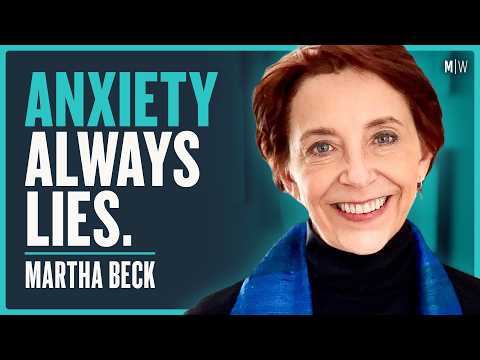
How to Break Free From Chronic Anxiety - Martha Beck
Chris Williamson (host), Martha Beck (guest)
In this episode of Modern Wisdom, featuring Chris Williamson and Martha Beck, How to Break Free From Chronic Anxiety - Martha Beck explores martha Beck Explains How To Exit Anxiety And Enter Creativity Martha Beck distinguishes clean, situational fear from chronic, story-driven anxiety and argues that modern culture and our brain’s negativity bias create a one-way anxiety spiral. She explains how anxiety reshapes perception, relationships, health, and creativity, essentially turning a temporary state into a fixed personality. Beck outlines practices to defuse anxiety—especially loving-kindness self-talk, curiosity, right-brain activation, rest, and self-expression—and emphasizes accepting and befriending anxiety rather than fighting it. She also connects integrity (living in inner truth) with reduced psychological suffering and greater creativity, suggesting that aligning with one’s real nature is the ultimate antidote to chronic anxiety.
Martha Beck Explains How To Exit Anxiety And Enter Creativity
Martha Beck distinguishes clean, situational fear from chronic, story-driven anxiety and argues that modern culture and our brain’s negativity bias create a one-way anxiety spiral. She explains how anxiety reshapes perception, relationships, health, and creativity, essentially turning a temporary state into a fixed personality. Beck outlines practices to defuse anxiety—especially loving-kindness self-talk, curiosity, right-brain activation, rest, and self-expression—and emphasizes accepting and befriending anxiety rather than fighting it. She also connects integrity (living in inner truth) with reduced psychological suffering and greater creativity, suggesting that aligning with one’s real nature is the ultimate antidote to chronic anxiety.
Key Takeaways
Anxiety is a future-story, not a present-moment reality.
Unlike fear, which responds to an actual, immediate threat and then subsides, anxiety is generated by imagined scenarios along the timeline—stories about what might happen—so it is never truly ‘in the room’ and is therefore fundamentally untrue.
Get the full analysis with uListen AI
The brain’s negativity bias and storytelling create a one-way anxiety spiral.
Our brains over-focus on threats (the ‘puppies and a cobra’ effect) and then spin narratives about danger; the amygdala treats those narratives as real environments, creating an unregulated feedback loop that drives anxiety higher unless we consciously intervene.
Get the full analysis with uListen AI
Befriending anxiety with kind self-talk is more effective than fighting it.
Practices like loving-kindness meditation (KIST) and a calm, ‘late-night DJ’ inner voice toward even our harshest self-critic can soothe the overcharged amygdala; fighting anxiety only amplifies the fight–flight response, while compassionate attention lets it relax.
Get the full analysis with uListen AI
Curiosity is a practical pivot out of anxiety in the moment.
Shifting from “Oh no” to “Huh? ...
Get the full analysis with uListen AI
Right-brain, body-based and nature-based activities rebalance the anxious mind.
Drawing, moving through nature, ‘spiritual sports’ (surfing, skiing, climbing), and even tracking animals pull us into right-hemisphere, present-moment, non-verbal awareness—restoring nervous system regulation and unlocking creativity that anxiety shuts down.
Get the full analysis with uListen AI
Deep rest and pleasure are prerequisites for genuine creativity.
For the chronically anxious or exhausted, Beck recommends several days of agenda-free rest and simple pleasures (comedy, ice cream, absorbing art) to ‘fill the well’; only after nervous system recovery does spontaneous creative impulse reliably return.
Get the full analysis with uListen AI
Most suffering is rooted in misaligned beliefs about self-worth and reality.
Beck argues that psychological pain signals a loss of ‘integrity’ (structural truth): early experiences and cultural messages often install a core belief of “I’m not enough,” and systematically uncovering and correcting these untrue stories reduces anxiety and restores a stable sense of self.
Get the full analysis with uListen AI
Notable Quotes
“Anxiety is like being haunted. If you sit with it, you will see that it is never with you in the room.”
— Martha Beck
“Anxiety only goes in one direction. It always goes up; it never reverses—unless you actively defuse it.”
— Martha Beck
“Always think of your anxiety as an animal, because that is literally what it is. It’s not a broken machine; it’s a frightened animal.”
— Martha Beck
“Anything you do that’s creative—the point is not the product. The point is the doing.”
— Martha Beck
“If you have psychological suffering, the physics are off. Somewhere in there is a belief that isn’t true.”
— Martha Beck
Questions Answered in This Episode
How can I tell, in real time, whether I’m experiencing clean fear about something real or chronic anxiety about a story in my head?
Martha Beck distinguishes clean, situational fear from chronic, story-driven anxiety and argues that modern culture and our brain’s negativity bias create a one-way anxiety spiral. ...
Get the full analysis with uListen AI
What would a daily, practical routine of loving-kindness self-talk and curiosity look like for someone with severe, long-term anxiety?
Get the full analysis with uListen AI
Which specific right-brain or nature-based practices are most feasible if I live in a city and have limited free time?
Get the full analysis with uListen AI
How do I start identifying and challenging the deep-seated belief that “I’m not enough” when it feels like the basic fabric of my personality?
Get the full analysis with uListen AI
If I allowed myself four days of genuine rest and pleasure, what fears about productivity, identity, or self-worth would I have to confront?
Get the full analysis with uListen AI
Transcript Preview
You say, "Anxiety always lies."
Mm.
Always. Why?
I say that at the end of the book. (laughs) And then-
Uh, spoiler alert. Sorry about that.
And then, boom! Come at me with the biggest tr- no, here's the thing. We have brains that are very prone to anxiety, and we have a culture that magnifies our proneness to anxiety. But anxiety, unlike fear, which is a very, uh, uh, a response, a visceral response to a danger that is present in the physical moment. There's a, a surge of adrenaline, a surge of activity, and then boom, it's gone. Anxiety comes from, uh, the way we perseverate and tell stories to ourselves in our heads about the things that may or may not happen. As Mark Twain said, "I'm an old man, and I have lived through many troubles, but most of them never happened." So, anxiety is like being haunted. And if you sit with it, you will see that it is never with you in the room. It is never in a form that you can address in the present. It's always saying about- things about something that are s- something that's happening somewhere else in s- uh, somewhere on the line of time. And for that reason, it's never real, it's never present, and it's never true.
This interesting cocktail between our brain's predisposition and our modern society's reinforcement of that-
Mm-hmm.
... I suppose. Yeah, I, it's an interesting one talking about anxiety because it's become so pattern-matched. People have used, "I feel uncertain," or, "I am worried," and the term has sort of concept-creeped itself out-
Yeah.
... to, to encompass all of this. So I wonder, I wonder how much of it is, uh, people giving a name which sounds way more pathological-
(laughs)
... to something which is a normal part of the human experience, you know?
Well, there is that. No question, we are like over-diagnosing ourselves and over-assigning diagnoses to everything that happens. But it's also true that even like the World Health Organization looking with, with fairly objective tests, as objective as you can get, has shown a dramatic rise in the number of people who are suffering crippling clinical levels of anxiety, um, as diagnosed by independent observers. So that went up by 25% during the, the pandemic and has continued to rise since the pandemic. The reason for that is, I found when I started to study it, is that anxiety only goes in one direction. It always goes up, it never reverses for reasons very particular to the human brain.
Dig into that. What do you mean anxiety only ever goes up, it never reverses?
Right. So if you've gone over a, uh, a tire ripper leaving a parking lot, and it's a, uh, there are these teeth, and when you go forward, they, they get smooshed under your wheels. But if you go back, they'll rip you apart. So it's a one-way process. In our brains, we have two things that make us capable of spinning anxiety up and up and up and largely unable to bring it down, down, down. Although that is possible, eminently possible. And the, the two things are something called the negativity bias, which I also call the 15 puppies and a cobra syndrome. If you went into a room and noticed 15 puppies and a cobra, where would all your attention go? It would go to the most frightening thing in the room because that's an evolutionary survival adaptation. Yeah? The problem is that when you see anything in your environment at all, you are likely to interpret it as something dangerous or negative because, and all brains have that, all ma- mammalian brains have that negativity bias. But in humans, it snags on the other capacity, and that is the ability to tell ourselves stories about what might happen, what could happen, what may have happened elsewhere that are so frightening to us that we actually, at a fairly regular rate, certain humans take their own lives rather than face what the story in their heads is telling them about a possible future. So you take the negativity bias, it sees the most negative thing in the room or online, the algorithms are written to give us more of whatever our attentions last, lives on the longest. You know, when we fixate attention, it gears those algorithms to give us similar material, which is an externalization of what's going on in our brains. We see something negative, we think it's gone wrong. We smell something, "Oh, that's strange." Then immediately it's, "Oh goodness, what if there's a gas leak? Oh my God, I know somebody who died in a gas leak. Oh my God." And that story, instead of being seen as fantasy, which it is, is reinterpreted by the primitive levels of the brain as an actual environment. So when you say, "Oh my God, the IRS is coming to take everything," your amygdala responds as if you are actively physically being attacked, and it can stay in that high fight or flight excitation level for literally years while you slowly die of degenerative illness because you were never meant to live in that high state of fear arousal. So yeah, it's, it's a one way, it's what scientists call an unregulated feedback system. It goes in, it feeds on itself.
Install uListen to search the full transcript and get AI-powered insights
Get Full TranscriptGet more from every podcast
AI summaries, searchable transcripts, and fact-checking. Free forever.
Add to Chrome