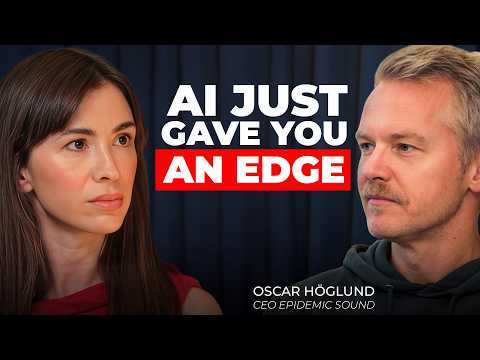
The 2026 Business Playbook: Leverage AI Before Your Competitors Do | Epidemic Sound CEO
Marina Mogilko (host), Oscar Höglund (guest), Marina Mogilko (host), Marina Mogilko (host), Marina Mogilko (host)
In this episode of Silicon Valley Girl, featuring Marina Mogilko and Oscar Höglund, The 2026 Business Playbook: Leverage AI Before Your Competitors Do | Epidemic Sound CEO explores epidemic Sound CEO’s 2026 playbook: AI leverage, discipline, value chains Oscar Höglund (Epidemic Sound co-founder/CEO) breaks down what makes content resonate and spread: creating meaningful human connection, often amplified by intentional audio choices.
Epidemic Sound CEO’s 2026 playbook: AI leverage, discipline, value chains
Oscar Höglund (Epidemic Sound co-founder/CEO) breaks down what makes content resonate and spread: creating meaningful human connection, often amplified by intentional audio choices.
He introduces the “CROSS” concept—pairing unexpected contrasts (visual vs. audio, or persona vs. story) to create cognitive dissonance that draws attention and boosts engagement.
Oscar outlines how Epidemic evolved from a single feature (simple licensing) into a product and then a platform, driven by rights ownership, software tooling, and a data/AI “platform moment” (Antidote).
He shares operator frameworks for growth—value-chain leverage, hiring A-players smarter than you, giving more than you take, disciplined boundaries to stay sane—and a practical “three WHYs” method for rigorous problem-solving in the AI era.
Key Takeaways
Virality is an emotion + connection problem, not a trick.
Oscar frames going viral as helping people feel something and connect; tools (including music) are multipliers, but the core is meaningful storytelling and audience resonance.
Get the full analysis with uListen AI
Use music to control emotion—commercial hits can weaken that control.
Relying on famous tracks imports unpredictable associations from the audience; purpose-built or carefully selected music gives creators more precise emotional steering.
Get the full analysis with uListen AI
The “CROSS” creates attention through contrast.
Unexpected pairings (e. ...
Get the full analysis with uListen AI
AI will democratize “expensive” creative roles like music supervision.
Epidemic aims to give solo creators capabilities once reserved for big-budget teams: recommendations, timing, sound effects guidance, mastering, and performance-informed suggestions.
Get the full analysis with uListen AI
Adapt the track to the edit (not the edit to the track).
Oscar highlights a workflow breakthrough: AI tools that can extend/shorten tracks so creators keep narrative pacing while still using the music they want.
Get the full analysis with uListen AI
Build big by moving from feature → product → platform.
Epidemic started as a licensing feature (a “vitamin”), became a product via creator workflow tooling (a “need”), and is shifting to platform by opening internal infrastructure/data capabilities (their “AWS moment,” branded “Antidote”).
Get the full analysis with uListen AI
Value-chain mapping creates leverage with minimal effort.
Instead of selling to thousands of editors, Epidemic sold to four broadcasters at the top of the chain; those buyers forced adoption downstream, turning a hard distribution problem into a small-number sales motion.
Get the full analysis with uListen AI
Hire people smarter than you—avoid being the smartest in the room.
Oscar’s hiring principle is to bring in A-players who can outperform and direct him; the goal is compounding judgment and capability, not preserving ego.
Get the full analysis with uListen AI
“Hustle” isn’t the point; relentlessness + guardrails are.
He acknowledges long hours and sacrifice (grit/relentless) but rejects always-on chaos; sustainable execution comes from disciplined constraints, not performative overwork.
Get the full analysis with uListen AI
Become someone others want to see succeed by giving more than you take.
Oscar treats generosity as a compounding strategy: lead with “How can I help? ...
Get the full analysis with uListen AI
Discipline is the unsexy burnout prevention system.
He set strict boundaries (no meetings before 9am, unreachable 6–9pm, no weekend work) after a breaking-point moment at home, protecting family while maintaining intense focus blocks.
Get the full analysis with uListen AI
In an AI-abundant world, advantage shifts to asking better questions.
Oscar’s “three WHYs” framework pushes founders to reach root causes before building; then AI can accelerate execution once the real problem is correctly defined.
Get the full analysis with uListen AI
Notable Quotes
“Content creation and going viral is ultimately about helping create meaningful human connections.”
— Oscar Höglund
“If you understand the value chain you are in, you can get leverage… with a small amount of input, you can get a huge amount of output.”
— Oscar Höglund
“If I'm the smartest person in the room, we're all doomed.”
— Oscar Höglund
“This was Oscar. He gave more than he took.”
— Oscar Höglund
“This doesn't work anymore because our life now is better when you're not here.”
— Oscar Höglund (quoting his wife)
Questions Answered in This Episode
How would you operationalize the “CROSS” idea into a repeatable checklist for creators (e.g., visual/audio mismatch, title/thumbnail dissonance, narrative reversal)?
Oscar Höglund (Epidemic Sound co-founder/CEO) breaks down what makes content resonate and spread: creating meaningful human connection, often amplified by intentional audio choices.
Get the full analysis with uListen AI
You mentioned comfort-music spikes post-COVID (warm/classical). What other macro “mood cycles” have you observed in the data, and how early can you detect them?
He introduces the “CROSS” concept—pairing unexpected contrasts (visual vs. ...
Get the full analysis with uListen AI
When does cognitive dissonance backfire—what’s the line between a compelling cross and audience confusion or mistrust?
Oscar outlines how Epidemic evolved from a single feature (simple licensing) into a product and then a platform, driven by rights ownership, software tooling, and a data/AI “platform moment” (Antidote).
Get the full analysis with uListen AI
What specific signals would your AI use to recommend *where* music should enter/exit a video (scene boundaries, speech density, sentiment shifts, retention dips)?
He shares operator frameworks for growth—value-chain leverage, hiring A-players smarter than you, giving more than you take, disciplined boundaries to stay sane—and a practical “three WHYs” method for rigorous problem-solving in the AI era.
Get the full analysis with uListen AI
On the “Antidote” platform vision: who are the two-sided participants (artists, creators, developers, brands), and what’s the core transaction the platform enables?
Get the full analysis with uListen AI
Transcript Preview
The world is crazy right now.
Yeah.
You're building a company in a very competitive market. How do you stay sane?
If I were to boil it down into one word, it's [beep] .
This is Oscar Höglund, the co-founder and CEO of Epidemic Sound, who grew a $1.4 billion company behind 3 billion views on social media every single day.
One of the most important things that we ever did was trying to understand value chains.
Can you explain value chain?
If you understand the value chain you are in, you can get leverage, and leverage, in my world, is with a small amount of input, you can get a huge amount of output.
With more data on viral content than almost anyone, Oscar is building an AI that will change everything. But success came at a price: the darkest moment that almost made him walk away.
My wife said, "This doesn't work anymore because our life now is better when you're not here."
[music] Oscar rebuilt everything after that night. Now, he breaks down the framework any founder can apply: how to scale bigger, make more money, and avoid the mistakes that cost him everything. Hello, everyone. Welcome to Silicon Valley Girl. I have Oscar from Epidemic Sound today. Oscar's company is behind 3 billion views on social media every single day, and that's just YouTube, right?
Correct.
So you know a thing or two-
Mm
... about going viral. Have you seen any patterns behind videos that stand out, that use your music? Is there anything like, "Oh, this is happening right now"?
Well, first off, thanks for having me, and then to answer your question, we soundtrack huge amounts of online video every single day across all platforms, and so we're privy to see a lot of different trends. I think that what's at the core of all of those trends, however, is like a very philosophical thing, which is content creation and going viral is ultimately about helping create meaningful human connections. And so what we do is we facilitate creativity, and we help spark interest.
Do you see any correlation? Like, if I'm a YouTuber, 'cause I use music-
Mm-hmm
... but I feel like the way I use music is like, "Okay, I was at Ed Sheeran's concert yesterday. Uh, let me just use Ed Sheeran."
Mm.
Like, and that's the way it works for me, but I'm trying to understand the mechanics. Like, do you see anything like, "Oh, this type of music performs better with this?" Like, have you noticed something-
[inhales]
... while analyzing that data?
Ultimately, what you're trying to achieve with music, as we said on the outset, is you wanna help create an emotion, and this, similar to common belief, if you only use commercially well-known music as a storyteller, as a person looking to help create a specific feeling, you abdicate from that power because you don't know exactly who's had what kind of experience-
Mm
Install uListen to search the full transcript and get AI-powered insights
Get Full TranscriptGet more from every podcast
AI summaries, searchable transcripts, and fact-checking. Free forever.
Add to Chrome