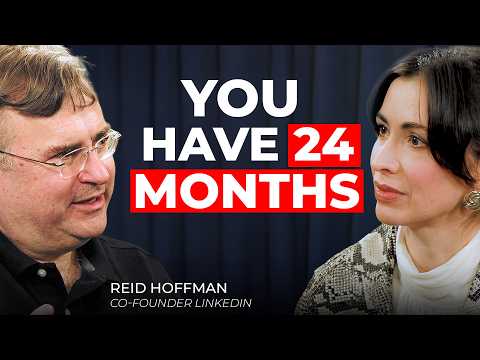
LinkedIn Founder: AI Is Changing Every Job Faster Than You Think | Reid Hoffman
Marina Mogilko (host), Reid Hoffman (guest), Marina Mogilko (host)
In this episode of Silicon Valley Girl, featuring Marina Mogilko and Reid Hoffman, LinkedIn Founder: AI Is Changing Every Job Faster Than You Think | Reid Hoffman explores reid Hoffman on AI agents transforming work, software, and entrepreneurship fast Hoffman argues we’re still only ~5% (or less) into the AI boom, and that AI’s “coding” progress is really generalized reasoning that will spread into nearly every kind of knowledge work and creativity.
Reid Hoffman on AI agents transforming work, software, and entrepreneurship fast
Hoffman argues we’re still only ~5% (or less) into the AI boom, and that AI’s “coding” progress is really generalized reasoning that will spread into nearly every kind of knowledge work and creativity.
He recommends non-technical professionals build practical fluency: voice interaction, long-form prompting, and role-based prompting—plus explicitly requesting web research because models can be out of date.
For companies, he predicts a major shift in SaaS: AI makes building/maintaining tailored internal software much cheaper, weakening feature-bloat moats and contributing to market shocks like the “$300B” selloff.
He expects jobs to change more than vanish in the near term (humans + AI), with many roles becoming “conductors” managing multiple agents; entrepreneurs should rebase products on AI, differentiate via trust/brand/community, and continually refactor as platforms evolve.
Key Takeaways
Assume AI change is early-stage—and accelerating.
Hoffman pegs current adoption/capability as ~5% (even “2%”) of what’s coming, implying workflows, tools, and competitive advantages will keep shifting rapidly year over year.
Get the full analysis with uListen AI
Treat “coding AI” as broad reasoning that will hit every job.
He frames code generation as a visible subset of generalized problem-solving, enabling AI travel agents, research assistants, content pipelines, and business-ops copilots—not just developer tooling.
Get the full analysis with uListen AI
Basic AI literacy now means voice + long prompts, not one-liners.
He recommends speaking to models to move faster and asking the model to write a detailed prompt (e. ...
Get the full analysis with uListen AI
Use role-based prompting to think wider and stress-test decisions.
Having AI answer as multiple roles (technologist, investor, policy, safety, contrarian) surfaces blind spots and improves argument quality—especially when you also ask which roles you missed.
Get the full analysis with uListen AI
Don’t forget models can be stale—explicitly request web research.
He warns many users assume models are fully current; for tool selection or fast-moving domains, you should instruct it to browse/pull sources and produce a report rather than rely on internal memory.
Get the full analysis with uListen AI
“Advanced” setups add meta-analysis across internal + external data.
He rates Marina’s multi-project agent workflow as “medium” and suggests leveling up with a meta-agent that finds through-lines across performance data and competitor/market signals to drive next actions.
Get the full analysis with uListen AI
AI is weakening classic SaaS moats and enabling bespoke software.
If customers only want a subset of features, AI makes it cheaper to generate and maintain their own tailored systems—reducing the advantage of feature accumulation and potentially compressing margins.
Get the full analysis with uListen AI
Many roles become agent managers; software jobs shift, not instantly vanish.
He expects engineers to move from “typing code” to orchestrating multiple coding agents; more organizations (even non-tech ones) may hire these “conductors” to adapt systems continually.
Get the full analysis with uListen AI
To double income, become visibly “AI-transformational” in a domain.
His practical career advice: build and publicly demonstrate AI competence applied to real business functions (supply chain, finance, risk, marketing, sales) so employers can easily find and trust you.
Get the full analysis with uListen AI
Entrepreneurs must rebase on AI and differentiate beyond “solo chatbot.”
He advises founders to assume core capabilities will be commoditized by big platforms (e. ...
Get the full analysis with uListen AI
Innovation will likely be human+AI, with growing AI-led share.
He estimates 60–70% of invention will be human+AI over the next 50–100 years, 25–30% primarily AI-driven, and ~5% purely unassisted human “eureka.”
Get the full analysis with uListen AI
The single best anti-obsolescence habit is an “AI reflex.”
Before tasks—work, planning, even difficult conversations—ask “How could AI help? ...
Get the full analysis with uListen AI
Notable Quotes
“Maybe five percent.”
— Reid Hoffman
“There aren't individual contributing workers anymore that we all deploy with a set of AIs.”
— Reid Hoffman
“In prompting, you don't just go, 'Oh, I type in seven words and see what I get.'”
— Reid Hoffman
“Its training run finished 18 months ago, so it's actually 18 months out of date... You actually have to ask it a research question.”
— Reid Hoffman
“I'm more of a conductor than I am a violin player.”
— Reid Hoffman
Questions Answered in This Episode
When you say we’re only at ~5% of the AI boom, what specific capabilities (agents, tools, interfaces) define the next “25%” phase?
Hoffman argues we’re still only ~5% (or less) into the AI boom, and that AI’s “coding” progress is really generalized reasoning that will spread into nearly every kind of knowledge work and creativity.
Get the full analysis with uListen AI
Can you give a concrete example of your “two-page prompt” method—what sections should it include (sources, constraints, evaluation rubric, deliverables)?
He recommends non-technical professionals build practical fluency: voice interaction, long-form prompting, and role-based prompting—plus explicitly requesting web research because models can be out of date.
Get the full analysis with uListen AI
How would you design a role-based prompting template for a non-technical job like sales or recruiting to reliably reduce bad decisions?
For companies, he predicts a major shift in SaaS: AI makes building/maintaining tailored internal software much cheaper, weakening feature-bloat moats and contributing to market shocks like the “$300B” selloff.
Get the full analysis with uListen AI
What’s your practical checklist for knowing when to trust a model’s answer versus forcing web research and citations?
He expects jobs to change more than vanish in the near term (humans + AI), with many roles becoming “conductors” managing multiple agents; entrepreneurs should rebase products on AI, differentiate via trust/brand/community, and continually refactor as platforms evolve.
Get the full analysis with uListen AI
On the SaaS “moat erosion” point: which categories (CRM, analytics, support, finance ops) are most vulnerable to internal AI-built replacements first, and why?
Get the full analysis with uListen AI
Transcript Preview
We've seen Claude releasing this two-hundred-line code that brought the B2B market down.
[chuckles]
We lost three hundred billion dollars of market value.
All of that is literally just beginning but is all line of sight.
This is Reid Hoffman, co-founder of LinkedIn, legendary investor who was among the first to see every major tech wave coming. And what he's saying now should concern anyone with a career.
There aren't individual contributing workers anymore that we all deploy with a set of AIs.
So what, what do I do?
Right.
What do people like me do?
Even most people who say, "Oh yeah, I'm using AI" are not using it seriously enough.
You've been mentioning this a lot.
Yeah.
Everyone will have a set of agents working for them. Is it possible now, or we're still not quite there yet?
It's totally possible now.
So for someone who has a 9-to-5 job, what's the first thing they should do to double their income this year?
Oh, that's interesting. Well, maybe the simplest one is...
And I'm super excited that we're talking again a year later-
Yep
... so we can revisit some of the things-
Great
... that you said last year. [chuckles]
Awesome.
It's been a crazy year.
Yeah.
And I see ChatGPT everywhere. People are using different tools to build their own things.
Yeah.
Is this the AI boom, or is it, like, ten percent of what we're gonna see?
Maybe five percent.
Five percent?
Yeah.
Okay.
Obviously the last couple years people have been talking about it a lot. And one of the things we should get you, and we'll figure out how to get to you, but, like, I actually made an AI Christmas record.
Ooh.
Um, you know, kind of AI m- uh, music I'd wanna see around Christmas. And it's just beginning to scratch what these kind of possibilities are, 'cause by the way, I'm not qualified to make a record. Um, you know, I have none of the skills. But with AI you can do that. And so what I think people are under-tracking is they're seeing, of course, um, the general discussion of Codex and Claude Code and, and other things, and they're not realizing how that spreads out to every portion of, of kinda human work and creativity, that it isn't just, oh, we all have a software agent as our co-pilot doing stuff for us. Yes, that'll be true too, but that the coding capabilities are like generalized reasoning capabilities that then enable a bunch of things. They enable you to say, "Well, you know what I've always wanted for, for someone working with me as a travel agent is someone who really understood, you know, my love of particular kinds of archeology. Could you then be the travel agent that figured out, like, where and what and da da da da-"
Mm-hmm
... "and could possibly book things and all this?" Like, all of that is literally ju-just beginning, but is all line of sight. So I think we're literally... Like for example, we're a small N number of years by which we realize something I've been saying for the last couple, which is there aren't individual contributing workers anymore that we all deploy with a set of AIs. Like, for example, um, almost for sure when we're doing this conversation, let's just project next year since we did last year.
Install uListen to search the full transcript and get AI-powered insights
Get Full TranscriptGet more from every podcast
AI summaries, searchable transcripts, and fact-checking. Free forever.
Add to Chrome