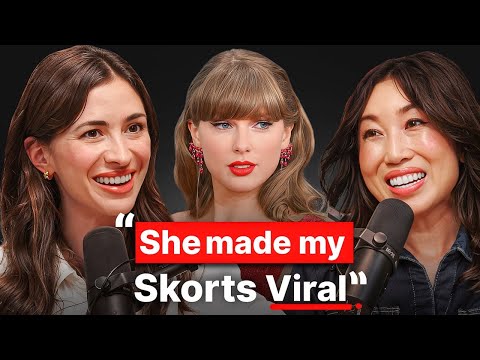
How to Build a Viral Brand Online ft. @blogilates
Marina Mogilko (host), Marina Mogilko (host), Marina Mogilko (host)
In this episode of Silicon Valley Girl, featuring Marina Mogilko and Marina Mogilko, How to Build a Viral Brand Online ft. @blogilates explores blogilates’ playbook for viral content powering durable DTC brands Cassey Ho breaks down her two-brand strategy: Popflex as the innovation-forward DTC lab and Blogilates as a mass-reach Target retail brand that can expand awareness without cannibalizing premium sales.
Blogilates’ playbook for viral content powering durable DTC brands
Cassey Ho breaks down her two-brand strategy: Popflex as the innovation-forward DTC lab and Blogilates as a mass-reach Target retail brand that can expand awareness without cannibalizing premium sales.
She shares that brand deals and ad revenue are now negligible (<1%), with 99%+ of revenue coming from apparel—driven primarily by organic short-form content that can directly cause sell-outs.
The conversation highlights what’s working now in marketing (behind-the-scenes product storytelling, community casting, TikTok Lives) and what’s fading (traditional UGC that feels overly produced).
Ho also details the emotional and operational realities of staying lean (30-person team), her strong stance against AI-enabled theft and deepfakes, and the ongoing fight against dupes—even when products are patented.
Key Takeaways
Use DTC as the innovation lab; retail as the awareness amplifier.
Popflex prototypes new ideas and validates demand; winning products are redesigned to hit Target’s lower price point, expanding reach while keeping the premium brand aspirational.
Get the full analysis with uListen AI
Lower-priced retail can increase premium DTC sales when positioned as discovery marketing.
Ho feared cannibalization, but the Target launch boosted Popflex because front-of-store visibility, sell-outs, and packaging/story tags funneled customers to the higher-end line.
Get the full analysis with uListen AI
A creator brand becomes durable when revenue doesn’t depend on brand deals.
She reports <1% of revenue from ads/brand deals and 99%+ from apparel, avoiding sponsor constraints and relationship tension around compliance and approvals.
Get the full analysis with uListen AI
Behind-the-scenes storytelling sells because it proves intent, craft, and differentiation.
Design sketches, failed samples, and “problem/solution” narratives make product development inherently watchable—and can trigger rapid sell-outs after a viral post.
Get the full analysis with uListen AI
Founder-made content can be a competitive moat—even if it’s time-expensive.
Ho still edits on her phone, noting a 60-second video can take ~9 hours; she chooses this because it preserves joy and authenticity that audiences respond to.
Get the full analysis with uListen AI
Community-driven “try-on diversity” content outperforms polished UGC right now.
Popflex’s content house uses open casting and models the same item across nine sizes (XXS–3X), helping shoppers self-identify fit—while Ho sees generic UGC fatigue rising.
Get the full analysis with uListen AI
Micro-creators and TikTok Lives can outperform “influencer” promos due to trust dynamics.
A TikTok user with ~1,900 followers went live for 5–6 hours and caused a noticeable sales spike, reinforcing that perceived honesty can beat polished endorsements.
Get the full analysis with uListen AI
Viral moments require operational readiness—especially for presales and replenishment.
After Taylor Swift wore the pirouette skort, it sold out in an hour; they launched a rare presale and took ~16,000 preorders, then had to manage fabric, dyeing, and production timelines.
Get the full analysis with uListen AI
Staying lean has a hidden cost: leaders absorb everyone’s stress.
With ~30 employees across two brands, Ho describes being mentally and emotionally exhausted, and growth outpacing hiring because she prioritizes culture fit after past toxic-employee experiences.
Get the full analysis with uListen AI
Patents don’t enforce themselves; for small brands, infringement becomes a budget war.
She describes enforcement as expensive lawyer-vs-lawyer battles, plus platform “hands-off” policies that push takedown labor onto creators (e. ...
Get the full analysis with uListen AI
Copycats damage more than sales—they erode brand meaning and create customer confusion.
Dupes can cheapen a design’s perceived uniqueness and mislead buyers using stolen photos/descriptions, causing complaints to land on the real brand’s channels.
Get the full analysis with uListen AI
Switching content categories can change the nature of harassment—and restore creative energy.
She left long-form fitness partly due to body-shaming and lack of creative challenge; after shifting to fashion/product content, body-based attacks largely stopped and joy returned.
Get the full analysis with uListen AI
Organic content is a revenue line item, not just “marketing.”
Ho estimates ~70% of revenue is driven by organic videos (hers and brand accounts), with email/SMS providing meaningful stability if posting slows.
Get the full analysis with uListen AI
Long-term survival comes from adapting to platforms without anchoring identity to any one algorithm.
She credits Blogilates’ longevity to “ebb and flow” with trends and expects constant change (even existential platform risk), relying on resilience and iteration.
Get the full analysis with uListen AI
Notable Quotes
““Over 99% of our revenue comes from the apparel businesses.””
— Cassey Ho
““One 60-second video takes about nine hours to make… I’m literally the one editing in CapCut and InShot on my phone.””
— Cassey Ho
““Swifties just started coming over… and then we get, like, 16,000 pre-orders for that one skort in that color.””
— Cassey Ho
““I absolutely hate AI… I think there needs to be some type of royalty built in.””
— Cassey Ho
““It’s completely a game of Whac-A-Mole.””
— Cassey Ho
Questions Answered in This Episode
On the product pipeline: what specific criteria determine whether a Popflex item ‘graduates’ to the Target line (sales velocity, margin, returns, fabric availability, or something else)?
Cassey Ho breaks down her two-brand strategy: Popflex as the innovation-forward DTC lab and Blogilates as a mass-reach Target retail brand that can expand awareness without cannibalizing premium sales.
Get the full analysis with uListen AI
How did you redesign Popflex bestsellers to hit Target pricing—what did you refuse to compromise on (fabric, construction, fit, features)?
She shares that brand deals and ad revenue are now negligible (<1%), with 99%+ of revenue coming from apparel—driven primarily by organic short-form content that can directly cause sell-outs.
Get the full analysis with uListen AI
You said the Target launch increased Popflex revenue—what attribution signals did you see (tag messaging, search lift, email signups, direct traffic spikes)?
The conversation highlights what’s working now in marketing (behind-the-scenes product storytelling, community casting, TikTok Lives) and what’s fading (traditional UGC that feels overly produced).
Get the full analysis with uListen AI
What are the three most effective short-form video formats you’ve found for selling apparel (e.g., sketch-to-sample, fit tests, ‘problem solving’ explainers)?
Ho also details the emotional and operational realities of staying lean (30-person team), her strong stance against AI-enabled theft and deepfakes, and the ongoing fight against dupes—even when products are patented.
Get the full analysis with uListen AI
Given the ~9 hours per video workflow, what parts of your process are non-negotiable for authenticity, and what could you delegate without losing performance?
Get the full analysis with uListen AI
Transcript Preview
every day there is a new fire, a new problem, problems on problems, and, like, you think you're gonna explode. Yeah.
But it looks like you were dealing with a lot of online hate, people just shaming you, et cetera.
People sent me the video of her wearing the Pure Wet skort. I went numb. I couldn't even feel anything. Swifties just started coming over. They found it, and then we get, like, 16,000 pre-orders for that one skort in that color. I absolutely hate AI. There have been instances where my videos are just stolen off of my page. They've used AI to actually change my face. I'm gonna keep fighting because it's not right. I can't work for free for somebody else. As a principle, I will never stop fighting.
Hello, everyone. Welcome to Silicon Valley Girl. I have Blogilates today.
Hi!
I am so happy that you're here. We met in 2022, I think, the creator, uh-
Summit
... Creator Summit-
Right, I remember
... on YouTube. Yeah.
And you were doing this Pilates thing in the morning-
Yeah
... which was amazing, and I still have your mat.
Oh, good!
Which is a huge business for you. So I'm excited to chat about-
Yeah
... AI-
Yep
... taking over everything.
Ugh, yeah.
And I'd love your take on what it's like to run a business in 2025 as a creator and also a woman.
Mm, let's do it.
So welcome, welcome to Silicon Valley Girl.
Thank you. I'm so excited to be here.
Can you tell me what's going on with your business right now?
So there's two brands.
Mm-hmm.
There's Blogilates, which is the retail exclusive to Target brand, and just at the top of this year, we launched apparel at Target for the very first time. It was all... at all 1,800 stores in the very front gateway, which was-
Wow
... so cool because it really felt like winning the retail Super Bowl. Like, you just don't get those opportunities.
Amazing, yeah.
So that was fully manufactured by our team. We're the vendor. Um, that was a s- [chuckles] that was such a crazy thing to pull off because in under a year, we had to figure out how to produce 1.1 million units. Yeah, and we had never done-
Wow
... anything like that before. The Popflex brand is my DTC brand that we mostly sell online, um, and, and that one is at a higher price point, and really focused on innovation, um, and performance, and also just, like, testing all sorts of things. I would say the Target one is more activewear, whereas Popflex started out with activewear, and then has now evolved into swimwear and-
Mm
... underwear and, like, casual dresses and stuff. So I'm having a lot of fun playing around with innovation over there.
That's, that's amazing that you have kinda just similar, but at the same time, uh, different brands.
Yeah.
How does it work when you think about launching a new product? Which brand does it go to?
Install uListen to search the full transcript and get AI-powered insights
Get Full TranscriptGet more from every podcast
AI summaries, searchable transcripts, and fact-checking. Free forever.
Add to Chrome