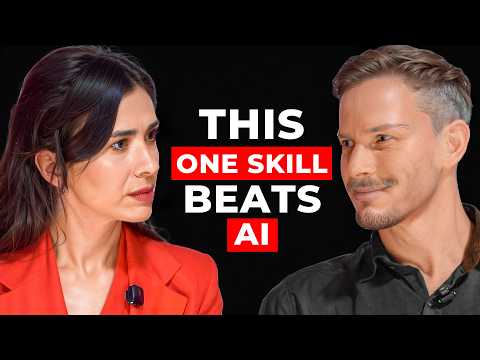
Big Job Disruption in 5 Years — Hugging Face Co-Founder on How to Stay Ahead
Thomas Wolf (guest), Marina Mogilko (host), Marina Mogilko (host)
In this episode of Silicon Valley Girl, featuring Thomas Wolf and Marina Mogilko, Big Job Disruption in 5 Years — Hugging Face Co-Founder on How to Stay Ahead explores hugging Face’s Thomas Wolf on AI tools, robots, job disruption Thomas Wolf, Hugging Face co-founder/CSO, describes Hugging Face as an open-source platform for models/datasets and a fast-growing “AI app store” (Spaces) that lets people try and even self-host AI apps.
Hugging Face’s Thomas Wolf on AI tools, robots, job disruption
Thomas Wolf, Hugging Face co-founder/CSO, describes Hugging Face as an open-source platform for models/datasets and a fast-growing “AI app store” (Spaces) that lets people try and even self-host AI apps.
He argues that “vibe coding” and AI tooling will expand who can build software while still rewarding deeper technical understanding—people will learn by generating first, then debugging and studying fundamentals when tools fail.
Wolf expects near-term growth in AI agents automating computer-based tasks and parallel advances in robotics, with household usefulness limited less by capability than by cost, safety/regulation, and privacy.
On jobs, he predicts significant disruption within five years (e.g., legal support work), advises mastering the tools and re-centering on human strengths like creativity, while noting society-level responses (e.g., UBI) are under-discussed.
Key Takeaways
Hugging Face is shifting from developer hub to AI “app store.”
Beyond hosting models and datasets for builders, Spaces provides searchable, no/low-code mini-apps (e. ...
Get the full analysis with uListen AI
Open source is ultimately about control of the stack—and optional self-hosting.
Wolf frames open-source AI as an alternative to closed APIs: you can download models/apps, run them locally, and avoid sending prompts/data to third-party servers, which becomes crucial for sensitive use cases.
Get the full analysis with uListen AI
Ownership with open source follows licensing norms—credit is the baseline.
He analogizes to software licenses like MIT/Apache: you can use and modify, but should credit creators; more restrictive or commercial licenses exist, and “open core” businesses monetize enterprise features (e. ...
Get the full analysis with uListen AI
AI lowers the barrier to building—but doesn’t eliminate the need to learn coding.
Non-technical founders can prototype quickly with vibe-coding tools, while new learners may start with AI-generated code and only study fundamentals when things break—changing the learning path, not necessarily the end skill level.
Get the full analysis with uListen AI
Creativity remains a durable advantage because LLMs optimize for the “likely.”
Wolf notes LLMs are trained to predict probable next tokens, so they excel at expected outputs; standing out still depends on non-obvious ideas, experimentation, and not self-censoring—skills he tries to cultivate in kids.
Get the full analysis with uListen AI
Robotics is close on capability, but adoption hinges on price, safety, and privacy.
He expects demos and early useful robots soon, but mainstream household robots depend on affordability (early devices “price of a car,” ~15–20K for two-handed systems), plus regulation and preventing physical harm and spying.
Get the full analysis with uListen AI
The biggest near-term risk isn’t sci-fi AGI—it’s concrete job disruption.
Wolf anticipates major disruption within five years in specific fields (he cites legal support work from his own background), and argues governments/think tanks discuss it less than speculative existential risks.
Get the full analysis with uListen AI
Notable Quotes
““Something that's definitely gonna happen in the coming five year… big job disruption.””
— Thomas Wolf
““It’s kind of a app store of AI… Spaces.””
— Thomas Wolf
““You can download and run them locally… cut the internet.””
— Thomas Wolf
““LLM… are still not very good at creating really novel thing… they’re trained to predict the most probable… next token.””
— Thomas Wolf
““Let’s not look too much at this… instead of just something that’s definitely gonna happen… big job disruption.””
— Thomas Wolf
Questions Answered in This Episode
For a non-technical user, what are 3–5 “starter” Spaces you’d recommend that demonstrate real value without setup?
Thomas Wolf, Hugging Face co-founder/CSO, describes Hugging Face as an open-source platform for models/datasets and a fast-growing “AI app store” (Spaces) that lets people try and even self-host AI apps.
Get the full analysis with uListen AI
When someone clones a Space and runs it locally, what are the most common compute bottlenecks (GPU RAM, latency, model size), and how should people choose models accordingly?
He argues that “vibe coding” and AI tooling will expand who can build software while still rewarding deeper technical understanding—people will learn by generating first, then debugging and studying fundamentals when tools fail.
Get the full analysis with uListen AI
In AI-generated media (images/video/voices), how do you expect licensing and attribution norms to evolve compared with MIT/Apache in software?
Wolf expects near-term growth in AI agents automating computer-based tasks and parallel advances in robotics, with household usefulness limited less by capability than by cost, safety/regulation, and privacy.
Get the full analysis with uListen AI
You mentioned open-core monetization: what enterprise features do you think will matter most in open-source AI over the next two years (security, observability, compliance, deployment tooling)?
On jobs, he predicts significant disruption within five years (e. ...
Get the full analysis with uListen AI
On robotics, what minimum safety guarantees should be required before a household robot can operate unsupervised (fail-safes, offline mode behavior, physical constraints)?
Get the full analysis with uListen AI
Transcript Preview
something that's definitely gonna happen in the coming five year, big job disruption.
This is Thomas Wolf, co-founder and the chief science officer of Hugging Face, the open-source platform shaping the future of AI. We met at Viva Technology to talk about the future of work and how to stay ahead. What skills will actually matter in the age of AI? How do you stay relevant when entire industries are being disrupted? And how close are we to having robots inside our homes?
Yeah.
So what's your advice to people who are studying for five years to do something that might be disrupted?
Yeah, I would say the two advice, I mean, one is definitely [beep] .
Hello, everyone. Welcome to Silicon Valley Girl. We have Thomas today, who's co-founder of Hugging Face. Thomas, thank you so much for being here.
Thanks for having me. It's a pleasure.
Please explain how can I, a non-technical person, use Hugging Face? Can you explain the concept?
Okay. So I mean, to be clear, Hugging Face is still mostly done for technical people. Most part of the website are made for software developer who want to develop something with AI.
Mm-hmm.
So that's the, the two- we have three main parts on the website. We have models, datasets. You want to use them if you're developing a new app with an AI component, and you don't want to use a closed-source solution like OpenAI Anthropic, but you want to be able to own the, the full stack.
Mm-hmm.
You want to have an open-source solution, like your open-source code. So in this case, you will go on our, on our platform. You'll find, select the right model for your task, for the, for the, for the application or website you're, that you're building, and you'll download it. But there is one big part, one big part of the, of the website that we created recently, and that's actually growing exponentially, which is much more accessible, and it's called AI Apps.
Mm-hmm.
It's kind of a app store of AI. So we call that Spaces. These are very kind of small website. You can go on Hugging Face/Spaces. You have a search bar, and basically just type something you would like to do with AI. You can type, I don't know, "I want to remove the background of an image." "I want to, um, to get the speech for a text I've written," like, um, ElevenLabs type thing.
Hmm.
Or, "I want to, uh, you know, generate a 3D character out of an image." And here you will have, like, spaces that are created by community. You can select one, and here you have a very no-code, easy, uh, button interface that lets you do these kind of, uh, magical, magical, uh, things, basically.
And you use them on your platform, or you can migrate to your own app that you're building with?
You can do both. So the nice thing is you can use that d- directly from the platform. Then we provide the compute, it's like website, right?
Install uListen to search the full transcript and get AI-powered insights
Get Full TranscriptGet more from every podcast
AI summaries, searchable transcripts, and fact-checking. Free forever.
Add to Chrome