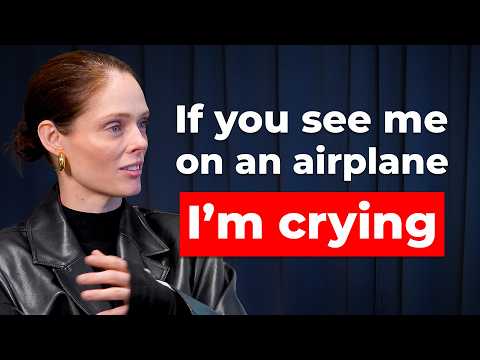
TOP MODEL on the Body Image, Pressure of Industry and How She is Dealing with Hate | Coco Rocha
Coco Rocha (guest), Marina Mogilko (host), Marina Mogilko (host)
In this episode of Silicon Valley Girl, featuring Coco Rocha and Marina Mogilko, TOP MODEL on the Body Image, Pressure of Industry and How She is Dealing with Hate | Coco Rocha explores coco Rocha on modeling careers, motherhood, AI disruption, and resilience Coco Rocha explains how her career—from starting modeling at 14–15 to running Model Camp and other ventures—works largely because of strong teams and a family-run business structure with her husband at the center.
Coco Rocha on modeling careers, motherhood, AI disruption, and resilience
Coco Rocha explains how her career—from starting modeling at 14–15 to running Model Camp and other ventures—works largely because of strong teams and a family-run business structure with her husband at the center.
She argues that long-term success in fashion is less about perfect features and more about being great to work with: kindness, energy, professionalism, and knowing how to collaborate on set.
Rocha addresses industry shifts like AI-generated models, predicting routine commercial work may be automated while performance-driven, “live art” shoots will still value exceptional talent and strong values.
She also reflects on motherhood, body-related career pressure, and dealing with backlash (including after advocating for protections for underage models), emphasizing emotional honesty, filtering feedback, and relying on grounded support rather than “yes-people.”
Key Takeaways
“Doing it all” is usually a team illusion.
Rocha pushes back on the superhuman narrative: her businesses function through strong teams, managers, and especially her husband’s operational leadership, enabling her to be present with her kids and still deliver professionally.
Get the full analysis with uListen AI
Longevity in modeling is strongly tied to behavior, not just beauty.
She claims the models who repeatedly succeed are typically “the nice ones in the room,” because people want to spend long shoot days with someone respectful and energized—attitude can change how others perceive your looks over time.
Get the full analysis with uListen AI
AI will commoditize mediocre, repetitive work—so skill and values become the moat.
Rocha expects experimentation with AI (e. ...
Get the full analysis with uListen AI
Social media isn’t optional—model and creator roles are converging.
She predicts a near future where models must have substantial social presence, while creators must broaden artistic range and learn to be a “muse” for other brands, not only promote personal products.
Get the full analysis with uListen AI
“Fast tracks” usually hide years of unseen reps.
Using Emma Chamberlain as an example, Rocha reframes “overnight success” as long-term consistency, arguing that non-traditional paths are valid and often produce more resilient talent.
Get the full analysis with uListen AI
Choose family and life milestones without letting the industry dictate your timeline.
Rocha describes wanting motherhood more than career optimization, noting she won’t let the industry control her choices again; she views career relevance as not worth sacrificing core life decisions.
Get the full analysis with uListen AI
Hate doesn’t disappear—build coping systems and interpret feedback more accurately.
She says vulnerability varies day to day and recommends “filtering” feedback before labeling it bullying; she also stresses the value of a reasonable partner/team who will challenge you (a “no-man”), not simply agree.
Get the full analysis with uListen AI
Notable Quotes
“"It's nice to be important, but it's important to be nice."”
— Coco Rocha
“"Why keep everyone around that's mediocre?"”
— Coco Rocha
“"You will not be able to model without having a substantial part in social media."”
— Coco Rocha
“"I wanted to be a mom more than anything, so I didn't even think of what that means for a model."”
— Coco Rocha
“"It doesn't fade away."”
— Coco Rocha
Questions Answered in This Episode
When you say top models are usually “the nice ones,” what specific on-set behaviors (before, during, after a shoot) most influence rebooking?
Coco Rocha explains how her career—from starting modeling at 14–15 to running Model Camp and other ventures—works largely because of strong teams and a family-run business structure with her husband at the center.
Get the full analysis with uListen AI
What parts of modeling do you think AI will replace first (e-commerce, lookbooks, campaigns), and what signals tell you a job will still demand a real performer?
She argues that long-term success in fashion is less about perfect features and more about being great to work with: kindness, energy, professionalism, and knowing how to collaborate on set.
Get the full analysis with uListen AI
You mentioned losing unseen opportunities due to social media early on—what would you advise a new model to post (and not post) to avoid the same tradeoffs?
Rocha addresses industry shifts like AI-generated models, predicting routine commercial work may be automated while performance-driven, “live art” shoots will still value exceptional talent and strong values.
Get the full analysis with uListen AI
How did you practically implement the 2013 underage model protections—what resistance did you face and what tactics helped the change pass?
She also reflects on motherhood, body-related career pressure, and dealing with backlash (including after advocating for protections for underage models), emphasizing emotional honesty, filtering feedback, and relying on grounded support rather than “yes-people.”
Get the full analysis with uListen AI
You described “filtering” feedback so it doesn’t feel like bullying—what are examples of feedback that models commonly misinterpret, and how should they reframe it?
Get the full analysis with uListen AI
Transcript Preview
at the age of 14, 15, it's get on a plane, do a shoot, come home. If it was back then, go to school-
Yeah
... do your homework.
What's the craziest story that happened to you through career?
Oh, there's too many. Being in a room that's just full of fire.
Oh.
Being in water. Working with an elephant. They have to pee every 15 minutes. If you see me on the airplane, I'm crying. I wanted to be a mom more than anything, but I didn't even think what that means-
Yeah
... for a model. Career is not that important.
What about AI? H&M just replaced their models.
Why keep everyone around that's mediocre?
Absolutely.
It's easier to use AI. But if there is still these core people with great values and who are so good at their job, yes, people will still wanna be around them.
How do you become that model?
Eh.
Coco, thank you so much. I'm enjoying this camp a lot, giving me so much energy, and this is your 147th-
Yes
... time doing it. [laughing] Where does the energy come from?
I honestly, sometimes at the end of it, I'm like, "Wow, we did that one more time," but it really has to do with the energy of the room. And as you saw, sometimes at the beginning, people can be shy or bashful, and you're like, "Oh, gotta get it out of them." And then there's a moment, something changes in the room, and everyone's excited. So it's really not my energy. You're feeling their energy, and it, it, it helps me, too.
How do you manage this? So you have a camp-
Mm-hmm
... that runs 10 times a year. You are a top model.
[laughing]
You have three kids, and you also have a modeling agency-
Mm-hmm
... and you invest in businesses.
Yes. [laughing]
Okay, tell me how this all works.
Yes, I think that it's funny how people see the name of anybody, like Coco Rocha, and therefore, she must do it all. It's beautiful teams. We have a fantastic team led by my husband here at Model Camp. I have fantastic managers at Nomad, but plus my personal managers, who, again, my husband is my manager. So I guess, like, family-oriented is really important. Like, we keep our business and family, you know, it's close at hand. Because, as you see, my daughter's here. S- it's not like it's one and the other. It's all one thing. So we make sure that our teams can support us, you know, personally, that can, like, be part of the business. We have great-grandparents that help with the kids. I... Yeah, I just think, like, the behind the scenes is what people don't register on, especially content creators, models, uh, athletes, actresses, and actors. They usually just think it's just us [laughing] doing-
Yeah
... all the work, like we're some type of supermodel.
But it's still a lot of you, right? You're leading this thing.
Install uListen to search the full transcript and get AI-powered insights
Get Full TranscriptGet more from every podcast
AI summaries, searchable transcripts, and fact-checking. Free forever.
Add to Chrome