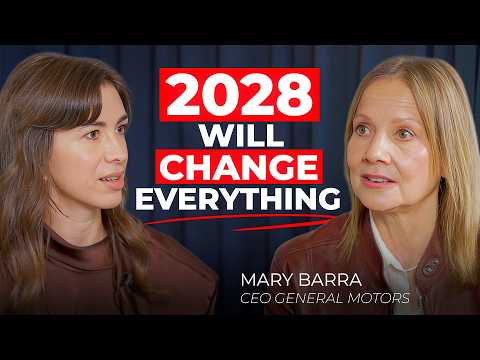
GM CEO Reveals the Truth About AI Cars & the Future of Driving
Marina Mogilko (host), Mary Barra (guest), Marina Mogilko (host), Marina Mogilko (host), Marina Mogilko (host)
In this episode of Silicon Valley Girl, featuring Marina Mogilko and Mary Barra, GM CEO Reveals the Truth About AI Cars & the Future of Driving explores gM CEO on AI cars: autonomy, assistants, privacy, timelines ahead GM outlines a roadmap toward “eyes-off” highway autonomy targeted around 2028, positioning it as a higher bar than today’s driver-assist systems and distinct from limited-area robotaxis.
GM CEO on AI cars: autonomy, assistants, privacy, timelines ahead
GM outlines a roadmap toward “eyes-off” highway autonomy targeted around 2028, positioning it as a higher bar than today’s driver-assist systems and distinct from limited-area robotaxis.
The conversation frames the car as a personalized, AI-enabled “purpose-specific robot” that can integrate with assistants like Google Gemini and eventually run errands (service, car wash) on the owner’s behalf.
Key blockers to broad autonomy adoption are safety validation, sensor redundancy, operational design domains (ODDs), economics of hardware (especially sensor suites), and today’s patchwork regulation—Barra advocates for a clearer federal framework.
They also discuss privacy expectations as vehicles collect more behavioral data, plus how GM is applying AI internally in manufacturing, design, and knowledge work—alongside career advice for workers facing entry-level job disruption.
Key Takeaways
GM targets eyes-off highway autonomy around 2028.
Barra says the team is “working toward” 2028 for eyes-off driving on highways first, with expansion to more complex environments (urban) later as readiness and safety allow.
Get the full analysis with uListen AI
Robotaxis are not the same problem as personal autonomy.
Barra argues full autonomy today is mostly in robotaxi deployments constrained to a defined Operational Design Domain (ODD), whereas consumer vehicles must handle broader conditions and transitions between human and vehicle control.
Get the full analysis with uListen AI
Eyes-off capability requires redundancy and no ‘human-as-backup’ safety model.
GM’s product leader emphasizes that to let drivers stop paying attention, the system must safely handle complex scenarios and weather using redundant sensors—without relying on last-second human takeover as the primary safety valve.
Get the full analysis with uListen AI
Highway-only first, with clear ODD boundaries and takeover at exits.
The described product is available only on highways; when exiting the highway/ODD, the system will request the driver to retake control, underscoring that “eyes-off” is bounded, not universal autonomy.
Get the full analysis with uListen AI
The assistant strategy is dual-track: Gemini evolution plus a GM-native agent.
GM plans to adopt Google Assistant’s evolution into Gemini in-vehicle, while also developing a GM-branded assistant built on third-party LLM providers, aiming for deeper context from vehicle data and “agent-to-agent” handoffs (e. ...
Get the full analysis with uListen AI
Personalization comes from vehicle data—and raises trust/privacy stakes.
Barra says data should be treated as the customer’s, with permission required even for anonymized use; GM has a privacy officer and dedicated security/cybersecurity focus as cars become more behaviorally aware.
Get the full analysis with uListen AI
Safety validation and readiness—not predictions—will gate autonomy rollout.
After earlier autonomy forecasting (since 2016), Barra now stresses deployment “as soon as it’s ready” and safe, highlighting the difficulty of autonomy as one of the hardest tech challenges.
Get the full analysis with uListen AI
GM sees AI as a manufacturing and engineering leverage point, not just a product feature.
Barra points to GM’s unique manufacturing data as an advantage to improve plant efficiency, operator support, design workflows, and validation—freeing engineers to focus on optimization and safety.
Get the full analysis with uListen AI
AI will compress routine work; advantage shifts to core knowledge plus curiosity.
Her advice to new entrants: get into the ‘core’ (manufacturing, design, software, go-to-market) and bring modern tool fluency to improve processes—like shrinking multi-day tasks to hours—while human connection and higher-touch work become more valuable.
Get the full analysis with uListen AI
Integrity and learning mindset are framed as career differentiators in an AI era.
Barra highlights “winning with integrity” and continuous learning/curiosity as the traits that help people adapt as technology and expectations change rapidly.
Get the full analysis with uListen AI
Notable Quotes
““By 2030, I’m kind of done making predictions… as it relates to autonomy.””
— Mary Barra
““What we announced today is an eyes-off autonomy capability. Nothing of that sort exists in the market today.””
— GM product leader (in conversation)
““Human intervention cannot be a backup. That cannot be a safety valve.””
— GM product leader (in conversation)
““We’re hoping for one federal regulation… because I think that will unlock autonomous technology.””
— Mary Barra
““The customer has to give the company permission, even if we’re gonna use it from an anonymized perspective.””
— Mary Barra
Questions Answered in This Episode
What exactly does GM mean by “eyes-off” on highways—does it include lane changes, merges, stop-and-go traffic, and construction zones?
GM outlines a roadmap toward “eyes-off” highway autonomy targeted around 2028, positioning it as a higher bar than today’s driver-assist systems and distinct from limited-area robotaxis.
Get the full analysis with uListen AI
How will the system handle edge cases like emergency vehicles, debris, or sudden severe weather if “human intervention cannot be a safety valve”?
The conversation frames the car as a personalized, AI-enabled “purpose-specific robot” that can integrate with assistants like Google Gemini and eventually run errands (service, car wash) on the owner’s behalf.
Get the full analysis with uListen AI
What sensor configuration (lidar/radar/cameras) is required for the 2028 system, and how will GM manage cost and serviceability at scale?
Key blockers to broad autonomy adoption are safety validation, sensor redundancy, operational design domains (ODDs), economics of hardware (especially sensor suites), and today’s patchwork regulation—Barra advocates for a clearer federal framework.
Get the full analysis with uListen AI
Can you clarify the takeover experience at highway exits—how much warning time is given, and what happens if the driver doesn’t respond?
They also discuss privacy expectations as vehicles collect more behavioral data, plus how GM is applying AI internally in manufacturing, design, and knowledge work—alongside career advice for workers facing entry-level job disruption.
Get the full analysis with uListen AI
How does GM plan to validate safety beyond Super Cruise’s driver-assist record—what new metrics or public reporting will exist for eyes-off autonomy?
Get the full analysis with uListen AI
Transcript Preview
we're hoping for '28, right?
Yeah, no, I mean, that's what the team is working for.
Imagine being able to take your eyes and hands off the wheel, go through your work emails, watch your favorite TV show, maybe grab lunch. [camera clicking] Gemini coming out next year, right?
Mm-hmm.
Uh, so it's- you will be able to talk to your vehicle.
It's gonna be able to even alert you before something happens, so you can take care of it.
This is Mary Barra, the CEO of General Motors, [camera clicking] one of the most powerful people in the automotive world, and the woman leading the transformation of how humanity moves. [camera clicking]
This is becoming a robot, and eventually, you can see a world where it's acting on your behalf fully autonomously.
[electronic music] AI is changing everything. It's no longer just a car. It's an assistant that might know you better than anyone. So the real question is: are we ready for it? [electronic music] Mary, thank you so much for doing this. I'm so excited to host you on Silicon Valley Girl.
I'm really excited to be on Silicon Valley Girl, and have a chance to talk to you and tell you what's going on at General Motors.
Oh, yeah, I'm a proud owner of a Cadillac Escalade.
Thank you.
Uh, it was, uh, one of the first with the Super Cruise. I was dying [chuckles] to get it, so we had to go to LA because the Bay Area was sold out. Went to LA, got it, and, uh, we've been driving it since. It's such a good investment, especially when you have technology mixed with quality, right?
Mm-hmm.
Because you still wanna feel good in your car. Today, you presented a lot of new updates. Let's imagine it's 2030. I'm in my new Escalade. What is the experience like?
Well, I think one of the things is, it's still going to be very personalized, and we think we can, uh, continue to advance the vehicle. Uh, you know, we talked about adding the Google Assistant. Uh, we'll follow up with, a, our own assistant that's much more integrated into the vehicle, leveraging vehicle data, and get to know you know the vehicle, so that it can even be a more customized experience. Be- and then, when you think about what we can do from an autonomy perspective, we shared that we'll start with highway autonomy, where you can-
Yeah
... literally take your eyes off the road, and then we'll continue to expand that into urban, urban locations. And, you know, by 2030, I'm, I'm kind of done making predictions-
Good [chuckles]
... as it relates to autonomy, 'cause I think it is one of the hardest challenges-
Mm-hmm
... from a technological perspective, but I think we're gonna make advancements like we do today with Super Cruise. Um, and we'll make those advancements once we have, uh, eyes off from a highway perspective. And so in 2030, I, I think, you know, people are going to see that their vehicle allows them to lead a much more integrated life, that the vehicle makes their life easier, makes them more efficient, gives them back some time. [upbeat music]
Install uListen to search the full transcript and get AI-powered insights
Get Full TranscriptGet more from every podcast
AI summaries, searchable transcripts, and fact-checking. Free forever.
Add to Chrome