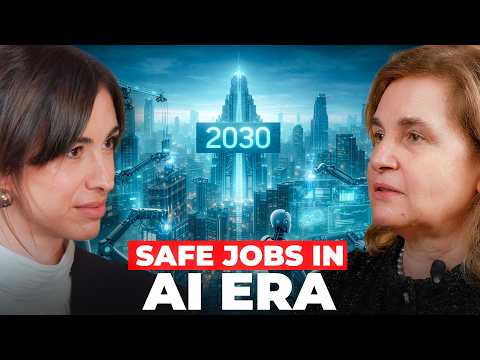
Top AI Researcher: The Skill Gap Getting People Replaced in 2026, Here's How to Fix It
Marina Mogilko (host), Daniela Rus (guest), Daniela Rus (guest)
In this episode of Silicon Valley Girl, featuring Marina Mogilko and Daniela Rus, Top AI Researcher: The Skill Gap Getting People Replaced in 2026, Here's How to Fix It explores mIT AI Lab leader explains 2026 skill gap and edge AI Daniela Rus argues that most people won’t be replaced directly by AI, but by other workers who can use AI tools to be faster, more effective, and more efficient.
MIT AI Lab leader explains 2026 skill gap and edge AI
Daniela Rus argues that most people won’t be replaced directly by AI, but by other workers who can use AI tools to be faster, more effective, and more efficient.
She predicts workplaces will become hybrid human-robot teams: AI handling cognitive support and robots handling physical support, freeing humans for judgment, creativity, and strategic work.
Rus highlights edge AI (running models on-device) as a pivotal, underused shift—analogous to computing moving from mainframes to PCs—unlocking cheaper, more private, more democratized innovation.
In robotics, she stresses timelines are long (self-driving research began decades ago), and today’s biggest gaps are common sense, robustness, and safe interaction—yet service robots and eldercare assistance are promising near-term frontiers.
Key Takeaways
The main threat is the AI skill gap, not AI itself.
Rus says workers are more likely to lose to peers who can leverage AI tools effectively than to automation alone. ...
Get the full analysis with uListen AI
Automation is already real—but brittle at the edges.
Chatbots can absorb high-volume customer service, yet fail on unanticipated cases outside their training distribution. ...
Get the full analysis with uListen AI
The future workplace is human-robot collaboration, not “lights-out” replacement.
Rus expects hybrid teams where AI supports cognitive tasks and robots support physical tasks. ...
Get the full analysis with uListen AI
Edge AI is an underused inflection point with PC-like democratizing potential.
Running AI on-device is cheaper and more private than cloud-only interaction, and could let individuals build products with minimal teams. ...
Get the full analysis with uListen AI
“AI everything” devices will make capability ubiquitous.
Rus anticipates AI-native phones, computers, and glasses that put models directly at users’ fingertips, reducing dependency on centralized infrastructure and enabling new consumer and startup experiences.
Get the full analysis with uListen AI
Home humanoids are constrained by common-sense reasoning and safe robustness.
A conference robot nearly poured water onto expensive shoes, illustrating the lack of common sense. ...
Get the full analysis with uListen AI
Aging-in-place robotics is both urgent and underbuilt.
Rus points to eldercare workforce shortages and simple but essential assistance (e. ...
Get the full analysis with uListen AI
Notable Quotes
“People will not lose their jobs to AI, but they will lose their jobs to other people who know how to use AI.”
— Daniela Rus
“Edge AI is already here.”
— Daniela Rus
“Just imagine how much innovation and economic flourishing we will have when anybody… could innovate… because they have access to more powerful tools.”
— Daniela Rus
“Today’s AI tools do not have common sense.”
— Daniela Rus
“The path from a successful research experiment… onto a full-blown product… takes a long time.”
— Daniela Rus
Questions Answered in This Episode
You argue people will be replaced by AI-skilled people—what are the top 3 practical AI skills for someone in a non-technical repetitive role to learn in the next 90 days?
Daniela Rus argues that most people won’t be replaced directly by AI, but by other workers who can use AI tools to be faster, more effective, and more efficient.
Get the full analysis with uListen AI
In your chatbot shipment example, what should companies implement as a minimum “human fallback” design to prevent automation dead-ends?
She predicts workplaces will become hybrid human-robot teams: AI handling cognitive support and robots handling physical support, freeing humans for judgment, creativity, and strategic work.
Get the full analysis with uListen AI
On edge AI: which use cases are most ready today (e.g., retail, healthcare, content creation), and what’s the biggest blocker—hardware, tooling, or business models?
Rus highlights edge AI (running models on-device) as a pivotal, underused shift—analogous to computing moving from mainframes to PCs—unlocking cheaper, more private, more democratized innovation.
Get the full analysis with uListen AI
If AI is moving from “mainframes to PCs,” what’s the equivalent of the operating system/app store layer that still needs to be built for on-device AI?
In robotics, she stresses timelines are long (self-driving research began decades ago), and today’s biggest gaps are common sense, robustness, and safe interaction—yet service robots and eldercare assistance are promising near-term frontiers.
Get the full analysis with uListen AI
For household robots, what’s the most realistic 2030 capability: dish loading, table cleaning, food prep, or something else—and why?
Get the full analysis with uListen AI
Transcript Preview
For someone who's doing a repetitive job right now, what should they be doing today?
Well, they should be training in AI, maybe in robotics. Whether you want to lead with AI, develop AI, or deploy AI, or use AI, there are different things that you need to know.
[upbeat music] This is Daniela Rus, MIT professor and head of the world's largest AI lab. For 30 years, she's been building the robots and AI systems that are about to change everything. She sees what others can't. In this conversation, she reveals what to do next before anyone else even knows it's coming.
Edge AI is already here. Imagine a world where you could build your own startup using the AI tools on your phone, right in your living room.
When you think about the future of workforce, how do you think robots and AI are gonna change the job market?
AI will support us with the cognitive aspects of our jobs. Robots will support us with the physical aspects of our jobs. The question is not whether robots and humans will collaborate in the workplace. The question is- [beep]
Daniela, thank you so much for doing this. I'm thrilled to have you on Silicon Valley Girl.
Well, thank you so much for having me. I'm excited to have this conversation with you.
Let's be futuristic straight away. When you think about the future of workforce, do you see any jobs being replaced in the next two or three years by robots, or we're still too far from that?
A lot of jobs are already enhanced, and in particular, the jobs where you have high volume, uh, quite repetitive, um, activity. And so, for instance, chatbots have, um, more or less taken over customer service. But even in the space of chatbots, there are aspects that the chatbots cannot handle. And, um, for instance, I had a, a recent experience where I, um, I was interacting with a chatbot because I had a problem with a shipment, and my problem was not captured by the seven options that I could get from the chatbot. And I went around and around and around in circles, and then I went to a human, uh, to a store, and the human said, "Well, you have to talk to the chatbot because," [chuckles] "uh, because we don't do that kind-
Mm-hmm
... of work anymore." And so my point is that even in these kinds of repetitive scenarios, it is important to have a human presence-
Yeah
... because there are aspects of, of tasks that are not anticipated, that are not captured by the data that has been used to train the chatbots.
For someone who's doing a repetitive job right now and thinks, "Well, maybe, um, [chuckles] my job is in line to getting, uh, enhanced by a robot or AI," what should they be doing today?
Well, they should be training, uh, in, uh, AI and, uh, maybe in robotics. Um, AI s- will support us with the cognitive aspects of our jobs. Robots will support us with the physical aspects of our jobs. And in my opinion, people will not lose their jobs to AI, but they will lose their jobs to other people who know how to use AI to be better at their jobs, to be more effective and more efficient at their jobs. So my advice is to keep learning, uh, to stay current, and to understand, um, what is the state of the art with the tools that are most applicable to your domain and to the, the field you're working in.
Install uListen to search the full transcript and get AI-powered insights
Get Full TranscriptGet more from every podcast
AI summaries, searchable transcripts, and fact-checking. Free forever.
Add to Chrome