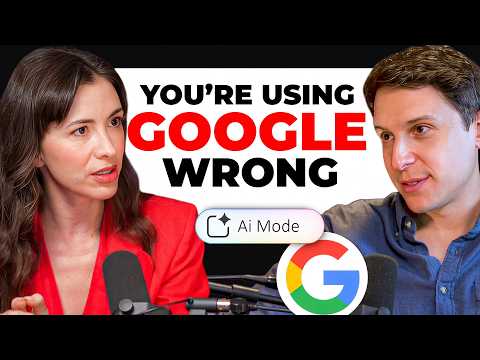
Google’s AI Search Expert: How to Get Ahead Before AI Changes Everything
Marina Mogilko (host), Robby Stein (guest), Marina Mogilko (host)
In this episode of Silicon Valley Girl, featuring Marina Mogilko and Robby Stein, Google’s AI Search Expert: How to Get Ahead Before AI Changes Everything explores inside Google AI Search: ranking, agents, ads, and visibility strategies Google Search is evolving from keyword queries to natural-language, multimodal, AI-assisted experiences that “fan out” into many sub-queries and synthesize results using Google’s web index plus internal knowledge systems (local, shopping, finance).
Inside Google AI Search: ranking, agents, ads, and visibility strategies
Google Search is evolving from keyword queries to natural-language, multimodal, AI-assisted experiences that “fan out” into many sub-queries and synthesize results using Google’s web index plus internal knowledge systems (local, shopping, finance).
New AI Mode capabilities include richer local recommendations, research-and-book flows (e.g., restaurant reservations), and agentic actions like calling offline businesses to gather availability and prices—without recording calls.
For businesses, visibility in AI recommendations still tracks classic SEO fundamentals, but PR/third-party mentions and well-maintained Google Business Profiles increasingly matter because AI systems look for reliable signals across the web.
Ads aren’t expected to disappear; Google is experimenting with ad formats inside AI experiences, but the stated priority is building high-quality consumer utility first—especially for complex purchase and decision journeys.
Key Takeaways
AI Mode ranks by decomposing your question into many searches.
Stein describes a “query fan-out” where a reasoning model issues dozens of related queries, pulls web results plus Google knowledge systems, then composes recommendations based on intent cues (e. ...
Get the full analysis with uListen AI
Local AI recommendations don’t use your ad spend as an input.
He states AI Mode doesn’t use ads information to decide recommendations; instead it uses web content and Google’s information systems, including claimed/updated business listings, menus, and reviews.
Get the full analysis with uListen AI
Agentic features shift Google from answers to actions.
Demos show Google researching across services (e. ...
Get the full analysis with uListen AI
PR becomes a core AI-discovery lever, not just a human one.
Because the model “Googles under the hood,” third-party articles, “top lists,” and widely discovered mentions can act as credibility signals the AI can retrieve and use when recommending “reliable businesses.”
Get the full analysis with uListen AI
Traditional SEO best practices still apply—now for an AI reader.
Stein emphasizes helpful, clear, reliable content remains foundational; the twist is optimizing for longer, more specific natural-language queries and multimodal prompts that AI users increasingly ask.
Get the full analysis with uListen AI
Google Ads isn’t going away; ad formats will likely evolve.
He frames AI as expanding search use cases (complex decisions, multimodal shopping) and notes early experiments with ads in AI Mode, suggesting monetization will adapt rather than disappear.
Get the full analysis with uListen AI
For builders, defensibility shifts from “can you build it” to “is it truly valuable.”
As building gets democratized via language-driven tooling, Stein advises being a “student of gaps,” interviewing users deeply (even ~12), and optimizing for daily value/stickiness for mainstream consumer products.
Get the full analysis with uListen AI
Notable Quotes
“AI Mode works is that it does something called the query fan-out technique.”
— Robby Stein
“So it doesn't use ads information. This is done entirely with… what's on the web and what's within Google's… information system.”
— Robby Stein
“Those are… not recorded.”
— Robby Stein
“Now you're investing in PR not for people to see it, but for AI entities to see it.”
— Marina Mogilko
“In the next era, lots of people will be able to build it, and so you really have to build something useful to people.”
— Robby Stein
Questions Answered in This Episode
On “query fan-out”: what are the strongest signals that determine which sources make it into the model’s context window for a local recommendation?
Google Search is evolving from keyword queries to natural-language, multimodal, AI-assisted experiences that “fan out” into many sub-queries and synthesize results using Google’s web index plus internal knowledge systems (local, shopping, finance).
Get the full analysis with uListen AI
For businesses: which Google Business Profile fields (menus, services, attributes, photos, Q&A) most influence AI Mode’s local summaries today?
New AI Mode capabilities include richer local recommendations, research-and-book flows (e. ...
Get the full analysis with uListen AI
PR for AI visibility: do “top lists” and media mentions outweigh first-party content on a company site, and how does Google handle low-quality listicles?
For businesses, visibility in AI recommendations still tracks classic SEO fundamentals, but PR/third-party mentions and well-maintained Google Business Profiles increasingly matter because AI systems look for reliable signals across the web.
Get the full analysis with uListen AI
Reviews manipulation: what detection approaches matter most in AI Mode (review velocity, reviewer history, text patterns), and how should honest businesses respond when competitors buy reviews?
Ads aren’t expected to disappear; Google is experimenting with ad formats inside AI experiences, but the stated priority is building high-quality consumer utility first—especially for complex purchase and decision journeys.
Get the full analysis with uListen AI
Agentic calling: how does Google disclose to businesses that the caller is AI, and what controls can businesses use to opt out or manage these interactions?
Get the full analysis with uListen AI
Transcript Preview
Give me some tips as a business owner. What should I focus on right now to be recommended by AI?
Interestingly, AI thinks a lot like a person would. If I were them, I would- [beep]
This is Robby Stein, VP of Product at Google Search, the man behind how ranking actually works inside the world's biggest search engine.
You can see what it's doing. It says, "Kicking off searches." It's looking for sushi restaurants, and so you could just book it. Yeah.
Oh, wow! Remember those stories where a mention in ChatGPT or another AI app made a business blow up overnight? A small bistro in Paris doubled its bookings. A restaurant in LA went viral just because AI recommended it, and Google ranking works the same way. So now you're investing in PR not for people to see it, but for AI.
Right.
In this video, Robby reveals how to make your business AI visible and use Google's own systems to get discovered, ranked, and recommended faster than ever. This video is sponsored by HubSpot. Robby, welcome to Silicon Valley Girl. Let's talk about search.
Thanks for having me.
Okay, I want to start with this question, uh, that is aimed for my au- my audience, who are 20, 25 years old. How should they think about search these days, and internet in general? So what's going on?
Well, I say, I say that search is now a place where you can truly ask anything and get pretty effortless information about whatever you have on your mind. And I think, ultimately, people are using it for so many different things, and that's not changing. Like, you can still use Google for all the ways you do to research homework, to look up, you know, specific, um, types of websites and find information that way. But also, you can ask natural language questions. You don't have to use what we call keywordese sometimes. Um, you can just ask exactly what you want. It could be multiple sentences, and now Google has AI that can tap into all of the knowledge and context that Google has about the web, about the world, about products, to help give you better information.
Okay, and follow-up right here. What about information about me? 'Cause I have Gmail, right?
Yeah.
I have my YouTube channel, which runs on Google, right? I have my Google Drive with all the files, all of my spreadsheets. Does it tap into that knowledge or not yet?
So something we're working on, we announced at I/O, um, an opportunity to... for users in the future to be able to opt in to an experience with enhanced personalization. So it's something that we're thinking about, too, for the same reason that you have. And, you know, we want people to be able to help Google and help the services know more about you so that it can be more helpful. 'Cause if you know the kinds of brands you love, if you know the kinds of places you go, um, if you know about a school project that's coming up, you can do more interesting things for people.
Install uListen to search the full transcript and get AI-powered insights
Get Full TranscriptGet more from every podcast
AI summaries, searchable transcripts, and fact-checking. Free forever.
Add to Chrome