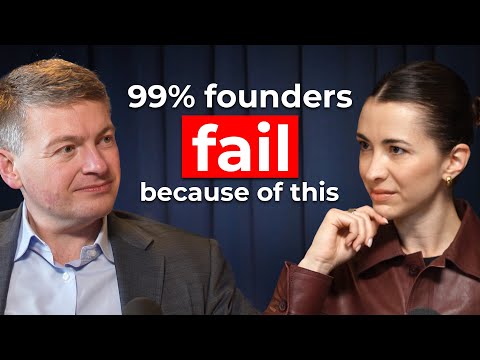
Started from Zero at 33 — Now He’s Building a $1B Airline | Blake Scholl
Marina Mogilko (host), Blake Scholl (guest), Marina Mogilko (host), Marina Mogilko (host)
In this episode of Silicon Valley Girl, featuring Marina Mogilko and Blake Scholl, Started from Zero at 33 — Now He’s Building a $1B Airline | Blake Scholl explores from Amazon engineer to supersonic airline founder, defying conventional wisdom Blake Scholl recounts quitting a well-paid corporate role at 33—while raising a toddler and newborn twins—to start Boom, betting that supersonic passenger travel was economically and technically viable despite widespread skepticism.
From Amazon engineer to supersonic airline founder, defying conventional wisdom
Blake Scholl recounts quitting a well-paid corporate role at 33—while raising a toddler and newborn twins—to start Boom, betting that supersonic passenger travel was economically and technically viable despite widespread skepticism.
He describes how Amazon shaped his approach to opportunity: find overlooked “long tail” spaces, automate/scale what others do manually, and validate ideas with quantitative models rather than received wisdom.
Scholl details Boom’s hardest battles: assembling an entrepreneurial-grade team in an industry without startup DNA, surviving repeated cash crises, and navigating regulations like the U.S./Canada supersonic overland ban framed as a “speed limit.”
He shares Boom’s progress (a privately built civil supersonic demonstrator breaking the sound barrier “boomless”), the path to carrying passengers by 2029, expected business-class pricing, and a broader argument that speed unlocks new human and economic possibilities.
Key Takeaways
Big outcomes start with declaring big intentions.
Scholl argues that historic change requires someone willing to say the “absurd” thing out loud (à la Gates, Wright brothers), accepting the risk of ending up in the unseen “dark matter” of failed attempts.
Get the full analysis with uListen AI
Don’t accept qualitative “expert” claims on quantitative questions.
He repeatedly returns to modeling: if critics say supersonic is too expensive or demand is too small, the response is “how much? ...
Get the full analysis with uListen AI
Entering a new domain works best as rapid de-ignorance, not confident ignorance.
Scholl rejects “ignorance is my superpower,” advocating first-principles learning: textbooks, remedial physics, and interviewing with “Teach me something” to extract real understanding vs opinions.
Get the full analysis with uListen AI
Team is harder than tech—and financing is harder than it looks.
He ranks Boom’s difficulty as: team (hardest), financing (next), engineering (third). ...
Get the full analysis with uListen AI
Startups usually fail when founders give up, not when cash hits zero.
Scholl describes recurring near-death moments (7 days cash, 3 weeks cash) and a mindset of enduring “whatever quantity of hell it takes,” including willingness to go through bankruptcy and restart rather than quit.
Get the full analysis with uListen AI
Regulations can be framed as safety but function as protectionism.
He characterizes the U. ...
Get the full analysis with uListen AI
Speed is not just convenience; it unlocks entirely new behavior.
Using Hawaii tourism and Nike’s origin story, he claims faster travel changes what people attempt at all (weekend cross-continent friendships, new trade/culture), making speed a “binary” driver of progress, not marginal efficiency.
Get the full analysis with uListen AI
Notable Quotes
“People have to be willing to declare big things in order for the big things to actually happen.”
— Blake Scholl
“I’d rather be in the dark matter of entrepreneurs than in the… didn’t try.”
— Blake Scholl
“Quantify everything—and don’t accept other people’s conclusions about quantitative questions.”
— Blake Scholl
“Industry experts don’t know what they’re talking about.”
— Blake Scholl
“Companies fail when the founder gives up.”
— Blake Scholl
Questions Answered in This Episode
You say a “single-digit efficiency improvement” over Concorde makes the economics work—what are the 2–3 key parameters (e.g., SFC, L/D) that matter most, and what ranges are you assuming?
Blake Scholl recounts quitting a well-paid corporate role at 33—while raising a toddler and newborn twins—to start Boom, betting that supersonic passenger travel was economically and technically viable despite widespread skepticism.
Get the full analysis with uListen AI
On the “boomless” claim: what exactly was measured (ground microphones, flight profiles), and what conditions must be true for it to remain inaudible at scale?
He describes how Amazon shaped his approach to opportunity: find overlooked “long tail” spaces, automate/scale what others do manually, and validate ideas with quantitative models rather than received wisdom.
Get the full analysis with uListen AI
You argue the Mach 1 ban is effectively protectionist—what specific evidence or historical decisions most strongly support that interpretation?
Scholl details Boom’s hardest battles: assembling an entrepreneurial-grade team in an industry without startup DNA, surviving repeated cash crises, and navigating regulations like the U. ...
Get the full analysis with uListen AI
If team is the #1 difficulty, what hiring mistakes did you make early, and what screening signals correlate best with success in an aviation startup?
He shares Boom’s progress (a privately built civil supersonic demonstrator breaking the sound barrier “boomless”), the path to carrying passengers by 2029, expected business-class pricing, and a broader argument that speed unlocks new human and economic possibilities.
Get the full analysis with uListen AI
You planned for “two failed startups” financially—what does that budgeting framework look like (runway targets, burn constraints, personal risk limits) for someone with a family?
Get the full analysis with uListen AI
Transcript Preview
So you worked at Amazon?
It was just an absolutely incredible place. They were paying me very well, and I was 33. Groupon had, like, acqui-hired my first company. Uh, I was running the world's largest spam operation.
Do you have a family?
Yes, 14-month-old daughter, and, like, twins who had just been born.
And you decide to quit your corporate job and start something completely new?
I guess. There has not been a startup in aviation for a century. There is opportunity, and we have to take advantage of it quickly enough. We raised $150 million from, like, some of the most amazing investors: Paul Graham, Sam Altman, Y Combinator, Bessemer-
Congratulations
... Michael Moritz, Reid Hoffman. Like, all of those people put in at least $10 million. The world is very open to supersonic right now. Now we've got runway, and then we broke the sound barrier, and it was 24 hours from breaking the sound barrier to being in the West Wing of the White House.
Can you give advice to someone who's stuck with their idea of building a Boom-sized company-
Mm-hmm
... but they just can't take this leap of faith? They have a family.
Oh, yeah.
Blake, thank you so much. I'm so excited about this conversation because you did something [chime] a lot of people are dreaming of, but they don't have enough courage. And I wanted to focus, um, this conversation on basically how you changed your mindset and went from a corporate job at Amazon to building the next-generation airline. So you worked at Amazon, right? You were a tech guy for 13 years?
Uh, I was at Amazon for about five, and then another startup, and then a startup I founded, and then that got acqui-hired by Groupon. But so yeah, I was bopping around tech for, like, 14 years. I started my first company in my parents' basement in high school, and, uh, and I always just wanted to go where the most interesting stuff was happening and, like, build something new. It was one of the things that was sort of a, like, mind fuck for me is, like, I didn't see myself as radically different. And the decision... I remember really struggling with the decision to, to start Boom. And, uh, and it was like, this is- like, if by going and starting a supersonic jet company, I'm almost, like, telling the world that I'm different. Uh, because if it succeeds, it will, like, by definition, be historic. And I'm like, "Who am I to do this? I don't have the resume for this." Um, like, and then I, I... T- the way I kinda got my mind around it was a couple things. One was I was very inspired by that 1997 Apple ad campaign, where the, the tagline was, "The people who are crazy enough to think they can change the world-
Uh-huh
... are the ones who do." And it's, it's really true. And then, and then I thought of Bill Gates, you know, who had started Microsoft in the '70s and had set a goal of, uh, putting a computer in every home and on every desk running Microsoft software. And, and it was- like, at the time he said that, that was, like, absurd. A- and yet he did it.
Install uListen to search the full transcript and get AI-powered insights
Get Full TranscriptGet more from every podcast
AI summaries, searchable transcripts, and fact-checking. Free forever.
Add to Chrome