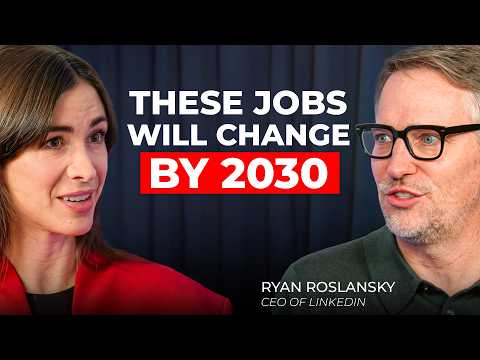
LinkedIn CEO: These 3 Jobs Will Explode in the Next 5 Years | Ryan Roslansky
Ryan Roslansky (guest), Marina Mogilko (host)
In this episode of Silicon Valley Girl, featuring Ryan Roslansky and Marina Mogilko, LinkedIn CEO: These 3 Jobs Will Explode in the Next 5 Years | Ryan Roslansky explores linkedIn CEO explains AI’s labor impact, skills, and booming roles LinkedIn CEO Ryan Roslansky argues today’s hiring slowdown is primarily driven by macroeconomic conditions (e.g., interest rates), not AI, while AI-related roles are growing rapidly on LinkedIn.
LinkedIn CEO explains AI’s labor impact, skills, and booming roles
LinkedIn CEO Ryan Roslansky argues today’s hiring slowdown is primarily driven by macroeconomic conditions (e.g., interest rates), not AI, while AI-related roles are growing rapidly on LinkedIn.
He describes entry-level hiring as down ~12% globally but not uniquely worse than other segments, and points to rising micro-entrepreneurship/creators and renewed interest in trade roles as alternative paths.
Roslansky emphasizes that linear career ladders are largely a myth and that success increasingly comes from frequent skill-building, combining AI literacy with durable human capabilities.
He shares practical guidance for using LinkedIn content to demonstrate expertise, discusses why college still matters (especially for social/human-skill development), and names three roles poised to surge: data annotators, data-center jobs, and forward-deployed engineers.
Key Takeaways
Hiring is sluggish, but LinkedIn attributes it mainly to macroeconomics—not AI.
Roslansky cites interest rates and reduced corporate investment as key drivers of slower hiring, while simultaneously seeing net-new AI jobs appear on the platform.
Get the full analysis with uListen AI
Entry-level hiring is down ~12% globally, but not disproportionately versus other roles.
He frames entry-level pain as part of a broader market slowdown rather than an “AI-only” displacement story, implying early-career candidates need strategy shifts beyond fearing automation.
Get the full analysis with uListen AI
AI is currently a net job creator in LinkedIn’s data.
He points to ~1. ...
Get the full analysis with uListen AI
Stop expecting a linear career path; focus on short-cycle skill building.
Roslansky says LinkedIn data doesn’t show a standard path to roles like CFO/CEO and predicts skill requirements will change dramatically (north of 25% recently; ~70% by 2030).
Get the full analysis with uListen AI
The winning skill stack is AI literacy plus “human skills,” not one or the other.
He recommends learning AI tools while doubling down on curiosity, creativity, courage, communication, and compassion—capabilities that differentiate professionals when tools commoditize execution.
Get the full analysis with uListen AI
Posting on LinkedIn can function as a living portfolio for hiring.
Both host and guest describe content as a way for employers to assess depth, thinking, and identity—often faster than calls—making consistent posting a career advantage.
Get the full analysis with uListen AI
Jobs most at risk are those dominated by automatable tasks like summarizing, rewriting, and translating.
Rather than naming specific titles, he proposes a task-based framework: break your job into tasks, estimate AI automability, and add adjacent skills to “future-proof” your role.
Get the full analysis with uListen AI
Notable Quotes
“At least in the US, 50% of college graduates this year will graduate either unemployed or underemployed.”
— Ryan Roslansky
“While we see that hiring is sluggish across most markets, the reason that it's sluggish... doesn't have anything to do with AI.”
— Ryan Roslansky
“In the data, there is no such thing as a linear career path. Like, it's all over the place.”
— Ryan Roslansky
“We expect [skills]’ll change by 70% by 2030, largely influenced by AI and new tools.”
— Ryan Roslansky
“We think [the] 5 Cs... will make you stand out in the future: curiosity, courage, creativity, compassion, and communication.”
— Ryan Roslansky
Questions Answered in This Episode
LinkedIn shows ~1.3M net-new AI jobs—how are you defining “AI job,” and what roles might be double-counted across categories?
LinkedIn CEO Ryan Roslansky argues today’s hiring slowdown is primarily driven by macroeconomic conditions (e. ...
Get the full analysis with uListen AI
Entry-level hiring is down ~12% globally—what are the biggest differences by region or industry, and where are entry-level hires still growing?
He describes entry-level hiring as down ~12% globally but not uniquely worse than other segments, and points to rising micro-entrepreneurship/creators and renewed interest in trade roles as alternative paths.
Get the full analysis with uListen AI
For someone without a technical background, what does “AI literacy” concretely look like on a resume or LinkedIn profile in 2026?
Roslansky emphasizes that linear career ladders are largely a myth and that success increasingly comes from frequent skill-building, combining AI literacy with durable human capabilities.
Get the full analysis with uListen AI
Data annotator work can vary from expert review to low-paid microtasks—what quality signals should candidates look for to avoid dead-end annotation roles?
He shares practical guidance for using LinkedIn content to demonstrate expertise, discusses why college still matters (especially for social/human-skill development), and names three roles poised to surge: data annotators, data-center jobs, and forward-deployed engineers.
Get the full analysis with uListen AI
Forward-deployed engineer sounds like a hybrid role—what titles are adjacent (e.g., solutions engineer, product analyst), and what skills transfer best into it?
Get the full analysis with uListen AI
Transcript Preview
at least in the US, 50% of college graduates this year will graduate either unemployed or underemployed, and credit card debt is being outpaced by student loan debt for the first time in history.
This is Ryan Roslansky, CEO of LinkedIn. He took LinkedIn from $7 billion to $17 billion in revenue and crossed a billion members by betting big on AI, smarter hiring tools, skills-based matching, and a massive push into video.
LinkedIn is the, the definitive labor market platform of the world. We have amazing insights into actually what is happening across the world.
His data doesn't predict the job market, it is the job market. What about entry-level jobs?
Entry-level jobs across the world right now, the hiring rate that we see are down roughly 12%. While we see that hiring is sluggish across most markets, the reason that it's sluggish h- doesn't have anything to do with AI.
Do you think college is kind of fading away?
When I talk to people about what they should do with their career, it's less about where do you wanna be in five years, and it's more about, over the next few months, like, what new skills do you wanna learn?
So what are the top skills people should be adding to their LinkedIn right now?
There's this, you know, this huge demand by- [beep]
Ryan!
Hi.
Thank you so much, and welcome to Silicon Valley Girl.
Great to be here.
I am so happy to have you. So you're the CEO of LinkedIn, and also Executive Vice President of Microsoft Copilot, uh, and Microsoft Office, and we're at Davos today.
Yes.
So w- what is everyone talking about?
I think there's a lot of the things that I'm seeing, but I think one of the things that's probably most, you know, interesting to you potentially is, I think if we were here maybe, like, three years ago, a lot of the conversations we would be having would be with traditional media. And this year, it's amazing to see kind of the creator influence, like, up and down the promenade, and-
Yeah
... kind of the role that creators are playing in this new economy. And, you know, we see it on LinkedIn. There's 4 million members now that, uh, their official job title is creator, and it's just amazing to watch this kind of new industry explode to where it is today. To be recognized at Davos, for example.
That is amazing, and I'm happy to be part of it.
Yeah.
It's amazing to see, starting 12 years ago, and being a creator now is just a huge-
Yeah
... huge difference. Uh, what do people say about AI? Do you think people hear more positive or negative?
It's interesting. I think people are all over the place because, um, their kind of opinions are based on what they heard from the last conversation. What I love about LinkedIn is that as the definitive, you know, labor market platform of the world, we have amazing insights into actually what is happening, uh, across the world. And it's interesting, while we see that hiring is sluggish, you know, across most markets, the reason that it's sluggish h- doesn't have anything to do with AI, in our opinion. It's actually more due to macro conditions, um, interest rates, not AI. As it relates to AI, we see something totally different. There's actually been m- almost, you know, 1.3 million brand-new net jobs on LinkedIn for AI. Roles like data annotators. Um, over 600,000 new data center jobs, uh, exist on LinkedIn. Um, you know, forward-deployed engineers, the companies need to understand AI. So at least in terms of what we're seeing in the LinkedIn data right now, AI is a net positive addition to the job market, not something that's detracting jobs.
Install uListen to search the full transcript and get AI-powered insights
Get Full TranscriptGet more from every podcast
AI summaries, searchable transcripts, and fact-checking. Free forever.
Add to Chrome