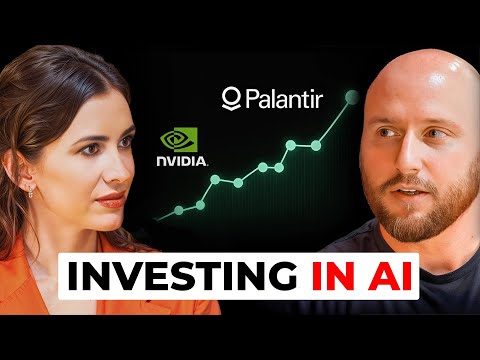
Ex-Rocket Scientist: The Secret to Millionaires' Investment Portfolios
Alex (guest), Marina Mogilko (host), Marina Mogilko (host), Marina Mogilko (host)
In this episode of Silicon Valley Girl, featuring Alex and Marina Mogilko, Ex-Rocket Scientist: The Secret to Millionaires' Investment Portfolios explores ex-rocket scientist shares AI-era investing strategy and mindset shifts Alex, an engineer-turned-full-time investor, argues we’re not in a uniform AI bubble: AI infrastructure (chips, data centers, compute) is supported by real demand, while some “AI software” valuations may be hype-driven.
Ex-rocket scientist shares AI-era investing strategy and mindset shifts
Alex, an engineer-turned-full-time investor, argues we’re not in a uniform AI bubble: AI infrastructure (chips, data centers, compute) is supported by real demand, while some “AI software” valuations may be hype-driven.
He emphasizes evaluating companies from a product-first perspective (what they sell and why it will matter) rather than relying heavily on analysts or headlines, and he uses metrics like forward P/E as one input—not the whole story.
His portfolio is concentrated (e.g., long-held NVIDIA and Palantir positions that grew into outsized weights), but for average investors he recommends a core index approach with selective individual stocks and minimal cash inside the portfolio.
A recurring theme is behavior: most investors underperform due to panic-selling and over-checking; the “best move is often doing nothing,” with tools like dollar-cost averaging and the Fear & Greed Index used to counter emotional decisions.
Key Takeaways
AI ‘bubble’ risk is uneven across the stack.
Alex separates AI infrastructure (chips, servers, data centers) from some software firms rebranding as ‘AI’ without durable revenue. ...
Get the full analysis with uListen AI
Forward P/E is useful, but growth context matters more.
He prefers forward P/E (next 12 months) and suggests ‘under ~30’ as a rough comfort zone, while noting value investors may want far lower. ...
Get the full analysis with uListen AI
Analysts are often wrong; product understanding can be faster.
He claims analyst consensus can miss by a lot and tries to front-run financial statements by tracking product adoption, customer value, and market direction—then letting earnings eventually ‘catch up’ to the thesis.
Get the full analysis with uListen AI
Concentration can happen when a thesis is right—and winners compound.
He didn’t buy NVIDIA/Palantir intending them to become 40%/25% positions; they grew into that weight. ...
Get the full analysis with uListen AI
For most people, a ‘core indexes + selective stocks’ mix beats complex portfolios.
Instead of a traditional 60/40 stocks/bonds, he suggests something like 25% S&P 500 + 40% Nasdaq 100 + ~30–35% individual stocks chosen from top/mid index constituents—adjusted to risk tolerance.
Get the full analysis with uListen AI
Inside-stock diversification can replace bonds—if you diversify elsewhere.
He takes a controversial ‘no bonds’ view and says diversification should come from holding other asset types outside stocks (real estate, possibly crypto/metals/collectibles), while stocks are split between indexes and selected names.
Get the full analysis with uListen AI
Investor psychology drives returns more than stock-picking.
He cites the famous Fidelity finding that ‘best-performing accounts were dead’ to highlight that not selling often wins. ...
Get the full analysis with uListen AI
Notable Quotes
“The best thing to do, almost always in the stock market, is nothing.”
— Alex
“They were all dead.”
— Alex
“If people are panicking, that's exactly when you wanna be greedy.”
— Alex
“Your behavior and your psychology is 90% of your returns.”
— Alex
“You should invest in what you understand, because then, when things crash, you understand what you're holding.”
— Alex
Questions Answered in This Episode
You say AI infrastructure isn’t in a bubble—what specific signs (orders, margins, utilization, capex) would make you change your mind?
Alex, an engineer-turned-full-time investor, argues we’re not in a uniform AI bubble: AI infrastructure (chips, data centers, compute) is supported by real demand, while some “AI software” valuations may be hype-driven.
Get the full analysis with uListen AI
Your rule-of-thumb is forward P/E under ~30—how do you adjust that for companies with temporarily depressed earnings due to heavy R&D?
He emphasizes evaluating companies from a product-first perspective (what they sell and why it will matter) rather than relying heavily on analysts or headlines, and he uses metrics like forward P/E as one input—not the whole story.
Get the full analysis with uListen AI
When NVIDIA or Palantir becomes 40% of a portfolio, what concrete triggers tell you to trim versus just hold through volatility?
His portfolio is concentrated (e. ...
Get the full analysis with uListen AI
You recommend ‘no bonds’ and a 60/40 indexes-to-stocks style split—how would that change for someone within 5–10 years of retirement?
A recurring theme is behavior: most investors underperform due to panic-selling and over-checking; the “best move is often doing nothing,” with tools like dollar-cost averaging and the Fear & Greed Index used to counter emotional decisions.
Get the full analysis with uListen AI
How exactly do you use the CNN Fear & Greed Index: what levels matter to you, and what actions (if any) do you take at ‘3’ vs ‘50’?
Get the full analysis with uListen AI
Transcript Preview
big investments that I've made recently have been [beep] like-
So like 40% in a single stock?
Yes.
This is Alex. He's a money nerd, and he's been paying for his lifestyle with his investments for the past 10 years. When I met him at dinner and he told me about his investing strategy, I realized right away that I need to bring this to you guys, because this is something I'm striving for, and this is something I'd encourage everyone to look at.
But people are panicking. That's exactly when you wanna be greedy.
In this episode, we're gonna dig deep into his investment strategy. We're gonna break down the AI bubble. We're gonna talk about what he invests in and how he sees the future, and of course, the psychology of smart investing, how not to buy high and not to sell low. Let's dive deeper into this conversation with Alex. For an average investor like me, what would be the ideal portfolio if I want to win in this AI era?
Yeah. The best thing to do almost always in the stock market is-
Hey, guys, welcome to Silicon Valley Girl.
Yeah.
My first question is, are we in a bubble?
Are we in a bubble?
Yeah.
Um, I think certain kinds of stocks are definitely in a bubble, and certain kinds are not. So for example, right now, hardware, you know, the infrastructure for AI is definitely not in a bubble. You know, we're already seeing some revenue returns on the infrastructure for AI, and we're seeing, like, a big explosion in demand for the compute power associated with AI. So I think the underlying infrastructure, you know, the servers, the data centers, the chips, things like that, are definitely not in a bubble. I think we'll see certain software companies that are claiming to be AI software companies today, we'll see their valuation skyrocket and then drop.
Mm-hmm.
So those might be in a bubble today. I think it'll be a few years before we see the next Facebook, the next Google, the next, uh, big software companies associated with AI.
Interesting-
So-
... 'cause a lot of people talk about, like, this dot-com crash-
Yeah
... right? When all the valuations were through the roof, and then su- suddenly everything dropped.
Totally.
Are we gonna see something like that, do you think?
I don't think so. I think, uh, you know, we will in, in certain sectors, for sure. Maybe not as extreme, but I think what you're... Like, if you look at the balance sheets of a lot of these companies, you'll see that their revenues and their profits are following their valuation.
Mm.
So, for example, NVIDIA, sky-high price, right? But if you look at their earnings per share, uh, and their PE ratio-
Can you explain to everyone who's watching what it means, and what's a good number?
Sure, yeah. So when you think about a stock's price, which is really based on its market cap, so that, that kind of tells you how highly valued the company is, and then, when you look at its earnings, that's literally, you know, you take it's- the number of shares of that company, the number of shares outstanding, and how much money it generates in profit per share, right?
Install uListen to search the full transcript and get AI-powered insights
Get Full TranscriptGet more from every podcast
AI summaries, searchable transcripts, and fact-checking. Free forever.
Add to Chrome