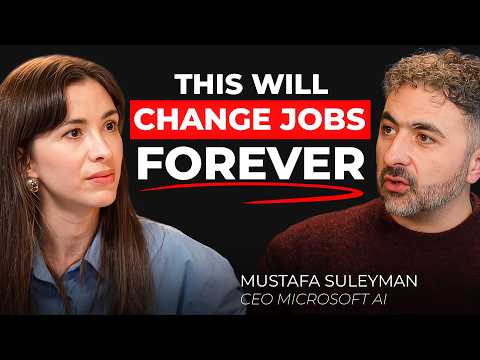
CEO of Microsoft AI:The Next 10 Years Will Change Humanity Forever
Marina Mogilko (host), Mustafa Suleyman (guest)
In this episode of Silicon Valley Girl, featuring Marina Mogilko and Mustafa Suleyman, CEO of Microsoft AI:The Next 10 Years Will Change Humanity Forever explores microsoft AI CEO on agents, education, work, and human future Mustafa Suleyman argues we are likely not in an AI bubble because AI is a uniquely powerful “prediction engine” improving rapidly and becoming more controllable, creating unprecedented economic value over the next 5–10 years.
Microsoft AI CEO on agents, education, work, and human future
Mustafa Suleyman argues we are likely not in an AI bubble because AI is a uniquely powerful “prediction engine” improving rapidly and becoming more controllable, creating unprecedented economic value over the next 5–10 years.
He pushes back on claims of AI consciousness, warning that human-like conversation drives anthropomorphic projection even though models lack subjective experience, suffering, or moral status comparable to humans.
He forecasts human-level performance on most knowledge tasks within ~5 years and a major shift toward AI agents that execute tasks end-to-end, compressing the gap between ideas and real-world products—driving intense competition and changing what work looks like.
He anticipates major societal adjustments: AI-driven decentralization of learning, medical “superintelligence” access, ubiquitous memory/ambient assistants, and—by ~2050—structural unemployment that will require government-led redistribution and new tax approaches to capital/automation.
Key Takeaways
Suleyman is bullish: AI’s value creation is real, not hype-driven.
He argues AI is the most capable technology yet and is improving faster than prior innovations, while becoming easier to shape and control—supporting sustained value growth rather than a pure valuation bubble.
Get the full analysis with uListen AI
AI is increasingly human-like, but not conscious—and treating it as such is dangerous.
He frames consciousness (capacity for subjective experience/suffering) as foundational to rights and legal responsibility, and calls claims of AI sadness or fear “anthropomorphic projection” rather than evidence of inner experience.
Get the full analysis with uListen AI
Human-level performance on most knowledge tasks may arrive within ~5 years.
He points to current strengths (summarization, translation, transcription, research, writing) and extrapolates to roles like project management, marketing, HR, and sensitive explanatory conversations (e. ...
Get the full analysis with uListen AI
The next phase is agentic AI—autonomous execution with strict containment.
He expects teams of agents to generate ideas, build assets, launch campaigns, and manage operations, but says the core design challenge is defining limits, approvals, and accountability so autonomy stays scoped to user intent.
Get the full analysis with uListen AI
AI will collapse the distance between “idea” and “company/product,” intensifying competition.
Democratized intelligence means less need for capital or elite teams to start; individuals can “think companies into existence,” which raises competitive pressure across knowledge industries.
Get the full analysis with uListen AI
Healthcare is poised to be the biggest near-term market disruption.
He says quality gaps in care will shrink as “medical superintelligence” becomes cheap; he cites that ~40% of Copilot queries are health-related and describes grounding answers with Harvard Medical and NHS citations plus physician recommendations.
Get the full analysis with uListen AI
Education shifts from knowledge delivery to coached practice and meta-skills.
He predicts decentralized AI tutoring (quizzes, curricula, generated podcasts/videos) with classrooms focusing on discussion, application, empathy, and communication—while parents should still cultivate self-teaching discipline and “friction.”},{
Get the full analysis with uListen AI
Perfect AI memory is coming—if users choose it—raising privacy and cognition questions.
He describes editable, selective memory today (durable preferences/facts) and envisions optional “remember everything,” arguing cognitive offloading mirrors calculators/phones while humans reallocate mental effort to synthesis.
Get the full analysis with uListen AI
By ~2050, structural unemployment is plausible; redistribution must evolve.
He calls AI “labor-replacing,” suggesting policy levers like shorter work weeks, higher taxes on capital/high incomes, and mechanisms akin to UBI; he insists governments must lead, with companies effectively funding via taxation shifts.
Get the full analysis with uListen AI
Social intelligence (multi-person AI in shared context) is an overlooked frontier.
He says he missed “SQ” in earlier frameworks and highlights Copilot Groups: AI in chats with up to 32 people, adapting tone per person and enabling mixed human+AI collaboration (e. ...
Get the full analysis with uListen AI
Notable Quotes
““It’s the smartest, most capable technology we’ve ever invented. It’s improving faster than anything we’ve ever seen.””
— Mustafa Suleyman
““These things don’t suffer. They don’t feel pain. They’re just simulating high-quality conversation.””
— Mustafa Suleyman
““Achieving human-level performance at most tasks… feels quite likely in the next five years.””
— Mustafa Suleyman
““The distance between an idea and the realization of that idea is gonna collapse.””
— Mustafa Suleyman
““By 2050… there’s gonna be significant structural unemployment.””
— Mustafa Suleyman
Questions Answered in This Episode
You argue we’re not in an AI bubble—what concrete indicators (unit economics, adoption curves, productivity metrics) would convince you the market is overheated?
Mustafa Suleyman argues we are likely not in an AI bubble because AI is a uniquely powerful “prediction engine” improving rapidly and becoming more controllable, creating unprecedented economic value over the next 5–10 years.
Get the full analysis with uListen AI
What is your operational definition of “human-level performance at most tasks,” and which task categories do you expect to lag beyond the next five years?
He pushes back on claims of AI consciousness, warning that human-like conversation drives anthropomorphic projection even though models lack subjective experience, suffering, or moral status comparable to humans.
Get the full analysis with uListen AI
You call superintelligence that sets its own goals an “anti-goal”—how do you reconcile that with the push toward more autonomous agents in consumer and enterprise products?
He forecasts human-level performance on most knowledge tasks within ~5 years and a major shift toward AI agents that execute tasks end-to-end, compressing the gap between ideas and real-world products—driving intense competition and changing what work looks like.
Get the full analysis with uListen AI
What specific containment/guardrail mechanisms do you think will become standard (approval thresholds, audit logs, sandboxing, spend limits, identity verification)?
He anticipates major societal adjustments: AI-driven decentralization of learning, medical “superintelligence” access, ubiquitous memory/ambient assistants, and—by ~2050—structural unemployment that will require government-led redistribution and new tax approaches to capital/automation.
Get the full analysis with uListen AI
On consciousness: what evidence would you accept as falsifying your claim that subjective experience will not emerge from these systems?
Get the full analysis with uListen AI
Transcript Preview
Are we in an AI bubble?
Uh-
This is Mustafa Suleyman, co-founder of DeepMind, one of the first companies to teach machines how to think. Today, he leads Microsoft AI, one of the Magnificent Seven shaping the future of our world.
It's the smartest, most capable technology we've ever invented. It's improving faster than anything we've ever seen, and it's very important that we keep reminding ourselves of that. Like, in twenty-five years' time, a large portion of the population are gonna struggle to compete in the workplace with AI.
But with that power comes a question none of us can ignore, because the same intelligence that builds our future could also rewrite what it means to be human.
These things don't suffer. They don't feel pain. They're just simulating high-quality conversation, so we've got to be very careful about that.
AI isn't just learning, it's starting to live with us.
Your personal AI is just gonna have ambient awareness of what you're trying to do and talk to you in real time. It is gonna remember everything in the future and be perfect if you choose for it to do that.
So if it remembers everything, what's gonna happen to our brains?
Um-
They don't sleep, they don't forget, they don't feel, but they're learning faster than we ever imagined. So the real question is, what happens to us next? This video is sponsored by HubSpot. Mustafa, welcome. Thank you so much for being here.
Thanks for having me.
The first question, everyone's talking about it on YouTube right now: Are we in an AI bubble?
Uh, yes. So, no, we're not. [chuckles] I don't think so.
You don't think so?
I don't think so. I think, um, when you kind of think about it, we are creating something that is truly magical. Um, intelligence is the thing that has made us successful as a species. Um, and we're now distilling that into a smaller and smaller unit, um, that can be spread all over the world, and that is gonna be cheap and widely abundant. So that's just a remarkable thought. Like-
Yeah, but we kind of had the same thought, you know, during dot-com crash, like, "We're inventing internet," blah, blah, blah. But there are some companies that, you know, their valuations are much higher than their revenues. And, like, everyone's talking about NVIDIA investing, and then that revenue going back to NVIDIA. What do you think about that?
Yeah. No, I, I, I think the value that we're gonna produce in the next five to ten years is gonna be unprecedented.
So you don't think we're gonna experience something like, you know, 2008, COVID?
I mean, who knows? But-
Yeah
... I, I think if you think, just focus on the fundamental value that's being created, this is the best prediction engine anyone's ever seen. It's the smartest, most capable technology we've ever invented. It's improving faster than anything we've ever seen. It has got more easy to shape and control, not less. Three years ago, we thought that it was gonna get more chaotic and more disorganized, that we weren't gonna be able to sculpt it, and now we're producing beautiful, powerful, amazing experiences that are surprising us every month. So yeah, no, I, I'm genuinely very bullish.
Install uListen to search the full transcript and get AI-powered insights
Get Full TranscriptGet more from every podcast
AI summaries, searchable transcripts, and fact-checking. Free forever.
Add to Chrome