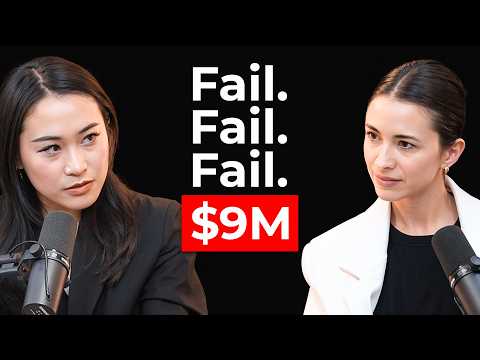
From $0 to $9M: How an Immigrant Turned Failure Into Fortune | Jenny Lei, Freja
Marina Mogilko (host), Jenny Lei (guest)
In this episode of Silicon Valley Girl, featuring Marina Mogilko and Jenny Lei, From $0 to $9M: How an Immigrant Turned Failure Into Fortune | Jenny Lei, Freja explores immigrant founder scales Freja bags from failed launch to $10M+ Jenny Lei, a Chinese-born founder living in New York on a visa, started Freja after struggling to find a confident, functional, logo-free work bag for an important interview.
Immigrant founder scales Freja bags from failed launch to $10M+
Jenny Lei, a Chinese-born founder living in New York on a visa, started Freja after struggling to find a confident, functional, logo-free work bag for an important interview.
She launched right before COVID, collected 2,500 emails, and still made zero sales at launch—taking a full year to sell her first 300 bags and hitting lows like three sales in a month.
Growth came through relentless iteration on paid ads (especially functional “in-action” video creatives), later paired with better media buying/targeting support and a clearer brand voice.
As Freja matured into $10M+ annual revenue, Jenny shifted from pure acquisition toward influencer/UGC, PR seeding, newsletters, and community initiatives like the Freja Fund—aiming to build a “legacy brand” rather than just sell product.
Key Takeaways
Saturated markets can be safer than “blue oceans.”
Jenny argues you should “fish where the fish are”—high competition signals existing demand. ...
Get the full analysis with uListen AI
A strong product alone won’t save a weak launch.
She spent eight months perfecting one bag, collected emails, and still got zero sales at launch. ...
Get the full analysis with uListen AI
Early traction can be brutally slow—persistence is a strategy.
It took a year to sell the first 300 units and she hit months with only three sales. ...
Get the full analysis with uListen AI
For performance marketing, show the product “doing the job.”
Freja’s ads worked best as simple videos showing the bag being packed and used; polished campaign images underperformed. ...
Get the full analysis with uListen AI
Creative matters most, but scaling may require backend expertise.
Jenny stresses creative is “more important than targeting,” yet her ROAS improved significantly after the right media buyer optimized targeting/structure once the ad account had data.
Get the full analysis with uListen AI
Avoiding “salesy” marketing can be a deliberate brand pillar.
Freja rarely discounts and frames promotions as community rewards rather than price slashing. ...
Get the full analysis with uListen AI
Founder-led storytelling builds loyalty—but increases reputational risk.
After years of being anonymous, PR pushed Jenny to become the face; she worried about backlash/cancellation harming the company. ...
Get the full analysis with uListen AI
PR seeding can outperform the initial celebrity bump when used strategically.
Hailey Bieber wearing the bag created validation; the larger lift came when they tied ads/queries to the moment so people searched and discovered earned media coverage.
Get the full analysis with uListen AI
Community initiatives can mark the shift from survival to meaning.
With stability, Jenny launched the Freja Fund to mentor seven women founders without taking equity. ...
Get the full analysis with uListen AI
A “legacy brand” frame changes decision-making without necessarily adding work.
Jenny’s team adopted a long-term lens—asking “would a legacy brand do this? ...
Get the full analysis with uListen AI
Notable Quotes
““You have to fish where there are a lot of fish in the water.””
— Jenny Lei
““Launch! Hey, we’re live. Not a single person bought.””
— Jenny Lei
““I was a marketing company. I was not a bag brand.””
— Jenny Lei
““Our customers don’t want to be sold to.””
— Jenny Lei
““If you don’t tell your story, someone else will.””
— Jenny Lei
Questions Answered in This Episode
What exactly was in your best-performing “packing the bag” ad—hook, structure, captions, and offer—and how did you iterate it over time?
Jenny Lei, a Chinese-born founder living in New York on a visa, started Freja after struggling to find a confident, functional, logo-free work bag for an important interview.
Get the full analysis with uListen AI
You mentioned ROAS jumped when a new ads specialist “got it.” What changed in targeting/account structure (campaign types, audiences, budgets, placements) if the creative stayed the same?
She launched right before COVID, collected 2,500 emails, and still made zero sales at launch—taking a full year to sell her first 300 bags and hitting lows like three sales in a month.
Get the full analysis with uListen AI
In hindsight, would you still wait to validate demand until after the product was finalized, or would you run mockup tests/preorders next time?
Growth came through relentless iteration on paid ads (especially functional “in-action” video creatives), later paired with better media buying/targeting support and a clearer brand voice.
Get the full analysis with uListen AI
How did you reposition a “work bag” during COVID when fewer people were commuting—what messaging angles worked best?
As Freja matured into $10M+ annual revenue, Jenny shifted from pure acquisition toward influencer/UGC, PR seeding, newsletters, and community initiatives like the Freja Fund—aiming to build a “legacy brand” rather than just sell product.
Get the full analysis with uListen AI
What criteria do you use to decide between creators for “aesthetic content” versus creators who “move product,” and how do you measure success for each?
Get the full analysis with uListen AI
Transcript Preview
now your business makes over $10 million in revenue annually.
I love New York. If I wanna stay in this country, I need to make money.
You're from China. Did you have a U.S. passport back then?
I don't have a U.S. passport, so-
Oh, so you were still on a visa?
So I'm also trying to sell a work bag right before COVID. Launch! Hey, we're live. Not a single person bought. [upbeat music]
Oh, my goodness.
But now Hailey Bieber wearing one of our bags.
And then I saw Anna Delvey wore your bag to court.
It's a part of our story now. If you don't tell your story, someone else will.
Jenny, thank you so much for being here. I'd love to talk about your business and your journey. First of all, can you walk me through this mindset? You're in New York-
Mm-hmm
... uh, and you have no design background, and you're like, "Let me start a brand that makes bags," and it's a-
[laughs]
... highly saturated market. You have all the designers you can think of. What was going on in your head?
A lot of things. [chuckles] um, well, first of all, thank you so much for having me. So Freja started as my dream to design the perfect work bag for modern women.
But why bags? Like, there are other ways to make money.
The reason why bags, um, I don't really believe in oversaturation. I think you should go fishing where there are a lot of fish in the water. Um, I think, like, trying something new and totally, like, no one- that no one else has ever done is actually a lot more risky. And then why bags is, it's, like, a twofold story. When I graduated from undergrad, same situation, I had to make money 'cause I didn't have a job, and I googled how to make money fast online, and I found dropshipping.
You probably found all of those YouTube videos like-
I did
... make $100.
I went to YouTube University. I did. [laughing]
[laughing]
Um, so I was like, "Okay, this is my thing. I'm gonna try this." I made, I think, six stores, maybe got, like, one or two sales this whole time-
Oh.
... and then my seventh store, I was dropshipping bags.
From China, or-
From China.
Yeah, mm-hmm.
And that worked really well, so I'm like, "Okay, I know how to sell bags. I know what kinds of bags people like. I know what colors. I know what countries. Okay." And then I kinda, like, shelved that idea. I still went back to grad school. I was like, "I should be a designer, like, I wanna..." A UX designer was what I went to grad school for. I was like, "I think this suits me. Um, I think I should still find a job." And then, I think this was halfway through grad school, I was preparing for a very important interview. This was, like, my last chance to get a job, in my head, and the night before the interview, I couldn't find a bag that I would... I could bring to this interview. Like, I wanted to walk in feeling confident. I was supposed to be there the whole day. They let me go after three people talked to me, and they're like, "Okay, you can go now." So I'm like, "Okay, I don't think I got that job." So I went to Bryant Park, and I sat there, and I thought, "Okay, um, what can I do? Like, I'm not gonna get this job. If I wanna stay in this country, I wanna- if I wanna stay, I need to make money. I need to find a job for myself. I feel like there are other women who might also experience what I experienced today, which is not having a go-to bag that they felt confident and was super functional and elevated with no, like, logos or anything like that." So I'm like, "Okay, I have an idea. I think I can make that, and I know how to sell bags, so what if I started my own bag brand?" That's how I started, and then I started sketching, um, the day I got back.
Install uListen to search the full transcript and get AI-powered insights
Get Full TranscriptGet more from every podcast
AI summaries, searchable transcripts, and fact-checking. Free forever.
Add to Chrome