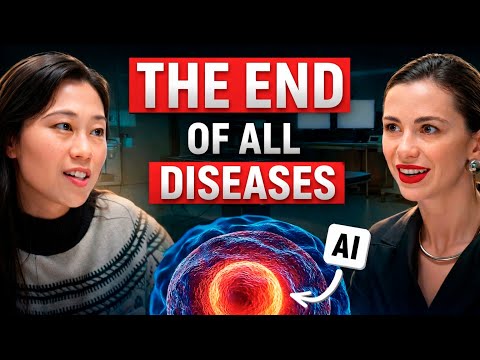
How AI Is Breaking the Rules of Biology | Dr. Priscilla Chan, Chan Zuckerberg Initiative
Dr. Priscilla Chan (guest), Marina Mogilko (host)
In this episode of Silicon Valley Girl, featuring Dr. Priscilla Chan and Marina Mogilko, How AI Is Breaking the Rules of Biology | Dr. Priscilla Chan, Chan Zuckerberg Initiative explores aI-built virtual cells aim to transform medicine and cure disease Priscilla Chan describes how a pivotal experience as a UCSF pediatrician—caring for children with conditions medicine couldn’t even name—pushed her toward funding basic science and tool-building through the Chan Zuckerberg Initiative (CZI) and its Biohubs.
AI-built virtual cells aim to transform medicine and cure disease
Priscilla Chan describes how a pivotal experience as a UCSF pediatrician—caring for children with conditions medicine couldn’t even name—pushed her toward funding basic science and tool-building through the Chan Zuckerberg Initiative (CZI) and its Biohubs.
CZI’s core bet is that curing or preventing disease broadly won’t come from tackling one illness at a time, but from building platforms (datasets, wet-lab methods, and AI models) that make every scientist faster and more capable of testing risky ideas.
She argues large language model-style approaches match biology’s “cell-by-gene” data structure, opening a near-term path toward virtual cells: computational models that simulate how human cells behave in health, disease, and in response to interventions.
Chan forecasts major shifts in the next 5–10 years: more human-relevant experimentation in silico, earlier disease detection via continuous immune monitoring, and increasingly personalized therapies—especially through understanding and reprogramming the immune system.
Key Takeaways
CZI’s strategy is platform-first, not disease-first.
Chan argues that building shared tools, datasets, and techniques makes the entire scientific ecosystem faster—enabling many diseases to be addressed in parallel rather than funding siloed, single-condition efforts.
Get the full analysis with uListen AI
LLM-like AI is well-suited to biological “cell-by-gene” data.
She describes a turning point when the team realized that large-model methods could extract meaning from the huge matrices produced by modern biology, accelerating interpretation and hypothesis generation.
Get the full analysis with uListen AI
Virtual cells could shift experimentation from animals to human-relevant simulations.
A core promise is cheaper, faster, more directly translatable testing on a computer model of human cell behavior—reducing reliance on mice/flies when translation to humans is weak.
Get the full analysis with uListen AI
The biggest patient impact is personalization—because nobody is “average.”
Chan emphasizes that today’s medicine often relies on population averages and best guesses; virtual-cell-style understanding could predict individual responses to drugs and conditions based on genetics and cellular context.
Get the full analysis with uListen AI
Immune-system modeling may unlock broad breakthroughs beyond infections.
She highlights autoimmune disease, neurodegeneration, and even cardiovascular plaque as areas where understanding immune balance and “tuning” immune behavior could produce major therapeutic gains.
Get the full analysis with uListen AI
Progress depends on a tight AI–wet lab feedback loop.
CZI pairs AI teams with wet labs so models reveal blind spots and labs generate targeted new measurements; conversely, AI tools remove lab bottlenecks (e. ...
Get the full analysis with uListen AI
The pace of measurement is accelerating dramatically, but multidimensional biology remains the bottleneck.
They went from mapping ~100M cells over a decade to ~1B in months, yet transcriptomics is only one layer; proteins, spatial layout, live-cell dynamics, and context are still needed to approach full virtual-cell fidelity.
Get the full analysis with uListen AI
Notable Quotes
““Our mission is to cure, cure or prevent all disease.””
— Dr. Priscilla Chan
““Science is going to be fundamentally different in, like, five years.””
— Dr. Priscilla Chan
““Common diseases are rare diseases.””
— Dr. Priscilla Chan
““We don’t understand how labor is triggered… It’s magic.””
— Dr. Priscilla Chan
““It took us 10 years to map… around 100 million cells… [and] months to map a billion cells.””
— Dr. Priscilla Chan
Questions Answered in This Episode
When you say “virtual cell,” what’s the minimum viable version—what behaviors must it predict correctly to be medically useful?
Priscilla Chan describes how a pivotal experience as a UCSF pediatrician—caring for children with conditions medicine couldn’t even name—pushed her toward funding basic science and tool-building through the Chan Zuckerberg Initiative (CZI) and its Biohubs.
Get the full analysis with uListen AI
You mentioned transcriptomics is only one dimension; which missing layer (proteins, spatial context, live dynamics, epigenetics) is the biggest blocker to a naturalistic virtual cell?
CZI’s core bet is that curing or preventing disease broadly won’t come from tackling one illness at a time, but from building platforms (datasets, wet-lab methods, and AI models) that make every scientist faster and more capable of testing risky ideas.
Get the full analysis with uListen AI
What concrete clinical workflow changes do you expect in the next five years—diagnosis, drug selection, trial design, or monitoring?
She argues large language model-style approaches match biology’s “cell-by-gene” data structure, opening a near-term path toward virtual cells: computational models that simulate how human cells behave in health, disease, and in response to interventions.
Get the full analysis with uListen AI
The phrase “cure or prevent all disease” can sound like hype—what milestones would convince a skeptic this is on track?
Chan forecasts major shifts in the next 5–10 years: more human-relevant experimentation in silico, earlier disease detection via continuous immune monitoring, and increasingly personalized therapies—especially through understanding and reprogramming the immune system.
Get the full analysis with uListen AI
In the immune-monitor “patch” scenario for lupus, what exact signals/molecules are plausible to track continuously, and how would you reduce false alarms?
Get the full analysis with uListen AI
Transcript Preview
science is going to be fundamentally different in, like, five years.
What would it mean for me as a patient?
This is the part I'm so excited about.
This is Priscilla Chan, a Harvard graduate who went to UCSF School of Medicine to study pediatrics. She treated children at UCSF until one moment in the clinic changed everything.
It was honestly scary, and really shook my understanding of medicine.
In 2015, alongside her husband, Mark Zuckerberg, [camera clicking] they launched the Chan Zuckerberg Initiative, with the most ambitious goal.
Our mission is to cure, cure or prevent all disease, and we used to say by the end of the century, but I think it's much sooner. I would say, like, in the next- [beeping]
Ten years later, they've invested over $7 billion, built three Biohubs, and are committed to creating AI models that map human cells, [camera clicking] unlocking how disease begins and how it could end. And once we do that, what will be the first diseases that you think are gonna be cured?
Um.
She's betting on a future where science, data, and AI converge to end sickness as we know it. The only question is, how soon can we make that future real? [electronic music]
We're rolling now.
Okay.
Okay.
Perfect.
All right.
Okay. Priscilla, thank you so much. Um, I have a personal story that I wanted to share.
Okay.
In 2015, you and Mark shared that you were pregnant with your first baby, but also that you've experienced, uh, miscarriages.
Yeah.
And I was going through the same process.
Oh.
But for me, it started in 2015, and we only were able to have a baby in 2019.
Oh, God bless.
And I think you were the first public couple to share something like this on social media-
Mm
... and that kept me through the process. So thank you so much.
Oh, you're gonna make me start off by crying. [laughing]
[laughing] I, I, I just really wanted to share this, and I am so grateful that you started talking about this problem, because when you're going through it, it feels like you're just alone in it. Now, with social media, people are sharing more and more-
Yeah
... but when you're in it, and when the doctors tell you, "Oh, it was your fault," or whatever, 'cause some doctors told me that-
Ugh
... um-
It's the worst.
But thank you so much-
Oh, I'm so glad
... for being brave and sharing it.
And now you have two kids.
And now I have two kids. Yeah.
It's just, like, I, I... Yeah. I, I mean, I'm so glad that that all worked out, and I felt the same way. I was like, "I'm completely alone. I don't know anyone who has gone through this." Actually, Beyoncé, um, also had this problem, so you, me, and Beyoncé are in the same group.
Okay. I feel like 20% of all women experience some kind of variation of this problem.
Install uListen to search the full transcript and get AI-powered insights
Get Full TranscriptGet more from every podcast
AI summaries, searchable transcripts, and fact-checking. Free forever.
Add to Chrome