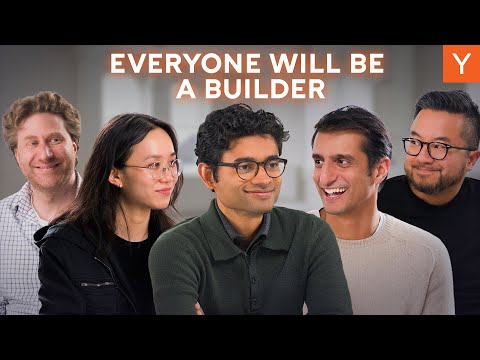
Windsurf CEO: Betting On AI Agents, Pivoting In 48 Hours, And The Future of Coding
Varun Mohan (guest), Garry Tan (host), Garry Tan (host), Garry Tan (host), Garry Tan (host)
In this episode of Y Combinator, featuring Varun Mohan and Garry Tan, Windsurf CEO: Betting On AI Agents, Pivoting In 48 Hours, And The Future of Coding explores windsurf CEO on rapid pivots, AI agents, and democratized software building Varun Mohan, co‑founder and CEO of Windsurf, explains how his team pivoted from GPU virtualization (Exafunction) to AI coding tools in a single weekend after realizing transformer models would commoditize their original business.
Windsurf CEO on rapid pivots, AI agents, and democratized software building
Varun Mohan, co‑founder and CEO of Windsurf, explains how his team pivoted from GPU virtualization (Exafunction) to AI coding tools in a single weekend after realizing transformer models would commoditize their original business.
He details how a lean engineering team rapidly built a Copilot competitor, then an agentic IDE (Windsurf) by leveraging deep GPU/inference expertise, rigorous evals, and relentless experimentation—even when most bets fail.
The discussion covers Windsurf’s architecture, agent design, RAG alternatives, enterprise adoption, and how AI is reshaping software development, hiring, and developer workflows.
Mohan argues that ‘developers’ will evolve into ‘builders’ as AI makes software creation radically more accessible, and that startups must continually generate new insights or risk slow death.
Key Takeaways
Pivot fast when your core thesis breaks, even if current metrics look good.
Exafunction was profitable with millions in revenue and a fresh Series A, but Mohan’s team killed it over a weekend when they realized transformer models would commoditize GPU infra; they treated pivoting as a badge of honor rather than a failure.
Get the full analysis with uListen AI
Combine irrational optimism with uncompromising realism to build enduring startups.
Mohan emphasizes that founders need enough blind optimism to attempt ambitious things, but must switch to brutal realism when facts change—otherwise they either never start or cling to dead ideas.
Get the full analysis with uListen AI
Moats in AI are dynamic: compounding insights and execution, not one-time breakthroughs.
Every technical insight depreciates quickly; Windsurf’s strategy is to continually find new edges (e. ...
Get the full analysis with uListen AI
Rigorous, domain-specific evaluation unlocks justified complexity and better systems.
Instead of blindly adopting vector DB RAG, Windsurf built detailed evals over real codebases (e. ...
Get the full analysis with uListen AI
Agents are only useful if they can operate precisely on large, real codebases.
Windsurf invested heavily in understanding huge repositories (100M+ LOC), tracking a unified timeline of human and agent actions, and designing workflows so agents make surgical edits rather than sprawling, unreviewable diffs.
Get the full analysis with uListen AI
AI shifts developer time from boilerplate to hypothesis testing and product insight.
Inside Windsurf, agents and autocomplete handle repetitive work, freeing engineers to run more experiments, design evals, and tackle higher-level system and product questions—turning engineering into something closer to applied research.
Get the full analysis with uListen AI
Software creation will broaden from ‘developers’ to ‘builders’ across organizations.
Non-technical staff at Windsurf already use the product to build internal tools and replace SaaS, with engineers mainly ensuring secure deployment; Mohan expects a future where many people ‘build’ without thinking of themselves as programmers.
Get the full analysis with uListen AI
Notable Quotes
“Every single insight that we have is a depreciating insight.”
— Varun Mohan
“Startups require irrational optimism and uncompromising realism, and they’re in tension with each other.”
— Varun Mohan
“If we don’t continually have insights that we are executing on, we are just slowly dying.”
— Varun Mohan
“The mission of the company is to reduce the time it takes to build technology and apps by 99%.”
— Varun Mohan
“This notion of just a developer is probably going to broaden out to what’s called a builder, and I think everyone is going to be a builder.”
— Varun Mohan
Questions Answered in This Episode
How far can agentic coding realistically go before human code review becomes the bottleneck, and how should tools adapt to that limit?
Varun Mohan, co‑founder and CEO of Windsurf, explains how his team pivoted from GPU virtualization (Exafunction) to AI coding tools in a single weekend after realizing transformer models would commoditize their original business.
Get the full analysis with uListen AI
What metrics or eval frameworks should other AI startups adopt to avoid building fragile ‘vibes-only’ products?
He details how a lean engineering team rapidly built a Copilot competitor, then an agentic IDE (Windsurf) by leveraging deep GPU/inference expertise, rigorous evals, and relentless experimentation—even when most bets fail.
Get the full analysis with uListen AI
In a world where non-programmers can build powerful internal tools, how should companies rethink security, governance, and technical ownership?
The discussion covers Windsurf’s architecture, agent design, RAG alternatives, enterprise adoption, and how AI is reshaping software development, hiring, and developer workflows.
Get the full analysis with uListen AI
How can individual developers best adapt their skills and workflows to thrive in an environment where AI produces most of the code?
Mohan argues that ‘developers’ will evolve into ‘builders’ as AI makes software creation radically more accessible, and that startups must continually generate new insights or risk slow death.
Get the full analysis with uListen AI
What kinds of highly specific, high‑value software tasks (like large-scale migrations) are still wide open for focused AI startups to own?
Get the full analysis with uListen AI
Transcript Preview
One of the things that I think is, is true for any startup is you have to keep proving yourself. Every single insight that we have is a depreciating insight. You look at a company like NVIDIA. If NVIDIA doesn't innovate in the next two years, AMD will be on their case. That's why I'm completely okay with a lot of our insights being wrong. Um, if we don't continually have insights that we are executing on, uh, we are just slowly dying. This notion of just a developer is, is probably gonna broaden out to what's called a builder, and, uh, I think everyone is gonna be a builder. I think software is gonna be this very, very democratized thing.
(Intro music) Welcome back to another episode of The Light Cone. Today, we've got a real treat. We have the co-founder and CEO of Windsurf, one of the people who literally brought Vibe Coding into existence.
(laughs)
Varun, thanks for joining us.
Thanks for having me, you guys.
Where is Windsurf now? Like, all of us intuitively know... I mean, well, we use it, but, you know, how big is it now? Where is it?
Yeah, so the, the product has had well over a million developers kind of use, uh, the product. Um, has, has hundreds of thousands of daily active users right now. It's being used for all sorts of things, from modifying large codebases to building apps extremely quickly, zero to one. Um, and, uh, and we're super excited to see where the technology's going.
Let's get to the brass tacks. How'd you get started?
The company actually started, uh, four years ago. Uh, we didn't start as Windsurf. Uh, we actually started as a company called Exafunction. We were a GPU virtualization company at the time. Uh, previously, me and my co-founder had worked on autonomous vehicles and ARVR, and we believed deep learning was gonna transform many, many industries, uh, from financial services to defense to healthcare. Uh, many industries.
You were right.
Yeah. Uh, we might have timed it wrong though. Ultimately, we built a system to make it easier to run these deep learning workloads. Uh, and similar to what VMware does for computers and CPUs, we did that for GPUs. Um, the middle of 2022 rolled around though, and what happened at the time was we were managing upwards of 10,000 GPUs for a handful of companies, and we had made it to a couple million in revenue. But the transformer became very popular with these models like Text-Davinci from OpenAI, and we felt that that was gonna fundamentally disrupt the business we had, or that small, small business that we had at the time. Uh, because we felt that everyone was gonna run these transformer-type models, and in a world in which everyone was gonna run one type of model architecture of transformers, we thought if we were a GPU infrastructure provider, we would get commoditized, right? "If everyone's gonna do the same thing, what is our alpha, alpha gonna be?" So at the time, we basically said, "Hey, could we take our technology and wholesale pivot the company to do something else?" And that's-
Install uListen to search the full transcript and get AI-powered insights
Get Full TranscriptGet more from every podcast
AI summaries, searchable transcripts, and fact-checking. Free forever.
Add to Chrome