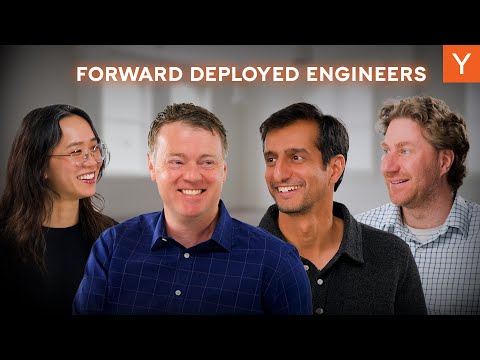
The FDE Playbook for AI Startups with Bob McGrew
Bob McGrew (guest), Diana Hu (host), Jared Friedman (host), Jared Friedman (host)
In this episode of Y Combinator, featuring Bob McGrew and Diana Hu, The FDE Playbook for AI Startups with Bob McGrew explores palantir’s Forward Deployed Model Becomes Blueprint For AI Agent Startups Bob McGrew explains how Palantir’s forward deployed engineer (FDE) model was created to bridge a constantly shifting gap between a flexible platform and highly heterogeneous, mission‑critical customer needs, especially in government and defense. Instead of classic SaaS product‑market fit followed by distance from customers, Palantir institutionalized “doing things that don’t scale” through embedded technical teams who discover, prototype, and validate outcomes on‑site. Product and engineering then generalize these bespoke “gravel roads” into reusable platform capabilities—the “paved highways”—while growing account value over time. McGrew argues this approach is now spreading rapidly to AI agent startups because agents are a new, undefined product category with no incumbents, demanding deep in‑enterprise product discovery and outcome‑based pricing.
Palantir’s Forward Deployed Model Becomes Blueprint For AI Agent Startups
Bob McGrew explains how Palantir’s forward deployed engineer (FDE) model was created to bridge a constantly shifting gap between a flexible platform and highly heterogeneous, mission‑critical customer needs, especially in government and defense. Instead of classic SaaS product‑market fit followed by distance from customers, Palantir institutionalized “doing things that don’t scale” through embedded technical teams who discover, prototype, and validate outcomes on‑site. Product and engineering then generalize these bespoke “gravel roads” into reusable platform capabilities—the “paved highways”—while growing account value over time. McGrew argues this approach is now spreading rapidly to AI agent startups because agents are a new, undefined product category with no incumbents, demanding deep in‑enterprise product discovery and outcome‑based pricing.
Key Takeaways
Treat forward deployment as embedded product discovery, not implementation services.
FDEs sit inside customer organizations to identify high‑value problems, rapidly prototype solutions, and validate outcomes; their work is explicitly used to inform what the core product team should generalize for the next 5–10 customers.
Get the full analysis with uListen AI
Structure field teams into complementary “echo” and “delta” roles.
Echoes are domain‑savvy, rebellious analysts/account leads who find and frame valuable use cases, while Deltas are fast‑moving engineers who absorb “pain” and ship rough but working solutions under tight timelines.
Get the full analysis with uListen AI
Hire domain heretics and rapid prototypers, not classic enterprise sales and craftsman engineers.
Echoes should deeply know the domain yet believe the status quo is broken; Deltas must prioritize speed and learning over elegant, long‑lived abstractions to deliver concrete wins quickly.
Get the full analysis with uListen AI
Design the core product as a leverage engine for FDEs, not a finished vertical app.
The home team’s job is to convert one‑off field solutions into generalizable platform capabilities (like Palantir’s ontology), increasing product leverage so future deployments deliver more value without proportionally more headcount.
Get the full analysis with uListen AI
Measure success by outcome value and contract expansion, not by minimizing per‑customer work.
Unlike classic SaaS, a healthy FDE business often starts unprofitable at an account; over time, product improvements and deeper access to critical problems should lower cost per unit of value and grow deal size.
Get the full analysis with uListen AI
Use demos as a forcing function to build from the user’s perspective.
Demo‑driven development, when grounded in real workflows, compels teams to integrate features into compelling end‑to‑end stories that create genuine desire in customers and reveal friction before broad rollout.
Get the full analysis with uListen AI
AI agents need FDE-style adoption because the category is undefined and heterogeneous.
With no clear incumbents and huge capability–adoption gaps, AI agent startups must learn in situ which workflows matter, how to integrate into complex enterprises, and how to price against real business outcomes.
Get the full analysis with uListen AI
Notable Quotes
“The FDE model effectively is doing things that don’t scale at scale.”
— Bob McGrew
“Fundamentally what you’re selling with the FDE model is that you’re not selling the installation of software. You’re selling an outcome.”
— Bob McGrew
“Your other key customer is the FDE. Your product should be delivering leverage to the FDE who’s delivering that outcome at the customer site.”
— Bob McGrew
“With AI agents, there is no incumbent product.”
— Bob McGrew
“This is like exactly the training to become a startup founder.”
— Bob McGrew
Questions Answered in This Episode
How can an early‑stage AI startup practically distinguish between high‑value “outcomes” worth pursuing and distracting bespoke requests that will push them into low‑margin consulting?
Bob McGrew explains how Palantir’s forward deployed engineer (FDE) model was created to bridge a constantly shifting gap between a flexible platform and highly heterogeneous, mission‑critical customer needs, especially in government and defense. ...
Get the full analysis with uListen AI
What concrete metrics or leading indicators should founders track to know whether product leverage for FDEs is actually increasing over time?
Get the full analysis with uListen AI
How do you design hiring, compensation, and career paths so that echo and delta roles remain attractive, sustainable, and tightly aligned with product evolution instead of drifting into siloed services?
Get the full analysis with uListen AI
In heavily regulated or on‑premise environments, what are the most effective strategies FDE teams can use to secure top‑level executive sponsorship and navigate IT and security roadblocks?
Get the full analysis with uListen AI
As AI capabilities race ahead but adoption lags, what kinds of “missing middle” companies or products are most needed to translate raw models into reliably deployed, organization‑wide workflows?
Get the full analysis with uListen AI
Transcript Preview
With AI agents, there is no incumbent product. And so that I think is why you're seeing the FDE model taking off because there's so much product discovery to do. You want to drive the contract size up so you're doing more and more valuable work for this customer and also for future customers. The FDE model effectively is doing things that don't scale at scale.
(Intro music)
Hello, and welcome back to another episode of The Light Cone. Gary wasn't feeling great today and couldn't be here, but we're thrilled to be joined by Bob McGrew. Bob was an early engineer at PayPal, an early executive at Palantir, and was recently chief research officer at OpenAI where he led the development of ChatGPT, GPT-4, and the o1 reasoning model. Now he's exploring the future of AI and has an exciting new role with the US Army that we'll get to in a bit. Bob, thanks so much for being here.
Great to be here.
So Bob, I've been particularly excited to sit down with you to talk about the forward deployed engineer model because this is a topic that keeps coming up in our lives. It is a really hot topic in Silicon Valley right now and especially among the AI agent companies that we've talked about on this podcast a lot. You were in the room when it all got started and so you know, like, you're exactly the right person to explain it. Y- you were actually telling me a, a funny story. Uh, you were at an AI conference that Y- YC organized a few months ago and you expected that all the founders would come up to you to talk to you about, you know, inventing ChatGPT (laughs) and instead what all of these AI startup founders wanted to talk to you about was the Palantir forward deployed engineer model.
Well, and it, it's really true. It hasn't, hasn't just been that one conference. Uh, as I've been advising startups this last year, I would say that a lot of them are pretty much exclusively trying to learn how the FDE strategy works.
Yeah, so there's, it's this intense topic of fascination and it's super timely because it's actually become, I think, the dominant way that the AI agent startups are organizing themselves. I was looking earlier today and if you look at the YC job board, there's over 100 YC startups that are hiring for a job with the title forward deployed engineer and up from basically zero three years ago. Perhaps before we get really into it, for anybody who doesn't already understand, can you just explain what a forward deployed engineer is and how it's relevant today?
So a forward deployed engineer is someone, typically technical, an engineer who sits at the customer site and fills the gap between what the product does and what the customer needs.
And how does this play out in practice?
You'll have a product and you go to a new customer site. You, you start working with a new customer and y- the, the problem that they want you to solve is not a problem that you've ever solved before, but you believe that it's one that with a little bit of work, maybe a lot of work, you can solve for this particular customer and you'd be making a huge impact for them. You'd be delivering an outcome to them that would be extremely valuable for them. So you take the product that you have and the FDE, with help from the product team, figures out how to deliver that outcome, how to build that use case, how to, you know, deliver the piece of software that you've built in a way that actually works for the customer.
Install uListen to search the full transcript and get AI-powered insights
Get Full TranscriptGet more from every podcast
AI summaries, searchable transcripts, and fact-checking. Free forever.
Add to Chrome