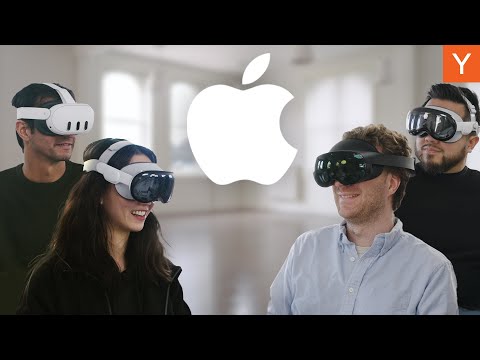
Apple Vision Pro: Startup Platform Of The Future?
Jared Friedman (host), Diana Hu (guest), Garry Tan (host), Harj Taggar (host)
In this episode of Y Combinator, featuring Jared Friedman and Diana Hu, Apple Vision Pro: Startup Platform Of The Future? explores apple Vision Pro: High-End AR Platform Poised For Startup Breakthroughs The episode explores Apple Vision Pro as a potential foundational platform for the next generation of startups, drawing parallels to early iPhone days and previous AR/VR attempts. Guests dissect why Apple's pass-through, camera-based AR approach is more tractable than optical AR and how it leverages a decade of investment in iPhone chips, sensors, and computer vision.
Apple Vision Pro: High-End AR Platform Poised For Startup Breakthroughs
The episode explores Apple Vision Pro as a potential foundational platform for the next generation of startups, drawing parallels to early iPhone days and previous AR/VR attempts. Guests dissect why Apple's pass-through, camera-based AR approach is more tractable than optical AR and how it leverages a decade of investment in iPhone chips, sensors, and computer vision.
They contrast Apple’s productivity-focused positioning with Meta’s gaming-centric strategy, arguing Vision Pro’s strength lies in high-information, professional use cases and replacing traditional screens. The conversation also highlights new UX primitives around eye tracking and spatial interfaces, suggesting major interaction breakthroughs are still to come from third‑party developers.
From an investor and YC perspective, they debate whether this is an “iPhone moment” or “Newton moment,” emphasizing adoption curves, platform risk, and when it actually makes sense for founders to bet on Vision Pro. Ultimately, they advise backing founders who are deeply, irrationally committed to spatial computing and willing to build through the early, awkward phase of the platform.
Key Takeaways
Pass-through AR lowers core technical barriers compared to optical AR.
By rendering the real world via high-resolution video (instead of complex light-field optics), Vision Pro turns many physics problems into software and compute problems, where Apple already has strong advantages in chips, sensors, and displays.
Get the full analysis with uListen AI
Vision Pro’s real power lies in understanding and augmenting the real world.
With LiDAR, multiple cameras, and eye tracking feeding a dedicated R1 coprocessor, the headset performs SLAM-style localization similar to self-driving cars, enabling precise spatial awareness that future apps can exploit.
Get the full analysis with uListen AI
Eye tracking is a new primary input primitive, analogous to multi-touch on iPhone.
Vision Pro uses foveated rendering and gaze-based selection, and Apple has codified early best practices in its Human Interface Guidelines—opening space for founders to invent entirely new interaction patterns beyond simple pinching and window dragging.
Get the full analysis with uListen AI
Initial killer apps are likely in high-value, high-information professional niches.
Use cases like trading desks, CAD, engineering, and complex monitoring—where people already use many screens—are more likely to pay for infinite spatial displays and dense visualization than casual consumers in the near term.
Get the full analysis with uListen AI
Major platform shifts usually take 5+ years to produce iconic startups.
Drawing on the iPhone timeline (Instacart, DoorDash, Uber arriving years after launch), the hosts argue we’re early in the Vision Pro cycle; mass adoption and truly native applications will lag the hardware by several years.
Get the full analysis with uListen AI
Apple’s SDK makes non-game spatial apps significantly easier than Meta’s.
Because Meta’s tooling is rooted in game engines like Unity/Unreal (great for bounded 3D worlds but clumsy for everyday utilities), simple tasks like showing a PDF are much more straightforward on visionOS, making it friendlier for productivity and general-purpose developers.
Get the full analysis with uListen AI
Founders should bet on Vision Pro only with deep conviction, not hype.
YC partners suggest backing people who are already compelled to build VR/AR in their spare time and are prepared to endure a small user base and technical friction while accumulating unique expertise that will be invaluable when adoption catches up.
Get the full analysis with uListen AI
Notable Quotes
“The dream has always been to get to something like this… so the developers would write the code once and it would work across all devices.”
— Diana
“You need to understand the real world in order to augment it… it’s starting to sound a lot like actually a technology of a self-driving car, but on a headset.”
— Diana
“With the Vision Pro, they invested so much on eye tracking… I think it is the moment that we’re seeing with capacitive touch where Apple got it right for the iPhone.”
— Diana
“If done well, this is going after the market cap of all screens that get sold.”
— Diana
“We would never try and discourage founders from building stuff they just think is cool.”
— YC Partner (Garry/Jared paraphrased in discussion)
Questions Answered in This Episode
What truly native Vision Pro app could exist only in spatial computing and not on any 2D screen?
The episode explores Apple Vision Pro as a potential foundational platform for the next generation of startups, drawing parallels to early iPhone days and previous AR/VR attempts. ...
Get the full analysis with uListen AI
How might eye-tracking-based interfaces reshape accessibility, privacy, and cognitive load for everyday users?
They contrast Apple’s productivity-focused positioning with Meta’s gaming-centric strategy, arguing Vision Pro’s strength lies in high-information, professional use cases and replacing traditional screens. ...
Get the full analysis with uListen AI
Which professional domains (e.g., finance, medicine, design) are most likely to justify Vision Pro’s cost early on, and why?
From an investor and YC perspective, they debate whether this is an “iPhone moment” or “Newton moment,” emphasizing adoption curves, platform risk, and when it actually makes sense for founders to bet on Vision Pro. ...
Get the full analysis with uListen AI
What technical or UX breakthroughs are still missing before Vision Pro can become a mass-market “Model 3” instead of staying a “Roadster” niche?
Get the full analysis with uListen AI
As a founder, how do you decide when platform risk (small user base) is outweighed by the chance to lead a new computing paradigm?
Get the full analysis with uListen AI
Transcript Preview
How much of, like, the hard interesting stuff Apple did is with the hardware in the Vision Pro versus the software?
You need to understand the real world in order to augment it. Technology of a self-driving car, but on a headset.
This is maybe where founders should sort of pay attention.
Is this a good opportunity for startups?
There's all kinds of new interactions that I think we have not figured out yet. What really truly takes advantage of this platform?
The dream has always been to get to something like this.
Welcome back to another episode of The Light Cone. And as you can see, it's not just any other day in tech. There are some new platforms that are coming up right now. You might have seen other places where there are reviews. We're not doing reviews today. We're going to talk about what these platforms might mean for founders and people who want to build things for a billion people. We actually have an expert at the table right now, don't we?
We do. Diana, who's a group partner at YC, before she worked at YC, she's been working in AR and VR for 10 years, since the dawn of the Oculus, before VR was a mainstream thing. In fact, her grad school research was in computer vision, so she's been interested in this from way before it was a thing other people were following. Diana, do you want to talk about your startup that you did which was an AR/VR startup? A really early pioneering one?
Yeah. We went through YC with a startup called Escher Reality. What we were building was a augmented reality SDK for game developers so that they could build multiplayer experiences and AR games and build the code once so that it would work on any platform, so between not just iOS and Android mobile device. But the dream has always been to get to something like this, or that, or that, so the developers would write the code once and work across all devices.
And what happened to your startup?
So what happened is this took a lot longer (laughs) to come to market. That's one thing. The other thing that ended up happening, we ended up getting acquired by Niantic, the makers of Pokemon Go. So I ended up heading a lot of the AR platform over there at Pokemon with Niantic. And we ship actually a lot of this AR SDK into a lot of games, so millions of players are running our code, which is really cool.
So if you've ever played Pokemon Go, you've literally used code that Diana wrote.
And I'm so excited with this platform coming in, and we can go dive deeper into it.
Okay, should we take the headsets off so we can, we can talk?
Yeah. (laughs)
Let's do it.
So it's been a long road. You've seen this technology basically evolve over the course of a decade. What's, uh, you know, why AR? Like, th- that's one of the big things here, you know. Previous platforms may be really focused on VR and the gaming aspect. Uh, Hololens from Microsoft seemed to try to do the AR thing. What's going on with, uh, the Apple Vision Pro, you know. Why is this important? Why are we talking about this?
Install uListen to search the full transcript and get AI-powered insights
Get Full TranscriptGet more from every podcast
AI summaries, searchable transcripts, and fact-checking. Free forever.
Add to Chrome